




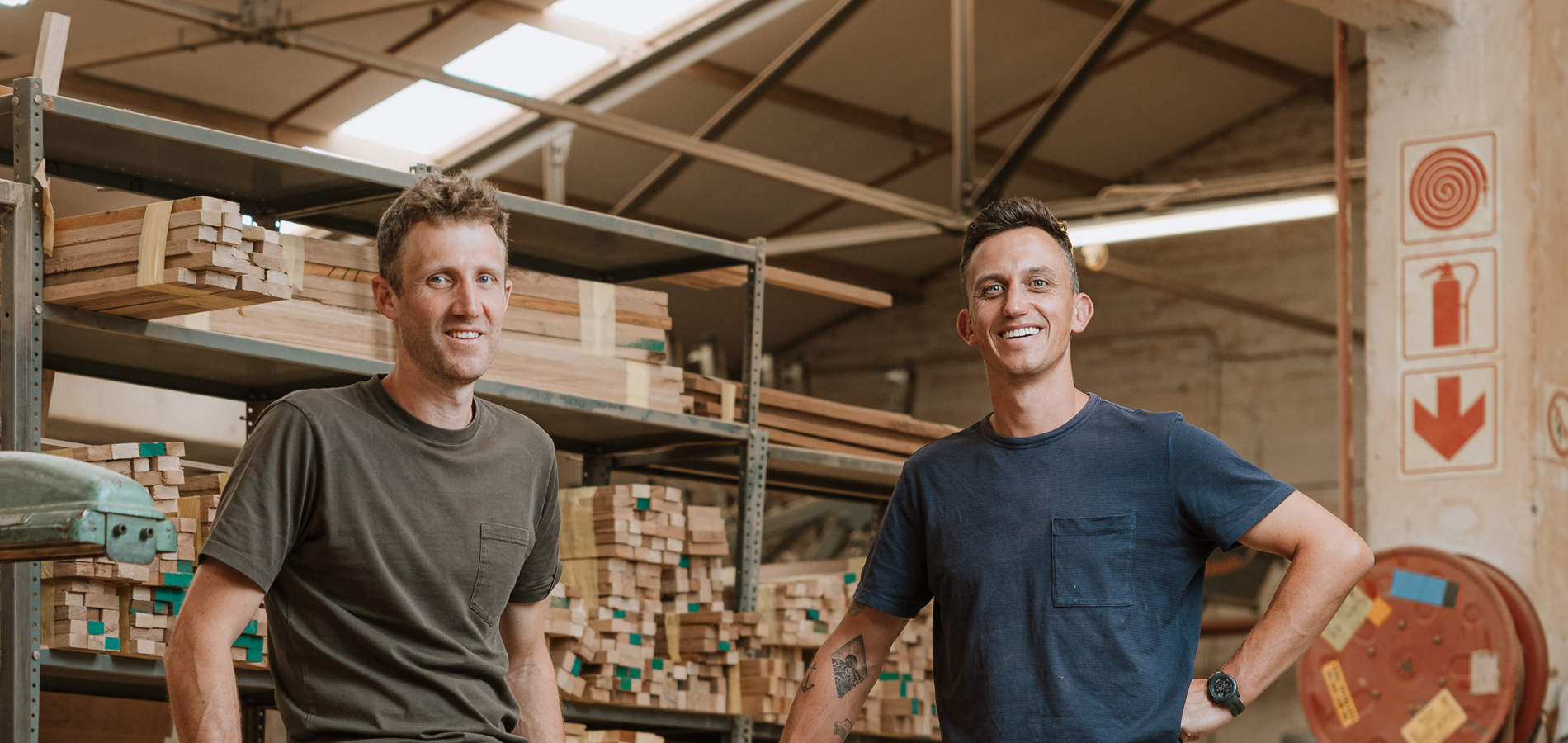
We met as industrial design students and have been running Pedersen + Lennard for the past 17 years. What started as two guys in a garage in Woodstock has grown into a powerful team of 60 people, most of whom support multiple dependants with their income.
Over the years, we’ve proven that local manufacturing is not only possible, it’s powerful – for jobs, the economy, and design integrity. It’s time we reframe local not as an aesthetic or a label, but as a strategy for national resilience.
Struggles that stoke the fire
If you’ve been in and around South Africa for the last 20 years, you’ll know that we’ve endured a litany of hardship: loadshedding, state capture, infrastructural collapse, eye-watering levels of corruption, xenophobia, and a debilitating lockdown. And yet, somehow, we’re still here and still smiling. What is it about this country’s people that keeps us buoyant and believing? It can’t just be the Springboks.
Beyond the resilience, ingenuity, and good humour that is in every South African’s DNA, curiosity is what has turned those traits into action for us. But this is not the kind of curiosity solved by a quick and vindicating Google search at a dinner party. It’s a rare, galvanising type of curiosity fuelled by rebellion, resourcefulness, a refusal to give up, and the odd stroke of luck. We believe that these qualities are the backbone of one of the most unusually run businesses in the country.
Why local production matters more than ever
We don’t outsource change. We make it – right here, in Cape Town.
- It’s job-creating – most of our 60 employees support multiple people. That’s hundreds of lives impacted by one small-ish business – not to mention the impact on those in our downstream local supply chain.
- It’s market-specific – when design and production happen side-by-side, we make better things for real South African needs.
- It’s change-driven – localising isn’t just a supply decision, it’s a mindset shift toward long-term impact over short-term savings.
- It’s timely – with rising import tariffs and global supply chain instability, there’s never been a better time to invest in local industries.
The serious business of joy
We mentioned our estimation of how many livelihoods each person employed at Pedersen + Lennard represents. Knowing that each job represents a handful of people is enough misplaced responsibility to crush curious, joyful business owners. Instead, we are proud to run a business that designs some of the most beautiful, quality furniture and homeware products you’ll ever see, manufacturing every stick of it, start to finish, on a single premises in Cape Town.
We learned early on not to be too particular about CVs when we hire – it’s proved much more effective to hire for character and train people on the job. Whether someone’s been trained to operate one of our high-tech machines or in the foundational practice of constructing high-quality, detailed pieces, the significance of this upskilling flows into any potential future jobs they may get in the market.
With a youth unemployment rate hovering around 60%, South Africa’s manufacturing industry is one of the only sectors with potential for rapid job creation – all we need is for businesses to re-invest locally. And with tariff wars picking up steam as superpowers throw their egos around, South Africa’s looking pretty appealing.
The business case for keeping things under one roof
Do you know that there’s likely no other operation in South Africa like this one? No single other business that we know of combines the disciplines of design, prototyping, timber machining, laser cutting, bending, CNC routing, welding, powder coating, assembly, and upholstery under one literal roof.
/file/dailymaverick/wp-content/uploads/2025/05/Pedersen-lennard_2025_May-Daily-Maverick-03.jpg "Web")
/file/dailymaverick/wp-content/uploads/2025/05/Pedersen-lennard_2025_May-Daily-Maverick-06.jpg "Web")
/file/dailymaverick/wp-content/uploads/2025/05/Pedersen-lennard_2025_May-Daily-Maverick-05.jpg "Web")
Most people don’t realise how rare it is to integrate all these disciplines on one site, despite how cohesive it is. We have yet to hear of another design-led business that manufactures across such a range of disciplines, and we think it makes sense; South Africa needs more businesses to operate like this.
It’s not just a manufacturing flex, but a practical, calculated call. It’s about quality control, solving problems quickly, and using our resources with rational efficiency. Each element of our deliberate investment into local production is centred on this: our constant pursuit of crafting quality pieces that last for generations.

A 5-question sniff test for whether your favourite brand is truly local
Food for thought before you buy into “local”
- Where is it actually made?
Plenty of brands drape themselves in the South African flag while quietly outsourcing production to factories in China, Vietnam or Turkey. ‘Designed in Cape Town’ might sound romantic – but unless it’s also made in Cape Town, it’s worth asking why.
- Who benefits financially?
Scratch a little and you’ll find that some ‘local’ companies are owned by offshore holding groups or private equity firms. Others manufacture abroad and import under a local-sounding name. If most of the profit leaves the country, the patriotic branding is more convenience than conviction.
- How much of the value chain is South African?
Look at where materials are sourced, where components are made, who handles logistics, packaging, and even photography. A brand that imports nearly everything and assembles locally might tick a technical box – but it’s not exactly keeping the economy turning.
- Do they partner with other local businesses?
One of the clearest signs of authenticity is interdependence; a genuinely local brand invests in the ecosystem. They use South African printers, employ domestic designers, and collaborate with other makers.
- Could they survive Stage 6 load-shedding?
Real local businesses are used to working around power cuts, port delays and postal woes – because they have to. But those grounded in local production have already adapted to the constraints of the South African context. For example, we are fully solar-powered and even sell surplus power back to the grid.
A business model worth noticing – and replicating
All of this isn’t just another story of one workshop or one brand. It’s an invitation to rethink what we value in local design, who we choose to support, and how we define success in a South African context. We’re making a case for doing things differently that actually benefits people and the economy too: we’re slower, more deliberate, and have deep roots.
So for you, that might mean buying local more thoughtfully – or just asking better questions the next time a brand says it's proudly South African. Together, we can reinvigorate a local economy that we’re actually proud of. DM
Comments
Scroll down to load comments...