




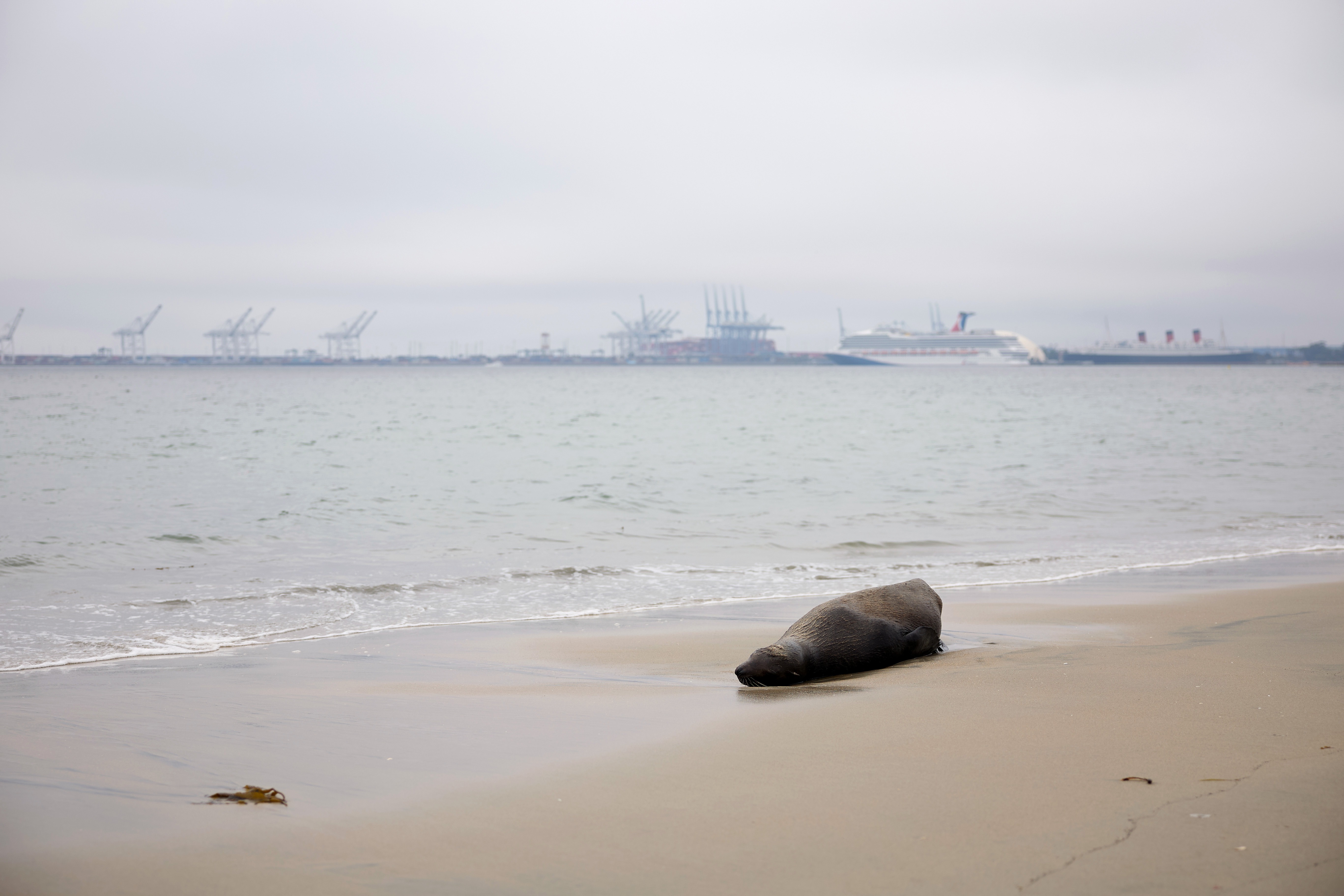
 epa12004381 A California sea lion suffering from domoic acid poisoning lies on the beach in Long Beach, California, USA, 31 March 2025 (issued 01 April 2025). Strong upwelling of nutrient-rich deep ocean water is fueling a harmful algal bloom along the Southern California coast. The algae produce domoic acid, a neurotoxin that contaminates shellfish and small fish feeding on the bloom. Marine mammals, including California sea lions, can be poisoned after eating the contaminated fish. The toxin accumulates in their bodies, potentially causing seizures, disorientation, brain damage, stillbirth, and death.
Climate scientists have identified a new link between warmer ocean temperatures and toxin-producing algae, highlighting how climate change is disrupting marine ecosystems. Dave Bader, Chief Operations and Education Officer at the Marine Mammal Care Center, warns that as ocean temperatures continue to rise, toxic algal outbreaks will become more frequent and severe. He says this years event is on track to be the worst yet, potentially surpassing the 2023 bloom that killed more than 1,000 sea lions. EPA-EFE/ALLISON DINNER
epa12004381 A California sea lion suffering from domoic acid poisoning lies on the beach in Long Beach, California, USA, 31 March 2025 (issued 01 April 2025). Strong upwelling of nutrient-rich deep ocean water is fueling a harmful algal bloom along the Southern California coast. The algae produce domoic acid, a neurotoxin that contaminates shellfish and small fish feeding on the bloom. Marine mammals, including California sea lions, can be poisoned after eating the contaminated fish. The toxin accumulates in their bodies, potentially causing seizures, disorientation, brain damage, stillbirth, and death.
Climate scientists have identified a new link between warmer ocean temperatures and toxin-producing algae, highlighting how climate change is disrupting marine ecosystems. Dave Bader, Chief Operations and Education Officer at the Marine Mammal Care Center, warns that as ocean temperatures continue to rise, toxic algal outbreaks will become more frequent and severe. He says this years event is on track to be the worst yet, potentially surpassing the 2023 bloom that killed more than 1,000 sea lions. EPA-EFE/ALLISON DINNER Four survivors rescued after the "panga"-style open fishing vessel washed ashore near Torrey Pines State Beach were transported to hospitals, and two other people found on a nearby beach were detained by authorities, according to U.S. Coast Guard officials.
The two taken into custody were suspected to be smugglers, Coast Guard spokesperson Hunter Schnabel told Reuters.
Earlier Coast Guard accounts put the number of people missing from the overturned craft at nine, but Schnabel said the tally of those unaccounted for was revised to seven after confirmation that two individuals had been detained.
A Coast Guard cutter, an emergency response boat and a helicopter were involved in an ongoing search for the missing, among whom were two children, another Coast Guard spokesperson, Chief Petty Officer Levi Read, said.
At least some of the boat's occupants were apparently from India, as a number of Indian passports "were found on the beach near where the panga washed up," Read said.
Shawn Gibson, a special agent in charge of the U.S. Homeland Security Investigations (HSI) agency, said the incident was a "stark reminder of the dangers posed by maritime smuggling."
"The ruthless smuggling of undocumented individuals is not only illegal, it’s deadly,” Gibson said of the incident, which occurred about 30 miles north of the U.S.-Mexico border. Read said ocean conditions off the San Diego County coast were rough at the time, with 7-foot (2 m) seas reported.
Personnel from HSI, the U.S. Border Patrol, the local fire department and law enforcement also responded to the scene, officials said.
So far this fiscal year, since October 2024, the Coast Guard has tracked 277 vessels clandestinely entering U.S. waters from Mexico in the San Diego area, some of the boats being interdicted and others getting away, Read said. Those incidents resulted in 983 people being apprehended.
That compares with 1,354 maritime border-crossing incidents in the same region during the previous 12 months, with 561 individuals taken into custody during that period.
Of the four hospitalized survivors from Thursday's panga capsizing, one was listed in critical condition when rescued, according to a statement from the city of Encinitas.
One survivor reported that 18 people had been aboard the vessel, and 18 life vests were located on shore, the statement said. But Read said the Coast Guard's best information was that the boat was carrying just 16 individuals when it capsized.
(Reporting by Karen Freifeld in New York; Additional reporting by Kristina Cooke, Steve Gorman and Jorge Garcia; Editing by Frank McGurty, Mark Porter and Stephen Coates)