




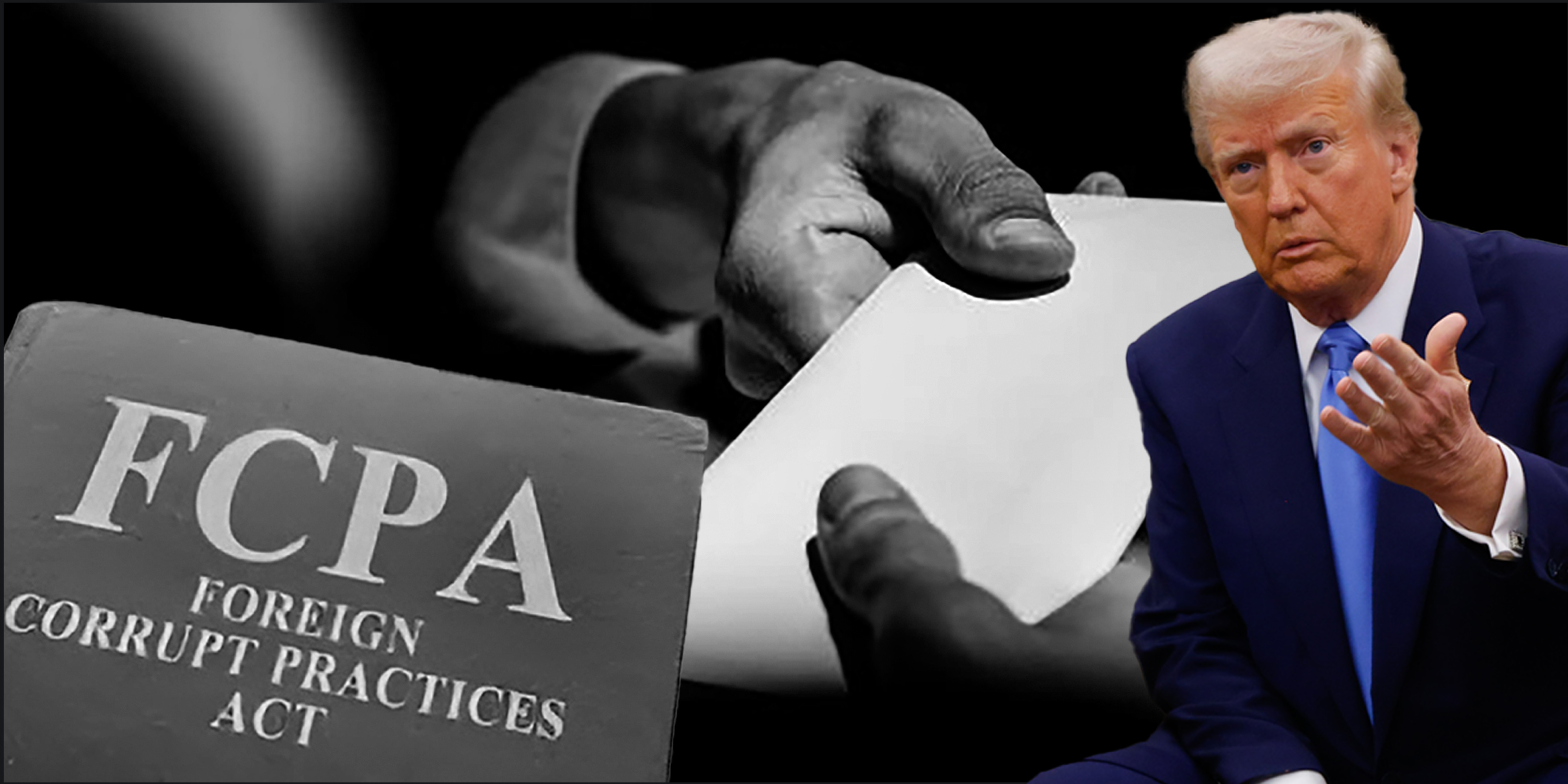
 Bribery illustration. (Photo: iStock) | The US Foreign Corrupt Practices Act. (Photo: Wikipedia) | US President Donald Trump. (Photo: EPA-EFE / Ludovic Marin / Pool)
 On 10 February 2025, US President Donald Trump signed an executive order directing Attorney General Pam Bondi to pause enforcement of the Foreign Corrupt Practices Act (FCPA) for 180 days.
The move, framed as an effort to reduce regulatory burdens and promote American competitiveness, has raised serious concerns about the future of global anti-corruption enforcement.
For decades, the US has led the charge against corporate bribery, holding multinational companies accountable under the FCPA. The pause in enforcement does not repeal the law. Still, it signals a fundamental shift in the US Department of Justice’s (DOJ) approach, potentially creating ripple effects across international compliance landscapes.
What is the FCPA and why does this matter?
The FCPA, enacted in 1977, prohibits US companies and individuals from bribing foreign officials to gain business advantages. The law, which was introduced in response to major corporate corruption scandals, imposes severe penalties, including:
- Up to 20 years in prison for individuals convicted of bribery-related offences;
- Corporate fines reaching billions of dollars for companies guilty of violating FCPA provisions; and
- Strict internal accounting requirements ensuring that companies maintain accurate books and records to prevent fraud.
Trump’s anti-FCPA stance is not new. During his first term, he called the FCPA a “ridiculous and horrible law”, arguing that it made it difficult for US companies to compete overseas. His recent executive order aligns with his administration’s pro-business, deregulation-focused policies.
What does this mean for corporate compliance?
Although the pause in enforcement temporarily limits DOJ-led FCPA actions, companies should not interpret this as a green light for corruption. Key considerations include:
- The SEC’s FCPA enforcement continues: the US Securities and Exchange Commission (SEC), responsible for civil FCPA violations, has not paused enforcement. Companies must still ensure compliance with books and records provisions;
- Bribery remains illegal: the FCPA itself has not been repealed. Companies engaging in corruption during this pause may still face prosecution in the future; and
- Other jurisdictions are stepping up: many countries have strengthened anti-corruption enforcement in recent years. Even if the US steps back, global regulators are unlikely to follow suit.
Will other countries fill the void?
The US has long been the global leader in anti-corruption enforcement, often coordinating cross-border investigations with international counterparts. However, with the DOJ stepping back, attention now turns to other major enforcement players:
- United Kingdom: the Bribery Act 2010 is one of the strictest anti-corruption laws globally, imposing criminal liability for failing to prevent bribery;
- France: Sapin II, enacted in 2016, requires companies to implement strong compliance programmes or face heavy penalties;
- Germany and China: both countries have taken an increasingly aggressive stance on corporate bribery; and
- South Africa: the recent Prevention and Combating of Corrupt Activities Act (Precca) amendments introduce a “Failure to Prevent Corrupt Activities” offence, similar to the UK Bribery Act. As a result of the Financial Action Task Force (FATF) grey listing, enforcement is a key state priority.
In major cases like Rolls-Royce, Airbus and the Brazilian Car Wash Scandal, global regulators worked alongside US authorities to pursue corruption charges. With the US stepping back, it remains to be seen whether the UK, France or Germany will take the lead in major international investigations.
What should companies do now?
Despite the DOJ’s pause, businesses cannot afford to relax their anti-corruption compliance efforts. Companies should:
- Maintain robust compliance programmes: future administrations may pursue retroactive enforcement, holding businesses accountable for misconduct during this period;
- Strengthen internal controls: ensuring compliance with SEC requirements, international regulations and best practices remains crucial; and
- Monitor global enforcement trends: companies with operations outside the US remain subject to foreign anti-corruption laws and should expect continued scrutiny.
Will the FCPA pause last?
Trump’s executive order is temporary, lasting only 180 days. However, it raises broader concerns about the US’s long-term commitment to fighting corruption. Several uncertainties remain, including:
- Will the SEC also scale back enforcement? Currently, there is no indication of this, but regulatory priorities may shift in the coming months;
- Will a future administration reinstate strict FCPA enforcement? The FCPA has a five-year statute of limitations, meaning violations committed during this pause could be prosecuted by a new administration; and
- Will global anti-corruption enforcement weaken? While the US pause creates uncertainty, most experts believe international regulators will remain active.
South Africa’s evolving anti-corruption framework
While the US moves toward deregulation, South Africa is moving in the opposite direction. The Prevention and Combating of Corrupt Activities Act has been strengthened with the addition of Section 34A, which introduces:
- A “Failure to Prevent Corrupt Activities” offence, holding companies accountable for corruption within their ranks;
- A requirement for companies to demonstrate “adequate procedures” to prevent bribery; and
- Alignment with global best practice, mirroring provisions in the UK Bribery Act.
Additionally, the National Prosecuting Authority has introduced an Alternative Dispute Resolution directive, offering non-prosecutorial outcomes for companies that self-report corruption and cooperate with authorities.
Compliance still matters
The temporary pause in FCPA enforcement does not mean the end of anti-corruption efforts. Ethical businesses will continue to uphold high compliance standards, recognising that:
- Bribery is not a sustainable business strategy – it increases costs, reputational risk and legal exposure;
- Global enforcement remains strong – the UK, France, Germany, China and South Africa continue to aggressively pursue corporate corruption cases; and
- Future US administrations may reintroduce stricter enforcement – companies engaging in bribery now may still face legal consequences later.
As the legal and regulatory landscape shifts, businesses must stay vigilant. Companies are advised to obtain expert advice to navigate these changes to ensure compliance and to mitigate risk in an evolving enforcement environment. DM
Steven Powell is Head of the Forensics Department at law firm ENSafrica.