




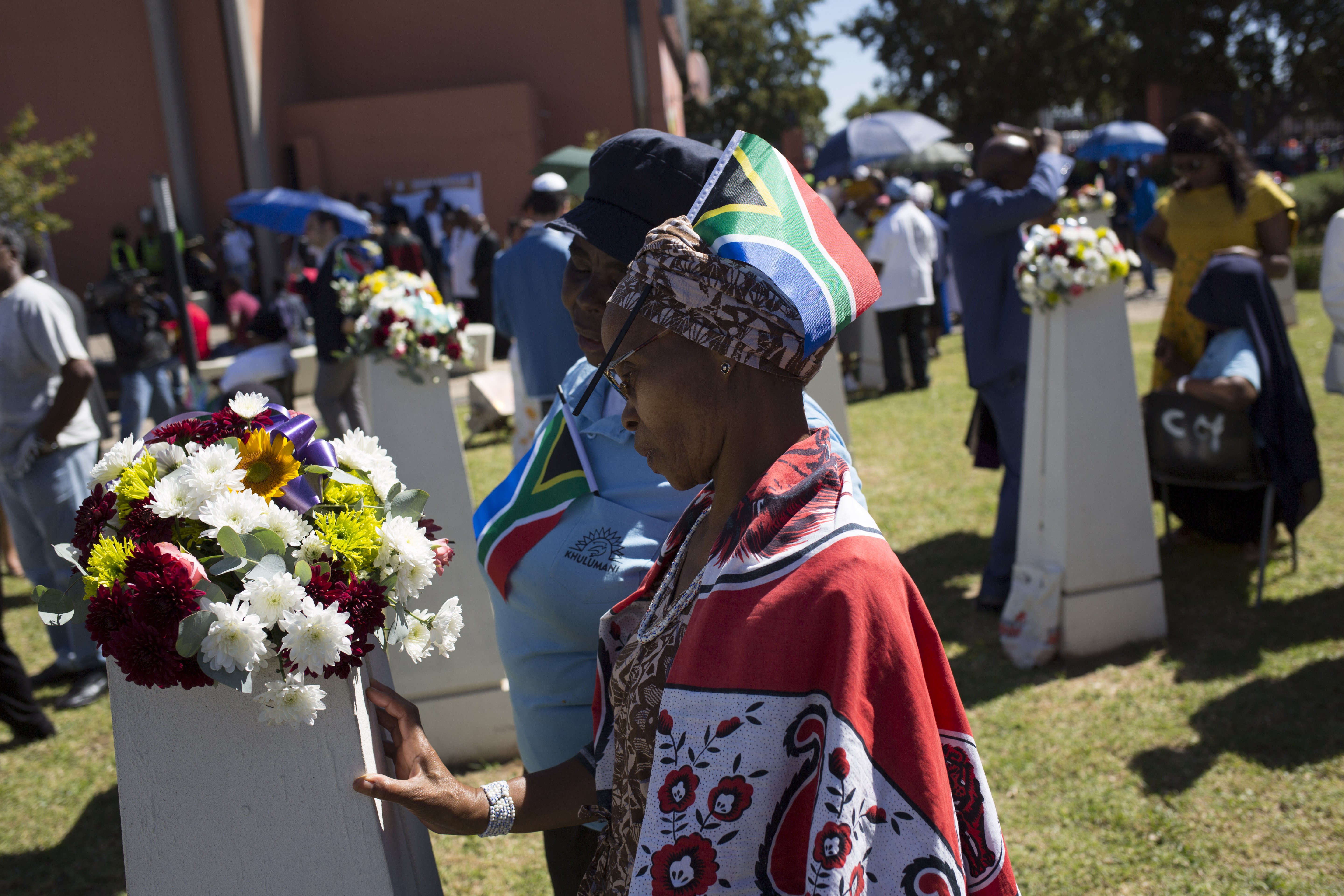
 Family members of those who were killed commemorate at a memorial service during a Human Rights Day event held in Sharpeville near Johannesburg, South Africa, 21 March 2017. The day is a public holiday and marks the Sharpeville massacre. The shooting occurred on this day in 1960 when 5,000 people marched to the police station in the area to protest against pass laws and police opened fire killing 69 people. EPA/Cornell Tukiri
 Activism is firmly rooted in the DNA of South Africans. On 21 March 1960, ordinary South Africans peacefully protested the oppressive pass laws aimed at dehumanising them based on the colour of their skin. Peaceful protesting was met with violence, resulting in 180 injuries and the deaths of 69 people. The Sharpeville Massacre is a watershed moment that forever changed the trajectory of South Africa’s struggle against apartheid.
Violence, however, did not quell the resilience of a people tired of being subjected to daily human rights violations. Hence, in the wake of Sharpeville, several organic grassroots movements sprang up across the country. Apartheid fuelled South African activism, and 31 years post-democratic South Africa, grassroots activism remains a vital tool to address ongoing struggles.
According to the World Bank’s global database of Gini coefficients, which measures inequality of per capita consumption, South Africa has the unenviable ranking of being the most unequal society in the world, ranking top among 164 countries. This is not surprising given that the South African landscape is ripe with inequality despite three decades since the fall of apartheid. Spatial apartheid, an unemployment rate of 31.9% (Q4 2024 according to the Quality Labour Force Survey), deteriorating essential services, and the misappropriation of resources meant for enhancing the lives of ordinary South Africans, contribute to the dire socio-economic realities plaguing the majority of people daily.
Against this stark backdrop, it may seem as if all is lost, that we should throw in the proverbial towel and declare South Africa a failed state, but this could not be further from the truth. We owe it to our forebearers to honour their legacy of activism. Although the 21st century struggle may not be aimed at advocating for the end of the system of apartheid, the legacy of inequality characterising apartheid must be dismantled and there remains a duty on each of us to advocate for basic human rights for all.
We are the activists. It starts with us.
One of the major driving forces of these dire socio-economic conditions is unemployment. The same unity, resilience and bravery employed to dismantle apartheid by ordinary people needs to be utilised in the struggle against unemployment. In order to address this scourge of joblessness, particularly youth joblessness, creative solutions need to be sought, and sustainable partnerships formed. One such solution is foregrounding entrepreneurship. Mzanzi is a country of creatives where people have a plethora of skills.
What is needed is to forge partnerships to nurture existing talents and create enabling environments, which in turn equip these entrepreneurs with the tools needed to start, maintain and thrive in an entrepreneurial environment. These businesses will, in turn, serve as employers of people residing in the areas in which they operate, thus foregrounding local employment, and in so doing, improve the socio-economic conditions across communities. It is through partnerships, particularly public-private partnerships, that real change can happen. SMMEs are recognised as crucial drivers of job creation in South Africa.[1] Given the country's high unemployment rate, this potential is vital. Studies indicate that a significant portion of new jobs are generated by SMMEs. Gaining access to markets and competing with larger businesses can be difficult for SMMEs, thus initiatives and partnerships aimed at providing support, funding, training and guidance around regulatory reforms are vital. One such partnership is the enterprise development programme at ENS, which focuses on creating environments for entrepreneurs in under-resourced areas to enable them to gain the knowledge and skills needed to start and maintain a business, particularly within the SMME space
However, organisations cannot operate in isolation. There is a need for sustainable partnerships with key stakeholders, such as government, local community organisations and other corporate entities, as these have proven to be hugely effective in fostering a culture of entrepreneurship.
“Overcoming poverty is not a gesture of charity. It is an act of justice. It is the protection of a fundamental human right, the right to dignity and a decent life.” – Nelson Mandela
Ordinary South Africans also have a pivotal role to play. We cannot rest on our laurels, simply raise our hands and state “This is not our problem!” It is incumbent on each of us to make a concerted effort to play an active role in the 21st-century struggle against unemployment. How? We can do so by choosing to buy local products and support local businesses. We need to raise our voices (and yes, sometimes march peacefully) to ensure that the rights enshrined in the Constitution of the Republic of South Africa are never denied. We need to teach our youth tolerance and live the principles of equality for all daily.
We need to be Active Citizens.
Sharpeville shaped our collective consciousness. The massacre is forever etched in our memories, epitomising the brutality of an oppressive state. The lessons learnt from the Sharpeville Massacre are timeless - resilience, bravery and courage are needed to conquer the struggles we face in the 21st century, especially the staggering 45,5% youth unemployment rate (Q4, 2024, Stats SA). The struggle for justice remains, and we honour the Sharpeville massacre through remembrance but also by building a united society, aimed at forging a better future for all. DM
Author: Natasha Wagiet, Pro Bono Manager
[1] Examining the Function and Contribution of Entrepreneurship through Small and Medium Enterprises as Drivers of Local Economic Growth in South Africa | African Journal of Inter/Multidisciplinary Studies