




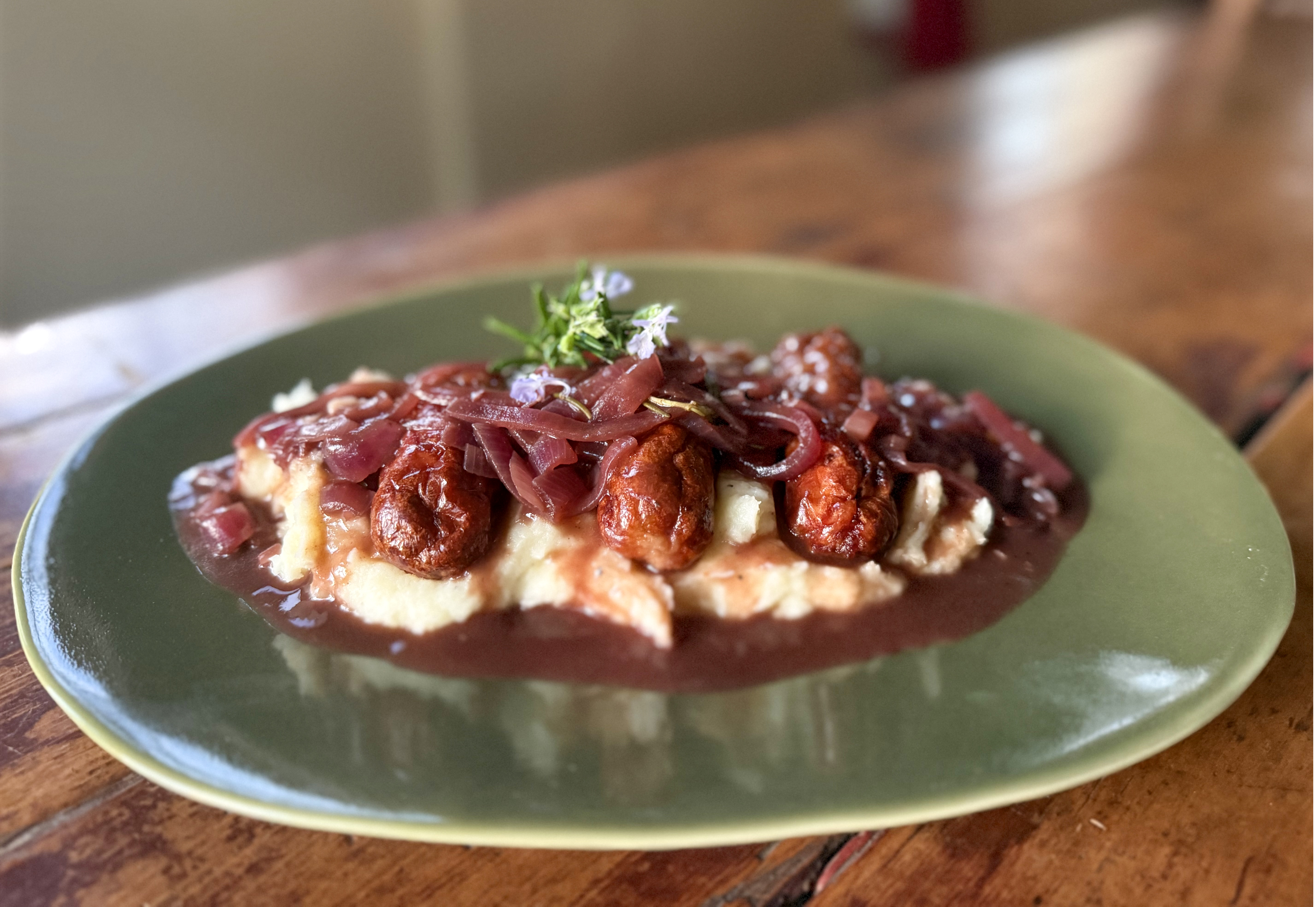
 Tony Jackman’s homemade pork bangers and mash, served in Mervyn Gers ceramics ware. (Photo: Tony Jackman)
Bread and dripping, bangers and mash: these are things steeped in the British psyche and redolent or war and rationing. During and after World War II, people would keep their leftover fat from a beef roast (if they were extremely lucky enough to afford that) and bacon fat (ditto) and use it again to cook something else in, or to use it as a spread, on meagre and most likely stale slices of war-time bread.
My own Yorkshire mother, who had been in the Land Army in Wales during the war, still kept the dripping from our Sunday beef roasts throughout the ‘60s, and it was quite usual for me to have beef dripping on my school sandwiches when the other kids had peanut butter or apricot jam. And I wasn’t complaining.
The pork banger has its origin, or at least the origin of its name, in the earlier war we know today as World War I but which at the time was called the Great War.
You know the terrible habit some bacon manufacturers have of adding water to the mix to make them go further (and make them more money), which some unscrupulous chicken producers do to their whole birds as well, as anyone who has eaten a British supermarket chicken will tell you? That used to happen to pork sausages too, more than 100 years ago, when Britain was finally coming out of that devastating war. Water was added to the sausages to contend with the shortage of meat. When cooked, the water would cause the casings to explode, hence the term “banger”.
Which brings me to these pork bangers. We’ve all had our pork bangers burst in the pan. We don’t want our pork bangers to explode, so what do we do to avoid that? Here are a few tips:
- Don’t puncture the sausage casing by poking or pricking it.
- Don’t overstuff the sausage…
- But don’t leave air pockets in it either.
- Don’t use a fork to turn them (you’d think that would be obvious, but many people do.)
- Two wooden spoons are a sensible way to turn them over.
- Shake the pan often to keep them from sticking to the bottom, as staying in one spot on too much heat can also cause the skin to rupture.
- Fry pork sausages on a low, low heat for as long as it takes for the meat to be cooked all the way to the centre, turning carefully as you go. Metal tongs can also puncture the casing.
- Use a quality sausage made by someone who knows what they’re doing. They should not have been made with too much water content, but they do need some, so follow the advice of the experts, in my case that of Mike Crewe-Brown, about which more on Friday.
- Start with fridge-cold sausages.
- One school of thought advises you to bake porkies in a 150℃ to 175℃ oven for 20 to 25 minutes. I have not tried this but that gentle approach makes sense. They do need to be on an oiled pan, though, with an edge to catch the fat drippings (for your kids’ school sarmies).
- Alternatively, steam them over boiling water, then pat them dry and let them cool, and brown them gently in an oiled pan to golden perfection. I often do it this way.
Or, do what I now do with pork bangers: cook them in an air fryer, shaking the basket vigorously every three or four minutes. About 15 minutes in all. The bangers that is — you can’t make mashed potato in the air fryer obviously. Or the onion gravy.
But the secret to bangers and mash doesn’t only lie with the perfect pork sausage. It needs fluffy, creamy mashed potato too, and to finish off it deserves a good dolloping of a traditional British onion gravy.
Everyone has their own way with their idea of perfect mashed potato. I keep mine simple and make it all about the butter. I don’t use cream in it. I have even stopped adding milk (after a lifetime of doing so; I much prefer them without these days).
The secret, for me, is to boil the potatoes until perfectly soft, quickly drain them, toss them around in the hot pan on the heat for a few seconds to get rid of excess water, and then mash them twice: first with whatever masher you normally use, and then with a strong fork, which, with vigorous stirring with the pan tilted at a 45 degree angle, really cuts through all possible lumps. All it needs is a little elbow grease and then a bit more.
While the mash is still hot, I stir in (using the same fork) a generous amount of butter, and then season them well with salt and white pepper. I’d recommend at least a heaped tablespoon of butter per every medium potato, and a bit more for luck. Milk, I believe, makes them less fluffy. And I’m not convinced that cream adds something to the fluffy character and taste of mashed potato. It just makes them, well, creamy… don’t you prefer them fluffy? And it’s not as if there aren’t enough calories in there as it is.
This, though, is not a recipe for actually making the sausages (more about that on Friday) but for cooking them with mashed potato and onion gravy.
Ingredients
(Serves 2)
4 good quality pork sausages (okay, 6)
2 Tbsp butter for greasing the pan to fry the bangers in
3 medium potatoes, peeled and cut in two
Salt for boiling the potatoes
4 heaped Tbsp butter for the mashed potatoes
Salt and pepper to taste, for the potatoes
For the onion gravy:
(Makes enough for 4 servings)
1 extra large or two medium onions, sliced into rounds
2 generous Tbsp butter
1 tsp sugar
Fresh thyme leaves, picked from their stems (at least 4 or 5 sprigs)
800 ml beef stock
1 Tbsp hot English mustard
80 ml port
Salt and black pepper to taste
1 heaped tsp cornstarch dissolved in milk, stirred until there are no lumps left
Method
Put the peeled and halved potatoes in a pot of plenty of cold water and salt generously. Bring to a boil and cook until tender. Drain, then return them to the pot and toss them around on the heat to get rid of residual water. Mash them very well, stir in plenty of butter and season with salt and pepper. You can keep it to one side and reheat quickly, while stirring, when everything else is ready.
Cook the sausages your preferred way, if you’re in the habit of doing a cracking (but not banging) good job of that. I recommend slow frying on a gentle heat, turning and following my tips above.
If cooking them in an air fryer, preheat it to 180°C, spray them with cooking oil spray, and air fry them for about 15 minutes, shaking the pan frequently to turn them over and turn golden brown evenly.
Meanwhile, caramelise the sliced onions in butter slowly over a very low heat for up to half an hour, with the sugar and thyme leaves, until they are lightly browned and packed with caramelised flavour. Shortening the time and cooking at a higher heat will only reduce the depth of flavour.
Add the beef stock, port and mustard (stir it in, it will dissolve quickly) and reduce gently until the gravy thickens and its flavours intensify significantly. Season with salt and pepper to taste, stir in the cornstarch and stir the gravy while it thickens, for about three minutes. Taste and adjust seasoning if necessary.
Serve a pile of mashed potato with two or three bangers cuddled on top, and don’t be too shy with the onion gravy. DM
Tony Jackman is twice winner of the Galliova Food Writer of the year award, in 2021 and 2023
Order Tony’s book, foodSTUFF, here.
Follow Tony Jackman on Instagram @tony_jackman_cooks.
This dish is photographed on a plate by Mervyn Gers Ceramics.