




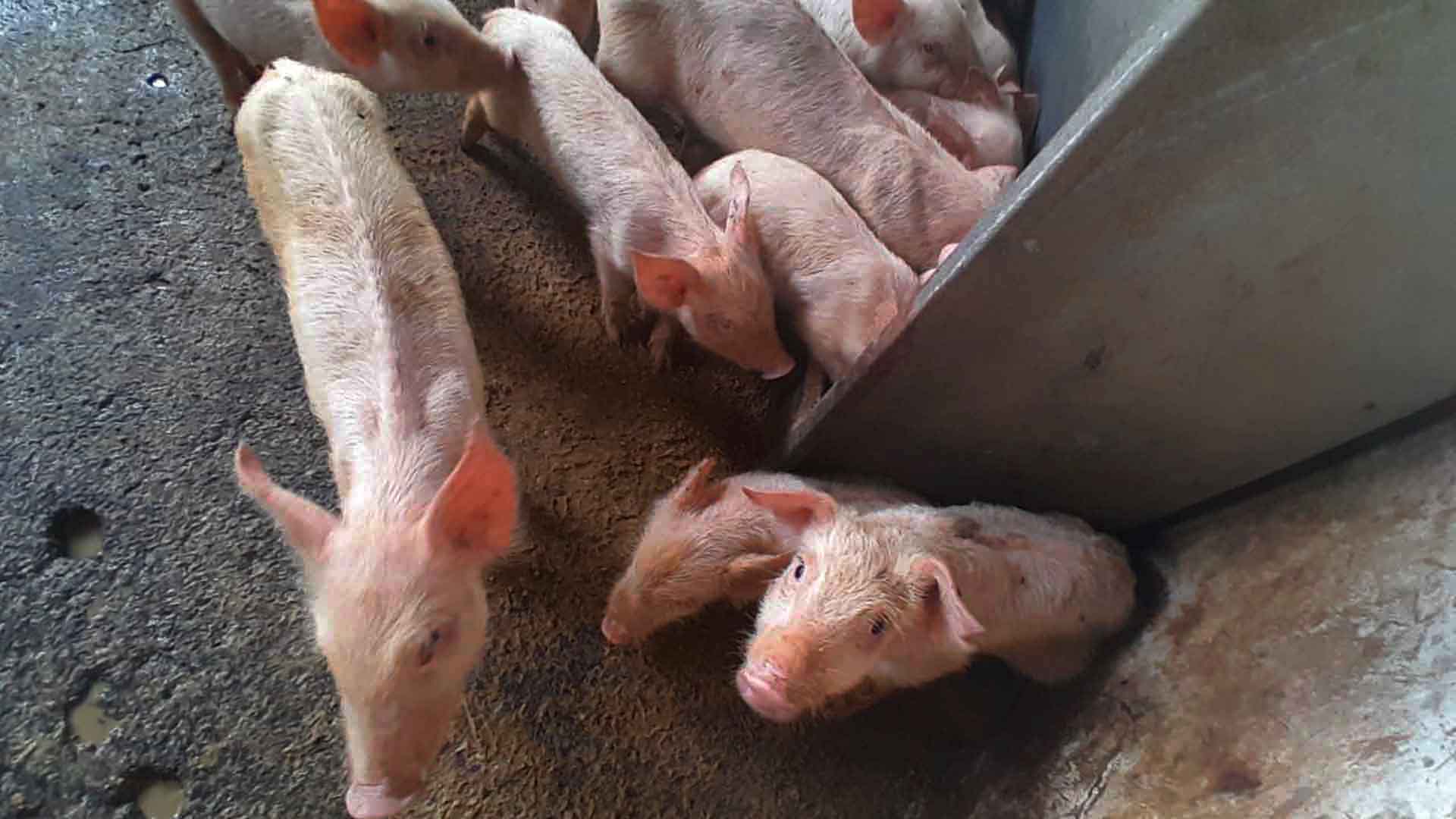
 Undernourished piglets at Baviaanspoort Correctional Centre. (Photo: NSPCA)
In the name of sustainability, prisons have farms to feed inmates and, in the case of horses and dogs, for security and patrols. Animals include pigs, cattle, sheep, goats and poultry.
The NSPCA has just completed an inspection of these farms and inspectors were shocked at the condition of numbers of underfed animals in poor condition. In some cases they had to euthanise pigs that were so far gone they could not be saved.
This has resulted from what the Department of Correctional Services calls “cost containment” – basically, budget cuts.
“At Baviaanspoort Correctional Centre we found pigs that were underweight and in some cases emaciated,” NSPCA inspector Navesh Singh told Daily Maverick.
/file/dailymaverick/wp-content/uploads/2025/03/Starving-pigs-at-Baviaanspoort-Correctional-Centre-1-NSPCA.jpg "Hungry piglets at Baviaanspoort Correctional Centre. (Photo: NSPCA)")
“We’ve found shortages of dairy cow pellets at other facilities. In some cases, suppliers haven’t been paid for six months and have stopped supplying food to prison farms. We’ve had to euthanise the worst cases.
“Prison farms are having to compromise, feeding pig food to laying hens, feeding pigs once a day with incorrect feed when they need feeding twice a day. Animals are not getting the correct nourishment. We’re soon going into winter, so grazing will dry up and cattle will have to be fed. It doesn’t look good up ahead.”
On 10 March, the NSPCA met officials from both the national and Gauteng departments, who admitted that cost-containment measures were taking place. Correctional Services National Director for Production Workshops and Agriculture Elizabeth Lupele expressed distress over the dire lack of feed at Baviaanspoort Correctional Centre. She said she had witnessed pigs screaming, which she described as “traumatising to me personally”.
Daily Maverick emailed Minister of Correctional Services Pieter Groenewald, asking if he knew about the situation and what the department was doing to rectify the problem. Asking was a formality. The department does not have a good record of replying, so we did not expect an answer. We were wrong.
Quick response
Within 24 hours, a reply arrived. The minister was busy with budgetary matters, but would reply as soon as he could. In the meantime, an interim answer was supplied. Clearly, they hadn’t got on top of the situation so the initial response was phrased in vague bureaucratese.
The department was “committed to upholding humane and ethical treatment” and that “necessary interventions have been implemented to uphold the highest standards for all animals under its care”. It said it had implemented corrective measures to address the shortages.
“Budgetary constraints do not equate to neglect” and “the wellbeing of animals in our care remains a priority”.
NSPCA communications manager Jacques Peacock rejected the statement. “It doesn’t address anything. How do you ‘remain committed to upholding humane and ethical treatment standards’ if we’ve had to issue warnings for non-compliance, and the fact that feed restriction is taking place?”
/file/dailymaverick/wp-content/uploads/2025/03/NSPCA-inspector-assessing-the-state-of-a-piglet-at-Baviaanspoort-Correctional-Centre-NSPCA.jpg "An NSPCA inspector assesses the state of a piglet at Baviaanspoort Correctional Centre. (Photo: NSPCA)")
However, close on the heels of the first statement, came one from Minister Groenewald, who was taking the situation very seriously. He expressed his gratitude to the NSPCA for “their thorough inspections conducted nationwide” and was committed to addressing its warnings.
“Immediate steps have been taken to implement corrective measures to ensure the welfare of all animals under our care.” The Ministry, he said, had begun discussions with the NSPCA and the office of the National Commissioner to begin corrective measures.
What those immediate steps are, was not made clear. The Correctional Services farming division is collectively the biggest agricultural enterprise in the country, caring for around 170,000 animals. Restoring the 22 farms to health will require considerable work and investment.
Medical issues
According to NSPCA inspector Singh, the budget restraints are having a knock-on effect beyond food, because veterinarians are not being paid.
Where prison officials can undertake medical care, he said, medical suppliers were withholding orders because of non-payment. “Animals are not receiving medical attention. That’s a huge concern,” he said.
There are four prison farms in each of KwaZulu-Natal, Eastern Cape and Western Cape. Gauteng and the Free State each have three, North West has two and Mpumalanga and Limpopo one each. Some of these farms also have fully functional abattoirs.
The NSPCA has a dedicated Farm Animal Protection Unit guided by the Animals Protection Act. Its job is to ensure farms meet minimum requirements and do not cause injury or stress to any animal and to sound the alarm when violations occur.
According to Jacques Peacock, “it’s a case of the proof is in the pudding, although we are extremely grateful that the Minister has responded to our plea and actually took the time to address the issue. It’s a rare occurrence in our experience, especially regarding animal welfare.” DM
Comments
Scroll down to load comments...