




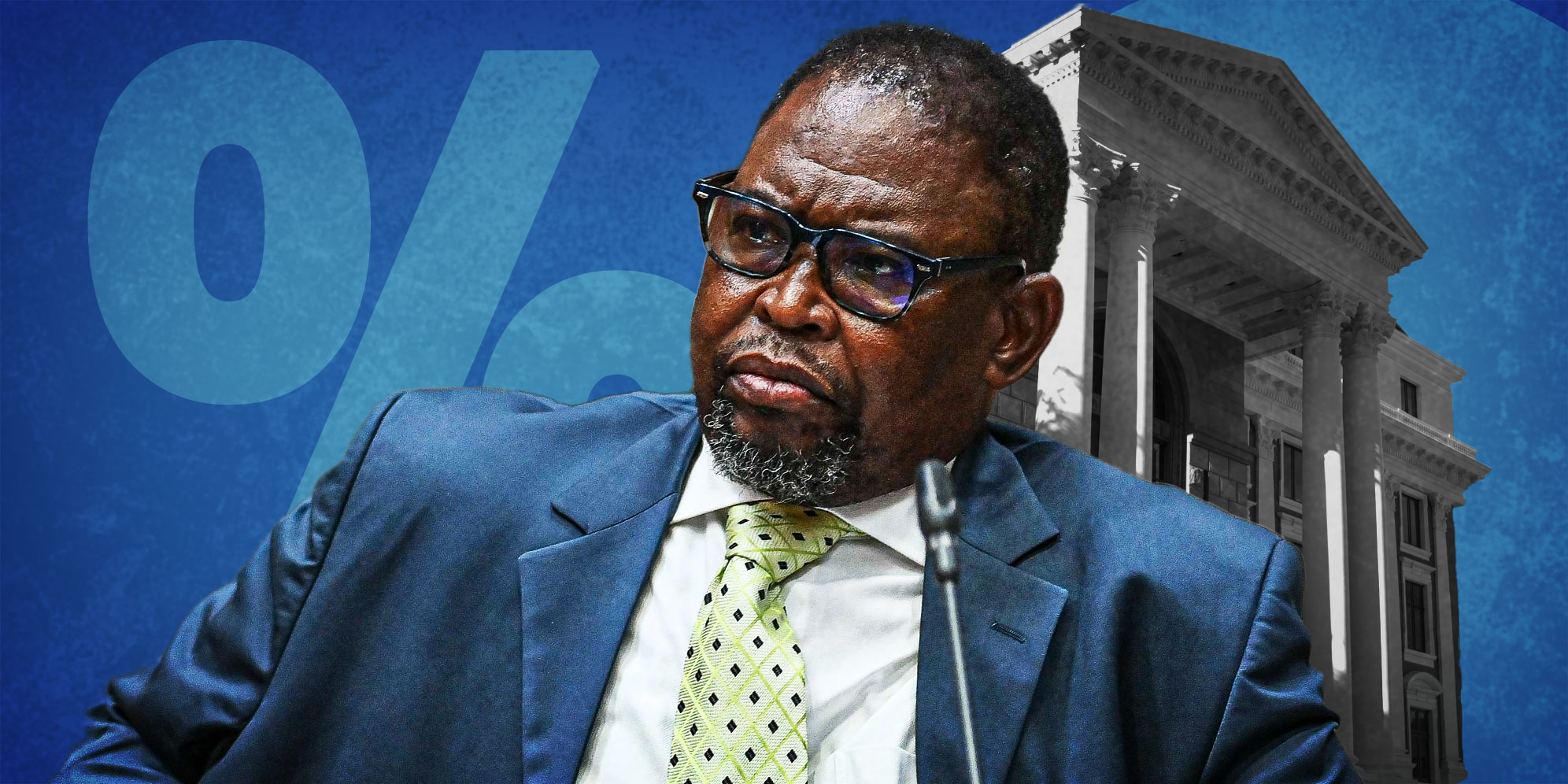
 Illustrative image: Minister of Finance Enoch Godongwana. (Photo: Gallo Images / volksblad / Mlungisi Louw) | Parliament building. (Photo: Daily Maverick)
 Coalition governments are a hot topic currently. Here, on home soil, the dramedy that played out in Parliament on Wednesday, 19 February 2025, left tongues wagging and many anxiously watching markets for a reaction.
As economist Izak Odendaal put it, the risk is less about the actual numbers in the Budget Review and more about whether the coalition government will survive this upset.
As in any relationship, the first disagreement is initially avoided as everyone compromises to keep the peace, and the proverbial s*** only hits the fan when one party reaches a point of no compromise.
According to reports, the VAT increase was actually discussed a few weeks ago and everyone agreed to it. The brouhaha is apparently that the number discussed and agreed to weeks ago was a 1 percentage point increase and the number that was printed in all the Budget Review documents - shared with journalists and economists, and that was all set to go into action - was a 2 percentage point increase.
As Zwelinzima Vavi pointed out – the 2 PERCENTAGE POINT increase in the VAT rate translates to a 13.34% increase in the VAT being charged. That’s a big difference from a 2% increase.
Anyhoo, now that the sticky point has been explained, back to relationships. South Africa is not the only country battling with disagreements at coalition government level.
Case in point, in November last year, the Germany coalition government was on the point of collapse when Chancellor Olaf Scholz fired a key minister and said he would call a vote of confidence in his government in 2025. The chancellor said he had no trust in Finance Minister Christian Lindner.
As Armida van Rij and Dr Patrick Schröder explain in this Chatham House article, the so-called debt brake – a constitutional mechanism which restricts Germany’s annual public deficit to 0.35% of GDP – was at the heart of the dispute.
Germans now have another national election on the cards for Sunday, and the jury is out on what political coalition will emerge.
Just three weeks ago in Norway, the Eurosceptic Centre Party quit the government after a dispute over the adoption of EU energy policies, leaving the centre-left Labour Party to rule alone eight months before an election.
Over in Austria, talks to form a coalition government with the far-right Freedom Party and the conservative People’s Party collapsed on Wednesday after the two sides failed to agree on disputed policy points.
The three European examples above have all occurred in the first two months of 2025. Which just goes to show: coalition governments are not an easy matter.
One of the big questions everyone in SA was asking was what will happen to the markets. However, the markets actually just ticked along rather sedately. Yes, the rand fell, but no more so than on any other day.
The real tell/impact will come from credit ratings agencies rather than the rand’s movements, methinks.
Mid-November last year, S&P Global revised the outlook for South Africa to positive. The ratings it handed to South Africa in November were:
A “BB–” long-term foreign currency debt rating – meaning South Africa’s debt is considered speculative, or “junk”, by global standards. Although it’s still investable, there’s a higher risk of the government struggling to repay its debt compared with more stable countries. Investors might demand higher returns to compensate for this risk.
A “BB” long-term local currency debt rating – slightly better than the foreign currency rating, suggesting the government’s debt in South African rand (its own currency) is a bit less risky than debt in foreign currencies such as the US dollar. However, it’s still considered to be in the “speculative” category.
At the time National Treasury was positively crowing: “The positive outlook reflects the agency’s view that increased political stability following the May 2024 general elections and impetus for reform could boost private investment and GDP growth. S&P further states that since the formation of the new broad coalition of 11 political parties under the Government of National Unity (GNU), debt yields and portfolio inflows have improved, leading to easing financing conditions and currency strengthening.”
What remains to be seen on Wednesday, 12 March, is what numbers will change and the ripple effect of any changes. It’s also worth noting that Treasury must have been superconfident that the VAT increase would fly. So much so that it printed out all the usual National Budget tomes – and I do mean tomes. Alas, as we raced back to the Imbizo room for a post-briefing with the minister and his director-general, I didn’t grab all my things. And when I heard the EFF was going to be using the room with all our things in it, I asked someone to please collect my stuff. No worries, I have it all saved on my laptop as do dozens of other journos.
A last word of advice. Like any relationship, the key to a good coalition is trust and communication. DM