



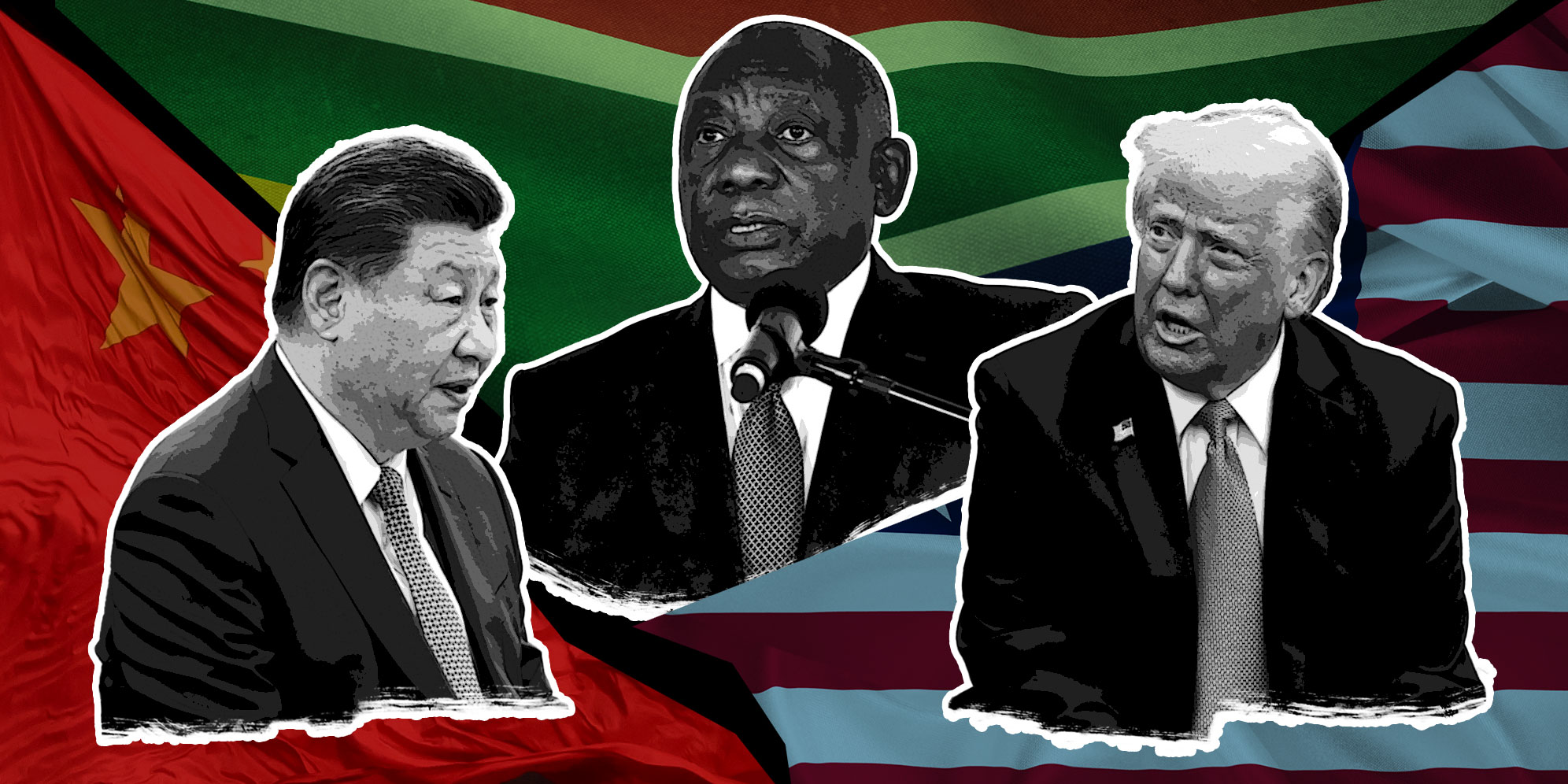
 Illustrative Image: China's President Xi Jinping EPA-EFE/KAZUKI KOZAKI / POOL | President Cyril Ramaphosa (Photo: Gallo Images / Frennie Shivambu) | President Donald Trump (Photo: Anna Moneymaker / Gallo Images) | Flags: Nadine Hutton / Bloomberg via Getty Images | Freepik)
 While South Africa’s economic prospects are improving, there is evidence that our leaders are unable to act decisively. This is not just about them, but about the structural reasons that prevent them from acting quickly.
The actions of US President Donald Trump and the statements by some of those around him show that the global multilateralist order created after World War 2 is now ending.
Trump has not stood up for democracy or freedom in Ukraine and appears to be negotiating that country’s future without its elected leadership.
US Vice-President JD Vance delivered a speech in Germany over the weekend that appears to confirm his government would not support Europe in any military crisis. Instead of focusing on Russia, he spent time lambasting a law that prevents someone from harassing women leaving a clinic that provides abortions, claiming he was protecting “free speech”.
The situation was perhaps put most bluntly by a Ukrainian official who told The Economist (before Vance’s speech), “Ukraine is fucked. And so is Europe, by the way”.
Trump’s words and actions make it clear that South Africa should expect to be removed from Agoa this year.
While our trade with the US will surely continue, it may become more difficult and less profitable (while there has been much public commentary about this, at least one estimate suggests Agoa is only worth 0.1% of our GDP).
Read more: Agoa in peril — a litmus test for SA’s ability to adapt to a shifting world order
Read more: How the loss of Agoa could hit South Africa’s citrus exports
Our next best option would be to increase trade with China, which is already our biggest trading partner. Unfortunately, it has big economic problems of its own, and attempts by its government to stimulate the economy have so far failed.
The fact that China’s problems are largely rooted in sentiment around property means they cannot be solved easily. If demography is destiny, its shrinking population means the country may be about to enter a difficult era.
This means that we will have reduced demand for our products, particularly platinum.
Better ec0nomic outlook
Despite all of this, and despite being under fire from Trump and others in the past week, the JSE has hit a new record high, and the rand has been remarkably resilient.
One of the reasons for this is that, again because of Trump (but also because of buying by central banks in emerging markets), the gold price is very high. That is pushing up shares in gold mining companies on the JSE.
Read more: Navigating uncertainty: How Trump’s turbulent leadership propels gold towards new heights in 2025
But, as RMB chief economist Isaah Mhlanga points out, it is also because of “our strong fundamentals”. He says the outlook for our economy is much better now than it was a year ago (before the election that led to the national coalition).
This means that there is a basis on which our government can build and continue the reforms that will lead to more economic growth.
There is some evidence this is happening. The relationship between government and business has never been closer (for good or ill), the virtual end of load shedding is hugely significant, Transnet is moving in the right direction, and so on.
Weak decision-making
However, to continue in this direction will require both strategic decisions and agility.
This may now be lacking. And in at least one case, there is evidence that our government has made a poor decision that led to huge losses.
Before SANDF soldiers went to Goma to protect civilians from M23, it was clear that without attack helicopters, they would be very vulnerable. In the end, 14 South Africans lost their lives.
Reuters has reported that hundreds more soldiers have now been sent there, despite the fact some of our soldiers on the ground cannot leave their base. While more soldiers may help the situation, they are still without attack helicopters.
Here, our domestic politics may also make it impossible to make proper decisions.
On Monday, 20 January, ANC secretary-general Fikile Mbalula said the party’s top seven national officials would announce how they would “reconfigure” the party’s provincial leaderships in KwaZulu-Natal and Gauteng in “a week”. It is now nearly a full month since that statement – and there has been no announcement.
The coalition government spends much of its time publicly squabbling, whether it be about expropriation or the impossible relationship between the DA’s Public Works and Infrastructure Minister and his deputy, the ANC’s Sihle Zikalala.
Instead of trying to improve or even fix the problematic aspects of BEE, the Department of Trade, Industry and Competition Minister Parks Tau appears intent on an unworkable new R100-billion fund.
Read more: Much-hyped R100bn BEE fund plan will struggle to get off the ground
It is easy in this situation to blame our leaders. After all, they have been elected to improve our lives. If they hold public office, they have also sworn an oath that they will work towards doing this.
Beholden leaders
But they are all beholden to constituencies that make it hard for them to work constructively together.
While the formation of the coalition has improved sentiment among the middle classes (and both the EFF and MK show no signs of challenging it), it is always going to be difficult for these leaders to take decisive action.
This also explains some of the apparent inaction of President Cyril Ramaphosa. He may be at the top of the political system, but even he cannot act quickly.
Unfortunately, acting decisively is only going to get harder. When Ramaphosa’s term as leader of the ANC ends in December 2027, whoever takes over will face a more difficult situation.
The outlook for the ANC is that it will continue to decline as our politics continues to fracture into more parties representing more groups of people.
This is likely to make it harder for leaders to make decisions one way or another.
There are signs that the world is about to become a more dangerous place, that might will more often become right, and no one will come to the aid of the vulnerable. In this choppy sea, we will have to provide our own direction and our own economic power to move there.
Unfortunately, it is becoming fairly likely that we will drift instead. DM