




 Illustrative image:
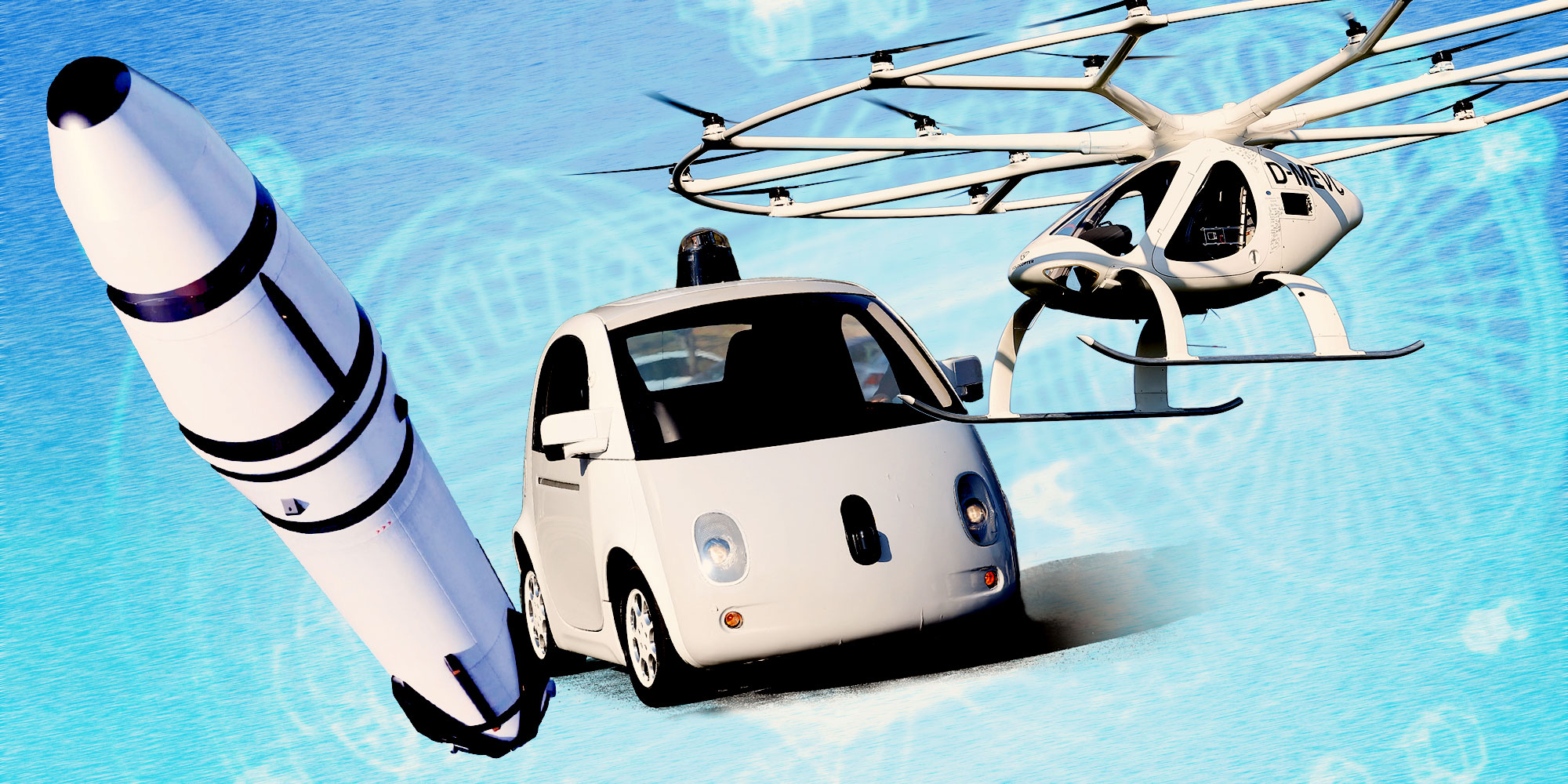
A rendering of Stoke Space's fully-reusable rocket as it separates stages during a launch into Earth orbit from LC-14 at Cape Canaveral. (Stoke Space) | A Google self-driving car at the Google headquarters. (Photo by Justin Sullivan/Getty Images) |
A Volocoptor X2 model is seen in a test flight during the official opening of a Volocopter hangar on April 04, 2023 in Bruchsal, Germany. Volocopter is developing two-seat multirotor aircraft for air taxi services. (Photo: Christian Kaspar-Bartke/Getty Images) |
Illustrative image:
A rendering of Stoke Space's fully-reusable rocket as it separates stages during a launch into Earth orbit from LC-14 at Cape Canaveral. (Stoke Space) | A Google self-driving car at the Google headquarters. (Photo by Justin Sullivan/Getty Images) |
A Volocoptor X2 model is seen in a test flight during the official opening of a Volocopter hangar on April 04, 2023 in Bruchsal, Germany. Volocopter is developing two-seat multirotor aircraft for air taxi services. (Photo: Christian Kaspar-Bartke/Getty Images) | For more than a century, the internal combustion engine has powered the world’s vehicles, fuelling economies but also contributing to environmental challenges. But, silently, in the background, an epochal revolution has been slowly unfolding, now made apparent by the experts at the World Intellectual Property Organization (WIPO).
What they have found and highlighted in the new WIPO Technology Trends: Future of Transportation report offers a hopeful, aspirational glimpse into a post-carbon future: patent applications for traditional combustion engines have plateaued, while innovations in sustainable transport technologies are accelerating.
Autonomous driving is projected to generate from $300-billion to $400-billion in revenue by 2035.
“At a global level, research activities are increasingly shifting toward technologies that will define the future of transportation,” the report’s authors write.
“Innovations in areas like Sustainability and Digitalization are becoming increasingly central to the research and development strategies within the transportation sector,” it continues, adding that “If this trend continues, it could indicate a significant shift in focus away from traditional transportation technologies, such as combustion engines, toward those that promise greater efficiency, connectivity and environmental focus”.
The news is a positive development because according to the International Energy Agency (IEA), transport accounts for more than a third of global CO2 emissions.
The authors ask readers to imagine a world where by the middle of this century, autonomous vehicles “drive silently through smart cities, drawing power from the road below”, a world where drones deliver packages minutes after you place your order and where hyperloop trains and hypersonic flight allows you to get from major cities across continents in less than two hours. The future, according to the patent applications, paints a picture of future transport that is faster, cleaner, more efficient and more sustainable.
Autonomous ships, smart ports
According to the report authors “Autonomous ships and smart ports are revolutionising transportation at sea; electric vehicles, high-speed trains and smart traffic management systems are driving change on land,” while “Vertical take-off and landing aircraft are offering new ways to travel by air, while reusable rockets and satellite technology are pushing what is possible beyond the earth’s atmosphere”.
The data speaks for itself with trends across global research and development shifting decisively toward cleaner, smarter, and more connected mobility solutions.
Innovation is reshaping the global transportation sector 🚢🚝🚘🚀, making the way we move people and goods faster, greener and more efficient, a new WIPO report shows.
Read more: https://t.co/KUWFlIX4rm#WIPOTechTrends pic.twitter.com/FiTKEb9SfP
— World Intellectual Property Organization (WIPO) (@WIPO) February 6, 2025
The WIPO report highlights four key technology clusters driving the future of mobility: Sustainable Propulsion, Automation and Circularity, Communication and Security, and Human-Machine Interface (HMI).
Sustainable Propulsion focuses on reducing emissions through electric propulsion, hydrogen fuel cells and alternative energy sources. Automation and Circularity could revolutionise vehicle production with smart factories, industrial robots, and additive manufacturing, while promoting sustainable resource use through biopolymers and recycling. The report suggests that autonomous driving is projected to generate from $300-billion to $400-billion in revenue by 2035.
Communication and Security technologies, including lidar, 5G networks, and connected vehicle systems could improve traffic management, safety, and autonomous driving capabilities, while HMI innovations such as touch displays, speech and facial recognition, and extended reality are reshaping user interactions, making transportation more intuitive, accessible and secure.
Transportation future: electric mobility
According to the report, there were more than 1.1 million inventions (patent families) published between 2000 and 2023 relating to the future of transportation. The authors of the report define transportation as “the systems, modes and infrastructures that facilitate the movement of people, goods and services from one location to another”.
“With a compound annual growth rate of 11% between 2000 and 2023, technologies relating to the future of transportation far exceed the 4% rate seen in traditional transportation technologies”, reads a section of the report.
“The top five inventor locations, namely China, Japan, the United States of America, the Republic of Korea and Germany, account for over 90% of all inventions, with recent double-digit growth seen in China, Sweden, Italy and India.” Of the patents related to transportation, a full 82% related to land transportation with sea, air and space accounting for 4%, 12% and 7% respectively.
One of the current, more tangible glimpses into this future is in electric mobility.
According to the report, “In 2000, there were around 5,000 sustainability-related patent family publications, reflecting early efforts to improve fuel efficiency and explore alternative energy sources. The years following 2010 saw continued growth, with patent family publications increasing to more than 28,300 by 2016, driven by advancements and lowering costs in battery technology and the growing adoption of electric and hybrid vehicles.
“By 2023, sustainability-related patent family publications had grown to nearly 56,500 (19% of all patent family publications in transportation).”
But what of South Africa (SA)? The report shows that not many of the patent applications come from the country. So while Johannesburg’s skies likely won’t be the first to be dotted with flying taxis, SA is not unsusceptible to the broader patterns that these technological changes and advances evidenced by the patents portend.
SA’s EV landscape
Hiten Parmar, Executive Director and Co-founder of South Africa Electric Mobility Association shared some information on the state of SA’s electric vehicle landscape with Daily Maverick.
“SA’s EV market to date has been slow since the first introduction in 2013 (Nissan Leaf), and after 10 years, by 2023 only 931 BEV (battery electric) models sold in 2023 out of sales of 347,695 passenger vehicles. However, what we are noticing is a growing market introduction of BEV models into the SA market which is very positive. Vehicle manufacturers are still seeing SA as a market opportunity and hence a growing new BEV model introductions year-on-year. In 2019, it was a key milestone that BEVs overtook PHEVs in South Africa and have continued to do so ever since. This is across that the BEV driving range offering in the local market became more favourable for local consumer needs, but also that the public charging infrastructure and associated role-players also increased in SA, therefore building a lot more confidence and awareness for the local market to transition to BEVs.”
Read more: Buses, taxis, batteries & gas — Cape Town mayor, Gautrain CEO share plans to decarbonise transport
Parmar continued “With SA’s long-standing automotive market, which is primarily production-led, we urgently need to shift our local automotive production capabilities towards zero-emission vehicles, as SA’s primary markets of exports as EU and UK have announced phase-out dates of our locally manufactured vehicles (internal combustion engine). SA automotive production has evolved over the years since 1924 when it first started in SA with the Ford Model T in Port Elizabeth. This has been supported through government’s automotive production policies over the years.
“While these production policies have generally been technology-independent, it remains key for SA’s production policies to quickly start having specific production incentives for zero-emission EVs (ie Battery electric or fuel-cell electric). With multiple global market bans on ICE vehicles from 2030, SA’s production will have to quickly transition to zero-emission vehicles to maintain and also grow its existing automotive production.
“SA’s automotive manufacturers have already showcased that they can produce locally, they just need the supporting incentive frameworks from government to support zero-emission vehicle production locally.” DM