




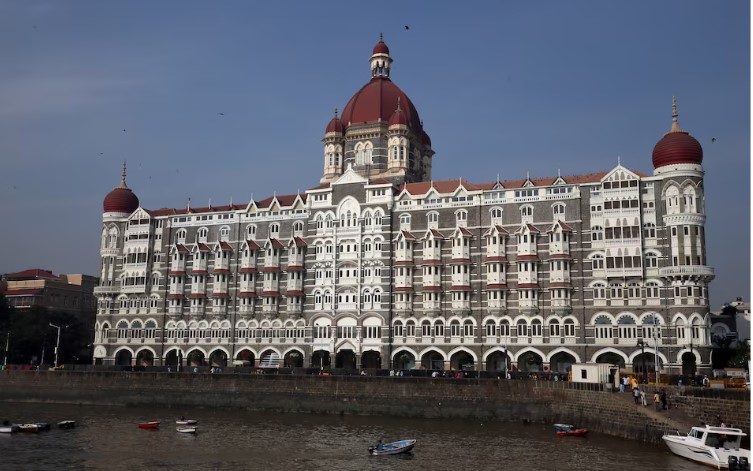
 A view of Taj Mahal hotel in Mumbai, India, November 25, 2018. REUTERS/Francis Mascarenhas/File Photo
Indian Hotels, owner of the luxury Taj brand, is emerging as a flag bearer of the South Asian country's tourism boom. The $12 billion company on Monday unveiled a fifth hotel under development in Mumbai. Overall it plans to more than double its footprint of properties to over 700 by 2030, and at least 10% of the additions will be overseas. But as domestic room tariffs hit the roof, Indians are increasingly eyeing overseas destinations.
The company shows no sign of being affected by a domestic consumption slowdown that is rippling across the economy. Revenue hit 25.9 billion rupees ($296 million) in the three months to the end of December, up 29% year-on-year, and its EBITDA margin grew 80 basis points to over 39%. Over the past 12 months, the stock outperformed the rallying Nifty 50 by 34 percentage points and Indian Hotels is valued at 63 times its earnings for financial year 2025, roughly double the multiple for Marriot International and Hilton Hotel.
Rich Indians are splurging on weddings and events, and people are hungry for experiences. Coldplay’s concert in Ahmedabad in January had an audience, opens new tab of 134,000, and room rates, opens new tab for one nearby Taj property leapt as high as 120,000 rupees, roughly $1,386, for a double-occupancy two-night stay. It's not a one-off: a shortage of hotels in prime locations is pushing up prices across the board even though foreigners are visiting India in fewer numbers than before the Covid pandemic.
Overseas destinations start to look relatively attractive to domestic travellers beyond a certain expense, says Amit Kumar at HDFC Securities. India may become the world’s fourth-largest market for outbound tourism after the United States, China and Germany, up from 10th, by 2035, says Capital Economics. Popular destinations for the South Asian country's travellers include the Maldives, United Arab Emirates, Oman and Thailand.
Concerns about the sustainability of room rates within India are growing, however. Karan Khanna, an analyst at Ambit Capital, warns of a potential faster-than-expected surge in domestic supply as rivals including ITC Hotels announce significant expansion plans in smaller cities. To address those worries, Indian Hotels is talking up its capital-light investment strategy. For now, it is on the move with rich India.
Editing by Una Galani and Aditya Srivastav
Comments
Scroll down to load comments...