




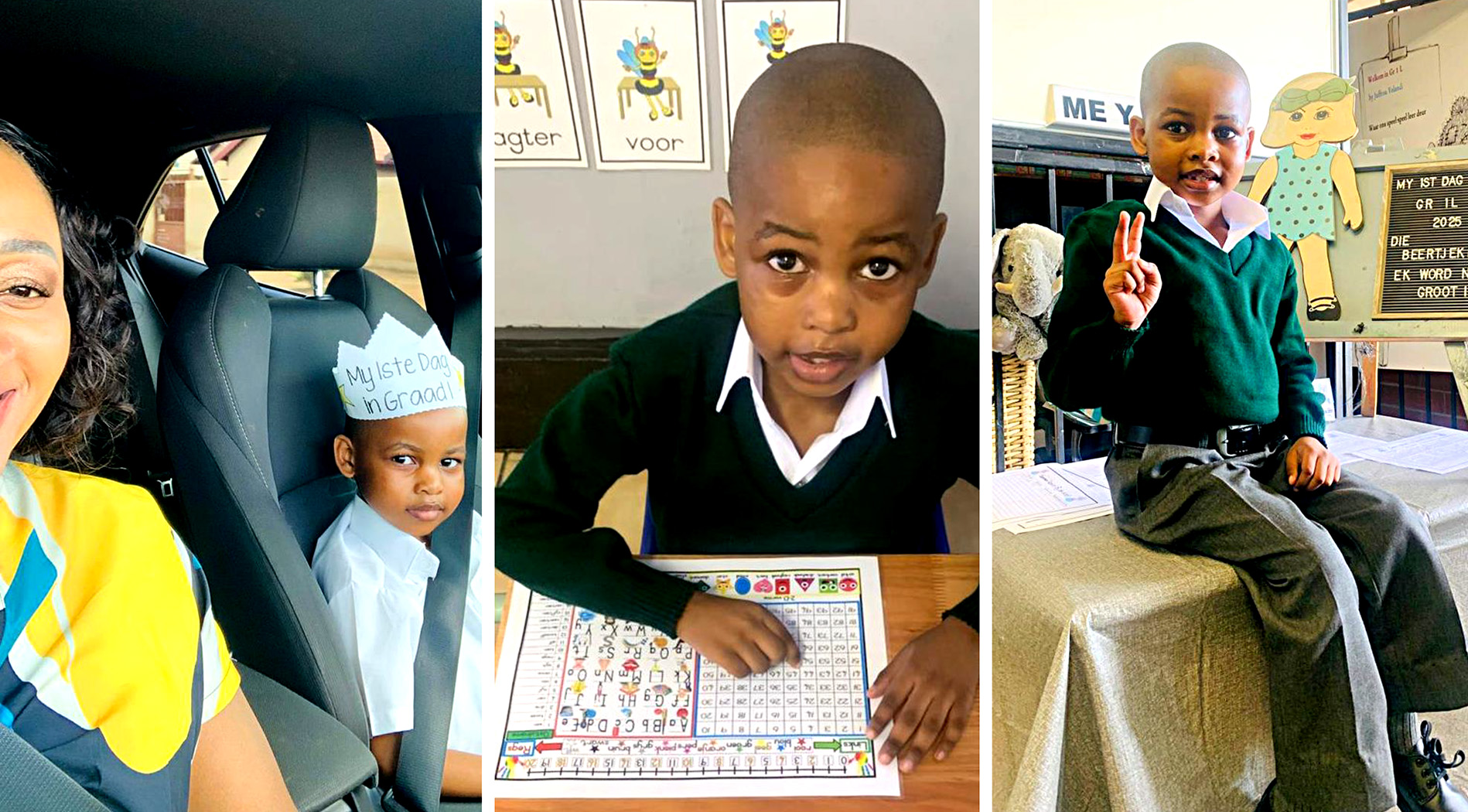
 Thabang Khoaisi and his mother Awelani Khoaisi on his first day of school at Laerskool Hermanstad. 'He is already learning to count in Afrikaans,' said Awelani. (Photos: Supplied)
 When Awelani Khoaisi, a mother from Pretoria, posted a TikTok video expressing frustration about her Grade 1 son’s unexpected placement in an Afrikaans-speaking school, she did not anticipate the emotional and social ripple effect that would follow.
In the video, which quickly went viral, Khoaisi voiced her concern: her son, Thabang, had been placed in an Afrikaans-speaking school — despite neither of them knowing the language.
For Khoaisi, the decision felt like an impossible challenge — one that exposed the deep divisions still present in the country’s educational system.
“He is enrolled in an Afrikaans school. Not an Afrikaans school to say that they teach in English — no, they teach all the subjects in Afrikaans except English itself. The child only speaks English and it’s Monday, and there is nowhere else the department has placed us except this school, so I am seated here with a problem that I don’t know how it is going to be resolved,” she said in the video.
With her son’s future at stake, Khoaisi’s words resonated deeply, sparking a heated debate about race, language, the school placement process, and the challenges of South Africa’s post-apartheid education system.
While some social media users offered suggestions — such as visiting the Department of Basic Education to explain her situation — others questioned the placement process itself. Some even found humor in Khoaisi’s emotional rant.
But the biggest surprise came when the viral video sparked an outpouring of support from Afrikaans-speaking South Africans, offering tutoring, language lessons, and encouragement for Khoaisi and her son. What started as a mother’s frustrated rant soon turned into an inspiring story of solidarity and empathy.
The placement process
Grade 1 and Grade 8 registrations close early in Term 2 of the previous year, requiring parents to select five preferred schools. After registering online, parents must also submit the necessary documents at the schools themselves — an important step that many often overlook. Schools receive a list of all applicants by Term 3, and the school management then works through the list to accept a certain number of learners, determined by available space and the final results of the current cohort.
For learners who aren’t accepted, their details are sent back to the district office, where further efforts are made to place them at one of the parent’s remaining school choices. If no space is available, the district office tries to place the child at a school near the parent’s place of work. In the worst-case scenario, if there is no availability in any of the chosen schools, the learner may be placed in a school that uses a different language of instruction — as happened with Khoaisi’s child.
Khoaisi said that she had applied for schools when registration opened in July 2024, but when placements began in October Thabang was rejected by all of them. Despite this setback, Khoaisi took matters into her own hands, going to the Department of Education in Pretoria to apply for other options, but the process remained challenging.
She shared that after being rejected by all of the schools they initially applied to, they were informed that they would have to wait for the next round of placements. This second round opened briefly in December, and in this round parents were only allowed to choose one school, not two or more options as in previous stages. Khoaisi chose Laerskool Tuinrand, located just 1km from the school where Thabang is currently enrolled.
From acceptance to action
On Monday, Thabang’s father received a message confirming that he had been accepted at Laerskool Hermanstad. Khoaisi then visited the school, where she was told it was a fully Afrikaans-speaking institution.
“The teachers explained that all subjects were taught in Afrikaans, with English as a second language,” Khoaisi told Daily Maverick. “I asked them, ‘What do you mean by fully Afrikaans?’ and that’s when I realised the extent of the language barrier.”
After leaving the school, Khoaisi went to the Department of Basic Education’s provincial district office in Tshwane North. There, she found long lines of other parents also trying to secure placements for their children. After finally being assisted, Khoaisi had to fill out an application form, choosing her preferred school for Thabang, with a 10 to 15 day waiting period for a response.
The following Tuesday, after receiving more calls and advice, Khoaisi and Thabang’s father made the decision to move forward with the placement at Laerskool Hermanstad.
Another factor in Khoaisi’s decision was that she would be in Cape Town for a course from January 20 to March. She felt she couldn’t leave Thabang in a frustrating and uncertain situation without support, especially since she wasn’t sure if the 10-day waiting period would bring a resolution.
“When I went to work I went with all the documents and registration papers so that my colleague, who is Afrikaans speaking, could help me to fill the application form for my child,” she said.
A wave of support
After, Khoaisi posted her video there was a heartwarming outpouring of support from Afrikaans-speaking people, offering tutoring and solidarity to a child they had never met.
Some offered to translate school letters if needed, others shared translations of key words, such as “class”, “hall”, “parents’ night”, “library”, and “office”, and others offered words of support.
“Mommy, you’ve got this. Many Afrikaners are following you and you have our full support. Sterke (good luck),” wrote one Tiktok user. On Thursday night, during the parents’ evening, Khoaisi live-streamed on TikTok, with users providing translations in the comments to assist her.
Various social media users offered free tutoring, including Keabetswe Baloyi, who shared her own experience.
Speaking to Daily Maverick, Baloyi said: “I was in a similar position because in Grade 1 I was enrolled in an Afrikaans school. I knew a little bit of Afrikaans so I can imagine how it feels for a parent who doesn’t know Afrikaans and also has a child who doesn’t know Afrikaans,” Baloyi said.
She explained that she felt compelled to help, and reached out to Khoaisi.
“I felt like I needed to help so that the child does good and still continues with their education, instead of staying home and waiting for enrollment at another school,” she said.
When asked about her TikTok video and whether she expected the overwhelming reaction and outpouring of support, Khoaisi explained that when she posted the video, she didn’t expect anything to come from it and had no idea that the video would gain so much attention. She also said that she meant no harm to anyone, including the Gauteng Department of Education, and apologised if her actions had caused any offense.
Read more in Daily Maverick: The story of the wonderful Mr Mtati and the 100% pass rate for maths
Gauteng Department of Education spokesperson Steve Mabona stated that the department was aware of the video in question. He added that, based on the information available, they were also aware of the circumstances that led to the placement at the school, which followed the department’s placement criteria and process, in line with the parent’s requirements. The department would engage with the parent to facilitate an alternative placement, he said. Khoaisi added that the office of Gauteng education MEC Matome Chiloane had reached out, offering to help change the situation and find a school that better suited their needs. However, she declined the offer as they had accepted the situation as it was and were hoping for the best.
“Yes, we were not happy, but we’re trying to be strong as a family, trying to embrace the diversity within South African schools, and all the languages are unique. However, we were not prepared, because Thabang only knows how to speak English, I speak Venda, his father is Sotho. Thabang understands a little bit of Sotho, but when it comes to TshiVenda, he can’t comprehend a single word. The only time he knows what’s being said is when I greet him,” she said.
Khoaisi mentioned that Thabang was already claiming not to know Afrikaans, which she thinks shows the influence of his siblings.
“I spoke to each of them individually and explained that Thabang does know Afrikaans. He wasn’t born speaking English; he was taught English, and there's no reason the same can’t be done with Afrikaans. I also told them not to speak negatively about it,” she said.
A heart full of thanks
When asked about the people offering free tutoring and help with homework, Khoaisi expressed her gratitude, saying she was deeply appreciative of everyone’s support. She said she felt thankful to South Africa as a whole, recognising the country’s unique and diverse nature.
“We are a rainbow nation, and no one judged me for my situation,” she said.
Khoasisi added that she didn’t wish to comment on those who were focusing on the negative aspect of her child’s situation, but rather she appreciated the kindness and understanding she had received.
I’m so grateful also to the Afrikaans community and all the unique South Africans who are vowing to help us.
“I’m so grateful also to the Afrikaans community and all the unique South Africans who are vowing to help us. Some of them, they’ve already started to say they want to send textbooks that their children used, some of them have already sent the links where I should buy the eBooks that I should use with Thabang. We have got several tutors, everyone is helping,” she said.
“I have enrolled myself for Afrikaans lessons and it’s going well. I can hear some words because I did Afrikaans a little bit when I was in primary school. It’s just that I cannot help the child with his homework. I need to learn so that I can be on this journey with Thabang, I don’t want him to go through this alone depending mostly on tutors and the aftercare for homework assistance, which starts on 20 January,” she said.
Khoaisi’s advice for parents who might find themselves in a similar situation was that all parents should recognise that we lived in a unique country with a rich diversity of languages, and each language was special and valuable.
“If your child finds themselves in a situation like this, it’s important to listen to the advice you receive before jumping to conclusions,” she said.
Khoaisi said that while the situation wasn’t ideal, it improved when she decided to embrace a change.
“It is also a chance for me to learn Afrikaans, as it is one of the official languages of South Africa. All parents should try to embrace the uniqueness of each language, with a willingness to learn being the most important key,” she said. DM