



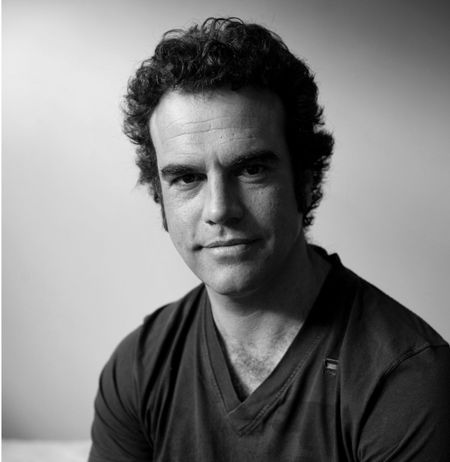
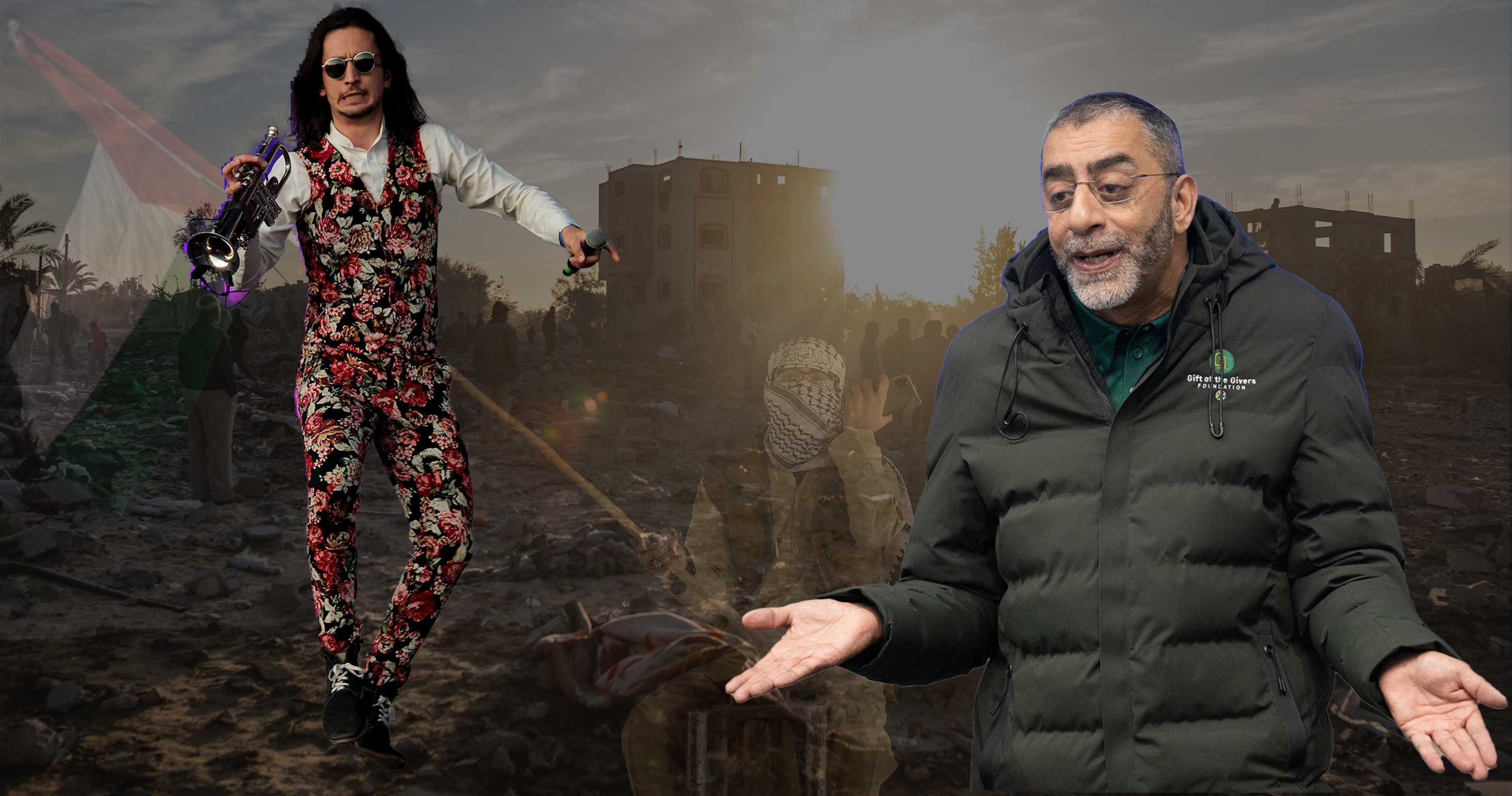
 David 'The Kiffness' Scott. (Photo: Gallo Images / Dereck Green) | A political party supporter in the Middle East. (Photo: EPA-EFE / BILAWAL ARBAB) | Dr Imtiaz Sooliman. (Photo: Gallo Images / Misha Jordaan) | Palestinians inspect the remains of destroyed buildings following the Israeli airstrikes in Khan Younis, southern Gaza Strip. (Photo: EPA-EFE / HAITHAM IMAD)
 Party of Satan
‘Iran hates me,” said Dr Imtiaz Sooliman. “Hezbollah hates me too.”
It was a Wednesday morning in early December 2024, less than a week after South African musician David “The Kiffness” Scott had invoked the wrath of his countrymen by dismissing Sooliman on X as a “false prophet” and “radical Islamist,” and the celebrated founder of Gift of the Givers — Africa’s largest humanitarian and disaster-relief agency — was in an exceptionally good mood.
“Hezbollah,” he repeated, smiling, “it means ‘Party of God’. I call them Hezboshaytan, ‘Party of Satan’. It’s in my book!”
And indeed, when Daily Maverick checked later that day, it was in Sooliman’s book — if not exactly the part about Satan, then certainly the part about why Iran and its proxy Shia militias would have reason to despise him.
“Iran plays this game of the Islamic Revolution,” it stated clearly in the text, beginning at the bottom of page 166 and running into page 167, “[and yet] there’s nothing Islamic about Iran. Say it like it is… when you can cause conflict by sending arms to kill women and children, there is nothing Islamic about you!”
The chapter in which the quote appeared was titled simply “The Syrian Story”, but it had a subtitle that promised to take the reader “behind the curtain”.
Sooliman, it turned out, had visited Syria in October 2012, after an Al Jazeera journalist had convinced him that a media blackout had been imposed for two nefarious reasons: firstly, to keep the world’s eyes away from the true scale of the conflict and, secondly, to safeguard the false narrative that sufficient humanitarian aid had been entering the country, with the Saudis and Qataris driving the supposed relief effort.
What Sooliman found when he got there, of course, was that it was way worse than even the journalist had told him. One of the first stories he confirmed, during a trip to a bombed-out village near the Turkish border, was about a man who had gone out to source food for his family — the man had managed to procure a hunk of five-day-old bread, but on his return to the village he had discovered that Bashar al-Assad’s forces (backed by Hezbollah and the Iranian mullahs) had shelled the houses, killing 72 civilians, including all 13 members of his family.
The text of Sooliman’s book, over the next few pages, was peppered with injunctions from the Qur’an about conduct during wartime — to not harm women and children, to not burn houses, to not damage crops, to not poison wells.
“Yet Hezbollah and Assad do everything opposite to that,” he was quoted. “They shut the water off to Qusair when 50,000 women and children are trapped inside. In Homs, they burn and slit the throats of 275 women and children. In Tartus, they wipe out 1,000 people. Is this what Islam teaches you? Is this what the Qur’an teaches you?”
All of which was to suggest that Sooliman, contrary to the allegations of Scott and his other South African detractors, had been doing a pretty bad impression of a Tehran-aligned Islamist.
Written by Shafiq Morton and originally published in 2014, with an updated edition released in 2021, the book — titled Imtiaz Sooliman and the Gift of the Givers: A Mercy to All — could not have stated the case in plainer terms. Also, in God-forsaken warzones such as Syria, where Gift of the Givers had set up a hospital with 70 permanent staff, the facts were known to thousands and easily verifiable.
So, what had brought on these allegations against Sooliman? In other words, if this was indeed a baseless smear campaign, what were its primary motivations?
“I can’t answer that,” Sooliman said to Daily Maverick, still smiling.
But that didn’t mean he was saying there wasn’t an answer. As far as Daily Maverick was concerned, it appeared that there was — and it all may have begun with Lawrence Nowosenetz, a former member of the South African Jewish Board of Deputies and a one-time acting High Court judge, who had recently made a new home for himself in Tel Aviv.
Funding, slander and innuendo
On 23 October 2024, under the title “To the Helen Suzman Foundation of South Africa”, Nowosenetz published the latest instalment in his blog series for The Times of Israel — a piece that differed from his previous blogs in that it was framed as an open letter to Naseema Fakir, Helen Suzman Foundation (HSF) executive director. According to Nowosenetz, “unpalatable information” had surfaced that required the HSF’s cancellation of its invitation to Sooliman to present the annual (and highly prestigious) memorial lecture.
Still, other than the open letter format, the substance of Nowosenetz’s blog was in keeping with most of his previous efforts.
Back in January 2024, he had published a piece under the self-explanatory title “South Africa’s disgraceful disregard for international humanitarian law in the ICJ”. In early May, he had published a broadside against The Guardian of the UK for having the temerity to grant a platform to the anti-Zionist Jewish writer Naomi Klein, who a few weeks prior had called for a mass “exodus” from the ethno-nationalist project that “commits genocide in [the ancestral Jewish] name”. In late May, Nowosenetz had followed that up with a screed against the South African government, which in his mind had fully aligned itself with the objectives of Iran and its proxy militias, Hezbollah and Hamas.
“[Naledi] Pandor travelled to Iran to meet with the [now] late President Raisi to discuss the Israel-Hamas war,” Nowosenetz had reminded his audience, referring to South Africa’s former international relations minister.
“Less than two months later, in December 2023, South Africa had filed the complaint against Israel in the [International Court of Justice]. In January, despite well-known crippling financial difficulties within the ANC, the party surprisingly announced that its finances had been stabilised.”
Clearly, what Nowosenetz was suggesting here — by his own admission, without any actual proof — was that Iran had paid the South African government to take the genocide case to the International Court of Justice (ICJ).
And then, in late September 2024, in a blog that attempted to savage the character and intentions of one Kelly-Jo Bluen, spokesperson for South African Jews for a Free Palestine (SAJFP), he had mentioned Sooliman for the first time.
“The SAJFP enjoys cordial relations with Gift of the Givers,” he had written, “a disaster relief and medical assistance philanthropic fund headed by Islamist Dr Imtiaz Sooliman … [who] cannot even acknowledge the humanity of the Israeli victims of 7 October and is contemptuous of the grief and trauma of Hamas’s victims”.
By late October, therefore, when he published his open letter to Fakir, Nowosenetz had already got away with multiple instances of slander and innuendo — breaches of journalistic best practice that, for whatever reason, had passed muster at The Times of Israel. In now choosing to allege that Sooliman and Gift of the Givers “may be directly or indirectly financially supporting Hamas”, it must have been obvious to him that he would get away with it again.
The basis for the allegation — and the primary reason that Nowosenetz had demanded HSF’s cancellation of Sooliman’s memorial lecture — was the non-profit that Sooliman had set up just before launching Gift of the Givers, known as the Al Aqsa Foundation.
Nowosenetz acknowledged in his blog that Sooliman had handed the Al Aqsa Foundation over to Sheikh Ebrahim Gabriels in 1992, after having spent only one year at the helm. But he went on to allege that the same foundation had later joined forces with the Union of Good, which in November of 2008 had apparently been blacklisted as a terror-supporting organisation by the United States Department of Treasury.
“Based on the detailed and highly credible information I have received,” Nowosenetz concluded, without having once provided documentary evidence, “it appears certain that Dr Sooliman’s activities in Gaza, from 2009 to current, will be rendered increasingly visible as the fog of war diminishes. The likelihood that donor funding in Gaza was used exclusively to provide humanitarian relief for innocent civilians is remote. Far more likely is that a significant part of the resources went into supporting Hamas itself, perhaps indirectly in the Hamas-run hospitals.”
Fakir, for her part, remained unconvinced — she affirmed in a media statement, released four days after Nowosenetz’s blog, that the HSF would “host its annual memorial lecture as planned”.
Three days after that, on 30 October 2024, the HSF’s former executive director, Nicole Fritz, published a scathing piece in Daily Maverick, calling out Nowosenetz for his white-male presumption that Suzman herself would have been “appalled” by Sooliman’s alleged misdeeds.
“No one can say definitively what Helen would have thought, felt, done in this situation today,” wrote Fritz. “But her record of abhorrence for bigoted and chauvinistic bullies is well documented.”
And yet not even that could stop Marika Sboros, writing for the conservative publication Daily Friend, from trotting it all out again in an inventive piece of analysis published on 9 November 2024. Republished on 24 November in BizNews, under a new title that deftly exploited its virality — “A very dark side to Sooliman’s Gift of the Givers” — the piece repeated all of the tropes from Nowosenetz’s compendium of blogs.
Iran, Hezbollah, Hamas, South Africa’s case at the ICJ — somehow, according to Sboros and the BizNews editors, Sooliman’s “open support for lawfare against Israel” was a clue to his shadow role as a sleeper agent in the Shia world-takeover plot.
Where, for Nowosenetz, the smoking gun was in the Al Aqsa Foundation, for Sboros it was in the Al Quds Foundation — but no matter the naming discrepancy, or for that matter Sboros’s assertion that the US had banned the organisation in 2003 (for Nowosenetz, as above, the year of banning was 2008), all you had to do was join the dots.
Also, just like for Nowosenetz, another significant factor for Sboros was Sooliman’s apparent “silence” on the Israeli hostages in Gaza. Was Sooliman an anti-Semite? The subtext, in both pieces, was that there was every indication that he was.
Blood libels and bank guarantees
The way Sooliman dealt with this existential question, for Daily Maverick, was to acknowledge that he had been brought up to severely distrust Jews. As a young brown Muslim kid in apartheid-era South Africa, he intimated, that was just the way it was.
“But in 1991,” he said, “when I met a spiritual teacher for the first time, in that place half the people were American Jews. Disciplined, respectful, obedient, compassionate — I thought to myself, you know what, I’m learning from them. And after that, no negativity.”
In the post-7 October world, of course, things got a lot more complicated. Early in 2024, Sooliman told Daily Maverick, he attended a talk at the University of Cape Town on the conflation of anti-Zionism with anti-Semitism. There he met members of the SAJFP, with whom he had already engaged, and after the talk they wanted to ask him questions.
“I said to them, I came here for only one reason,” Sooliman recalled. “I came here to thank you, because you don’t get enough credit for what you do. You’re first in line at all of the marches. I’m sure the Zionists don’t like you, I’m sure you’ve been cut off from your families.”
The way he remembered it, some of the SAJFP members began to “tear up” — so Sooliman told them that they had a “new family” in the Muslim community.
Still, as genuine as the sentiment appeared, these were not the words of a man who was unaware of the stakes. After that, said Sooliman, when he was invited to speak in the mosques, he would make sure to remind the congregants that “the Jews are not the enemy”.
More to the point, he added, he had taken it upon himself to inform the SAPS, state security and the private security companies of the new dangers — because, while Sooliman knew better than anyone that there had been no real history of Muslim-on-Jew violence in South Africa, the Israeli reaction to 7/10 had drastically increased the risks.
“If any Jew is threatened by a Muslim,” said Sooliman, “we stop him.”
Given the ethos of Gift of the Givers — which, according to the latest statistics, had distributed a staggering R6-billion in aid across 47 countries — there was no reason to doubt his commitment to non-violence. “We don’t import disasters,” he told Daily Maverick, with reference to the situation in Gaza, “we export good.”
And indeed, since the organisation was now delivering around 3 million litres of water per month, attending to over 15,000 patients per month and distributing 120,000 food parcels per year in some of the world’s most marginalised conflict zones, the accusations of his detractors were wearing increasingly thin.
Had he really said nothing, ever, about the fate of the Israeli hostages in Gaza?
Sooliman laughed. “I said it clearly on TV, I said it many times,” he told us. “Human rights on both sides is sacred. Islamic law doesn’t allow you to hurt innocent people.”
Of course, what his detractors were after was a lot more than that — an assurance, for instance, that he had never funded or aided a banned terror organisation. And here, admitted Sooliman, it was true that as a young man he had established a non-profit called “Al Aqsa Foundation”.
“But Al Aqsa is a common name, it’s like saying Mohammed or Mecca or Medina,” he told us. “We took a picture of the mosque [in Jerusalem], we set up a Palestine collection fund, we raised some money and we sent it across to the other side. End of story.”
A year later, he continued, acting on a spiritual instruction, he parted ways with the foundation to set up Gift of the Givers — which had since been subjected, he stressed, to the constant oversight of local and international authorities.
“We know the terrorism laws,” he said. “In 2001, the Americans tried to say, well, we are working in Afghanistan, we must be involved in terror funding. Nkosazana Dlamini-Zuma [the foreign affairs minister at the time] said no, this is our organisation, we can vouch for them. Then they shut up; they didn’t come for me after that.”
Sooliman emphasised the “process” in such matters. “Your own bank applies to the Reserve Bank for clearance to send money across,” he said, adding that Standard Bank handled all of his work. “The money goes from Standard Bank into an American bank, Standard Chartered, which exchanges it into dollars and transfers it to the organisation that finally gets the money. So, there’s a foolproof system.”
The Reserve Bank, he noted, which was obliged to issue a report after every transaction, had “never had an issue”. Also, since Gift of the Givers worked closely with the South African government, it had to be extra careful.
“When we’re not sure about something,” Sooliman explained, “we say to Standard Bank, look, our network is not big enough, can you check for us. Standard Bank will come and do a due diligence.”
Ultimately, said Sooliman, the onus was on his detractors to prove that he had been channelling funds to Hamas. “I’m telling them, charge me personally,” he said. “Go to the SAPS, go to the Hawks, go to the NPA, go to state security, and charge me. I’m giving you an open challenge.”
Then, voluntarily, Sooliman offered the following: “I have no relationship with Hamas. They don’t like me.”
As it turned out, many years prior to 7 October 2023, Sooliman had criticised Hamas while he was in Gaza — out in the streets, with the media present — for its inability to create cohesion among the people and organisations of Palestine.
“I’m a Muslim, I’m not scared of anybody,” he said to Daily Maverick. “What is wrong is wrong and what is right is right. How do you solve a problem when you’re fighting amongst yourselves?”
Eating the words
Sooliman had never heard of The Kiffness before the infamous tweet of 28 November, he told us. But the tweet, which garnered 1.5-million views, was unequivocal — aside from calling Sooliman a “false prophet” and “radical Islamist”, Scott alleged that Gift of the Givers was a “front for a far more sinister agenda”.
Whether Scott had been influenced by the work of Nowosenetz and Sboros was impossible to determine; his assessment, on the face of it, may have been based purely on the appended TikTok clip — sourced from the South African Zionist talk show host Howard Feldman — that purported to justify his words.
“Strike terror into the hearts of your enemies and Allah’s enemies,” Sooliman had been recorded saying, at a Muslim event in South Africa, “don’t be afraid. One of those lawyers asked me, ‘what did you achieve by going to the ICJ?’ I said, ‘what kind of a dumb question is that?’ What did you achieve? You made 60 other countries not be afraid any more.”
From Daily Maverick’s perspective — as informed by the perspective of this writer, a formerly indoctrinated Jew — the “enemy” in Sooliman’s speech was not the Jewish community in general.
“What’s important is to tell the Zionists,” he had said in closing, “we are not afraid of you!”
Still, it wasn’t as if Scott hadn’t misused the words of public figures to advance his own agenda before. Back in mid-September 2024, as a significant chunk of humanity was aware, he had released a track called “Eating the Cats” — the track, which would apparently drive Scott’s viewing figures on YouTube to a mind-boggling 2.2-billion, was based on the allegations of JD Vance and Donald Trump that the Haitian community in Springfield, Ohio, had been feasting on the local pets.
By the end of September, the allegation had been analysed and dismissed as “disinformation” by The New York Times, which had also termed it “racist”. More importantly, two days before Scott released his track, law enforcement in Springfield, Ohio, had stated that they had received “no credible reports or specific claims” of Haitians harming, injuring or abusing the pets of the town.
What Daily Maverick wanted to know from Scott, therefore, was whether he confirmed or denied that his global hit had contributed to anti-immigrant and/or racist sentiment in the United States and beyond. We also wanted to know, aside from the TikTok clip that he had reposted on X, whether there was anything — “concrete evidence, etc” — that had led him to conclude that Sooliman was a “radical Islamist” with a “sinister agenda”.
At the time of writing, Scott had not responded to these questions (emailed on Friday, 6 December, to his management). Neither had he responded to our third question, which was about the apparent cancellation of a speaking engagement at the prize-giving ceremony of the Pridwin Preparatory School in Johannesburg, scheduled for Wednesday, 4 December.
Sooliman, during the interview with Daily Maverick, had reached for his phone when the subject of The Kiffness came up. “That’s him, isn’t it?” he had asked, pointing to an “update” from the school to parents — forwarded to Sooliman by a friend — that stated Scott would no longer be guest speaker at the event.
Ross Grimley, the headmaster of Pridwin, would later confirm to Daily Maverick that the update was genuine. In response to the question as to why Scott had been cancelled, Grimley texted the following:
“Some of Mr Scott's views were recently the subject of debate and comment, including amongst our school community. We took the decision to change the guest speaker at prize-giving to ensure that the focus of the entire Pridwin community remained the extraordinary achievements of our senior primary boys, which were celebrated at prize-giving. We did not want anything to detract from the celebratory nature of the occasion.”
And so there it was; a path, however humble, through all of the innuendo and gaslighting. Ordinary South Africans, it appeared, could intuit the truth for themselves — a truth that was less about words, although those were important too, than it was about deeds.
Because Scott, for all of his crowing that “actual humanitarians” didn’t use Sooliman’s “kind of rhetoric”, had been praised in October 2024 by Israel’s most widely read daily newspaper — the pro-Netanyahu Israel Hayom, owned by Miriam Adelson, who also happened to be the largest individual donor to the Trump campaign — for “defending” the country on X. And yet regardless, after the cancellation of his speaking engagement at Pridwin, he had doubled down.
“I’ve emailed the headmaster of my prep school to give insight into my concerns over Dr Sooliman,” he had tweeted on 5 December, also stating that he had asked Grimley to share his email with staff and parents.
By his own admission, he hadn’t heard back.
Meanwhile, over in Gaza, where all of this had started, Sooliman’s people were still doing the best they could to deliver food, water and medical care.
Incredibly, in the midst of the growing allegations of war crimes and genocide against the Zionist regime, Gift of the Givers was still standing — despite the murder, during the first weeks of the conflict, of its office boss in a suspected “targeted” attack; despite the consistent bombing of its tents and vehicles and medical facilities; despite the loss to its staffers, according to Sooliman, of more than 175 family members.
“That’s why they’re mad at me,” said Sooliman, repeating his message from the TikTok clip. “Because I’m not afraid of them.”
Marika Sboros responds:
Kevin Bloom’s reporting on the curious case of Dr Imtiaz Sooliman and his global Gift of the Givers charity (Daily Maverick, December 11, 2024) devotes inordinate space to nitpicking inconsequential detail in an article I wrote in Daily Friend in November.
Bloom also disingenuously suggests that I somehow influenced South African musician and parody artist David Scott, aka The Kiffness to criticise Sooliman.
He says the same of retired human rights lawyer and former acting High court judge Lawrence Nowosenetz.
For the record, I don’t know Scott or Nowosenetz personally.
Bloom also refers to BizNews republishing my article (after which it went viral). BizNews has with Daily Friend to lift content freely.
Bloom acknowledges Gift of the Givers as Africa’s largest humanitarian and disaster-relief agency. I’ve done so as well but he ignores that.
I’ve said that Sooliman and his charity have long enjoyed global acknowledgment and awards for their humanitarian work.
Bloom nitpicks my concerns with Sooliman’s public statements about not following international or local law, only Koranic law, and that he and his charity “know how to move cash”.
Bloom raises “a naming discrepancy” I made. He is correct. I misplaced a sentence in a rewrite, leaving the impression that Sooliman started a branch of the Al-Quds International Foundation in South Africa in 1991 before handing it over to start Gift of the Givers in 1992. As my next sentence refers, Sooliman started a branch of the Al-Aqsa Foundation.
Mea culpa. I’m human. I have corrected the error (as I do). I thank Bloom for pointing it out.
Bloom claims I erred again – in saying that the US first sanctioned the Al-Aqsa Foundation as a terror entity for alleged ties to terror funding of Hamas in 2003. I am right. It was 2003.
He also accepts without question Sooliman’s dismissal of importance attached to the names, Al-Aqsa and Al-Quds, as mere generic Islamic references, like terms such as “Mecca” or “Medina”. DM
Read more by Kevin Bloom on the war in the Middle East:
High noon at the ICC: Zionism’s intractable Netanyahu problem (24 November 2024)
Open court: In dialogue with a South African Zionist leader, Benji Shulman (3 November 2024)
Fascism’s strange resurgence — a ‘bad Jew’ South African breaks bread with the German media (9 October 2024)
Conversations with Randa: How the life of a Gazan refugee maps Israel’s dilemma (17 July 2024)
Holy War revisited — ‘You want it darker, we kill the flame’ (8 May 2024)
Messianism and madness: An intimate hell ride through end times in the Holy Land (22 October 2023)