



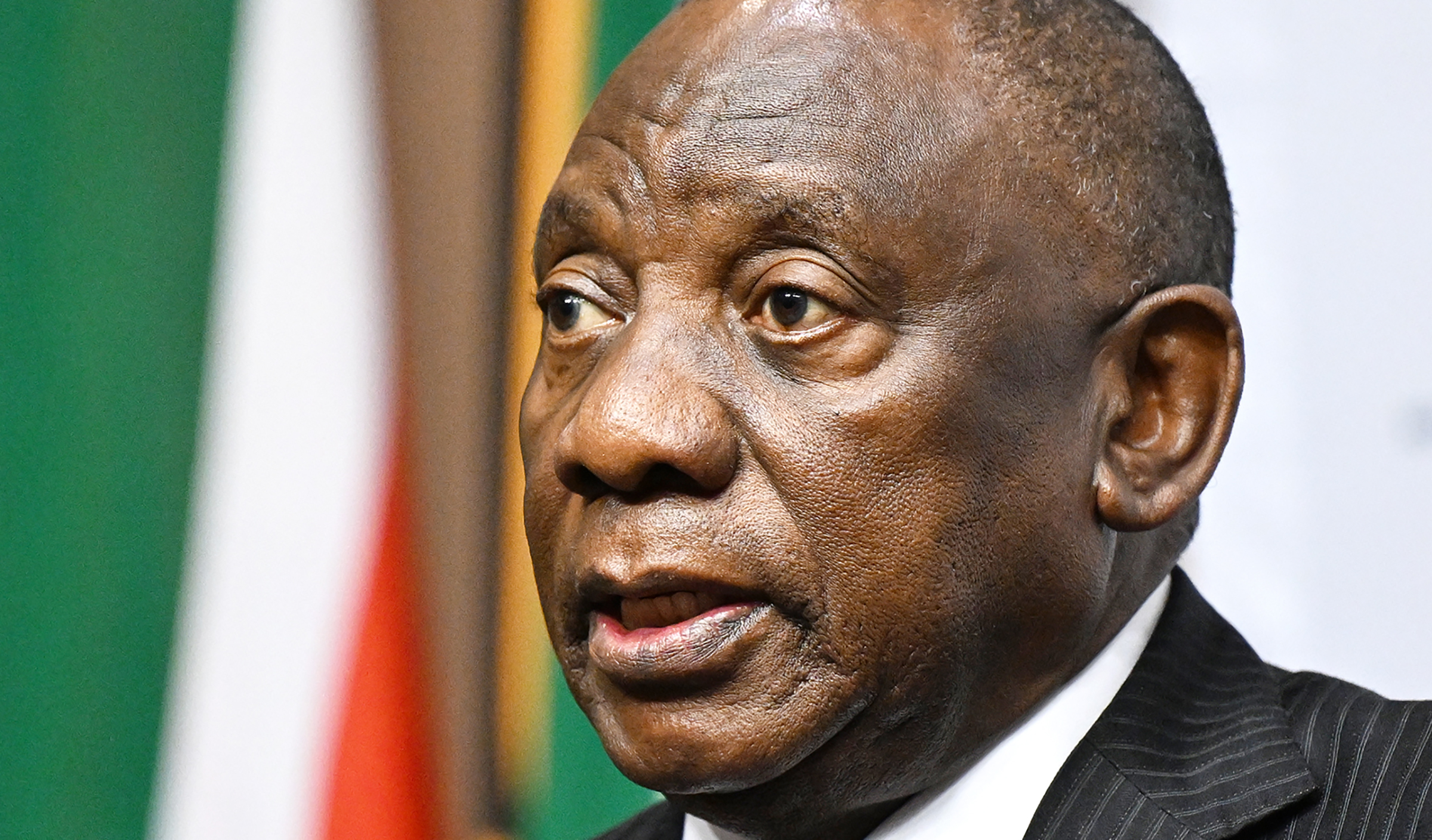
 President Cyril Ramaphosa addressing the media during the launch of the G20 presidency in Parliament, Cape Town . (Photo : Phando Jikelo/ Parliament of SA)
 Question: Will US President Donald Trump attend the G20 Leaders' Summit in South Africa in 2025?
Answer: By G20 tradition, he should. But No. President Donald Trump has officially announced that he will not attend the 2025 G20 Leaders' Summit in Johannesburg. The Trump administration has directed a boycott, with neither Vice President JD Vance nor Secretary of State Marco Rubio attending, making the US the first G20 member country to refuse high-level representation. Argentina's Javier Milei followed Trump's lead and also pulled out.
Daily Maverick reports here that US President Donald Trump recently issued a social media post banning all US officials from attending the G20 Summit in Johannesburg, because, he falsely claimed, “Afrikaners … are being killed and slaughtered, and their land and farms are being illegally confiscated.”
On Thursday, 20 November, there was a suggestion from President Ramaphosa that the US might, however, send its chargé d'affaires, acting ambassador Marc Dillard, to the summit.
Vance was to have attended the summit, and his planned visit to South Africa, together with his wife, Usha, and young family, had taken months to prepare.
As J Brooks Spector reports here, the US embassy in South Africa was thrown into disarray by its principal’s intemperate post, in which he confused South America with South Africa.
Government sources said Vance’s advance team had already made most of the arrangements, and South Africa was still awaiting clarity on what would happen.
Daily Maverick’s Trump Tracker reveals that this was the 15th attack on SA by the US leader or his representatives in 2025.
In this episode of The Readiness Report, Redi Tlhabi speaks with Honorary Professor, International Relations, at the University of the Witwatersrand, Professor John Stremlau about the power play behind the boycott, the diplomatic fallout, and what it signals about an era where disruption is strategy.
Q: Is it a big deal?
Very big. The G20 represents about:
- 85% of global gross domestic product (GDP).
- 75% of international trade.
- 60% of the world’s population.
Q: Which are the G20 countries?
There are 19 member countries and two blocs: the European Union and now the African Union. The countries are Argentina, Australia, Brazil, Canada, China, France, Germany, India, Indonesia, Italy, Japan, Mexico, Russia, Saudi Arabia, South Africa, South Korea, Türkiye, the UK, and the US. This is 21, but the nomenclature of the G20 remains.
Q: Is the G20 a single meeting in November 2025?
No, it’s a full year of meetings.
“Tens of thousands of delegates and support staff from the largest countries arrive in South Africa over the year-long presidency,” said the Department of International Relations and Cooperation’s director for economic development, Masotsha Mnguni.
Think of it as a one-year-long showcase for South Africa. Through the meetings, direct and indirect jobs will be created. The price tag will be between R1-billion and R2-billion, with much of it footed by sponsorships from the private sector. South Africa’s budget will be transparent in February.
The Treasury’s director-general, Duncan Pieterse, said: “From 1 December 2024 to 29 November 2025, there will be 130 virtual and in-person meetings across the country. It is a marathon of yearly international meetings to influence the global agenda and shape economic policy.
“It’s the premier global forum for discussing financial and global issues where developed and developing countries are represented,” he said.
Of the 133 meetings scheduled during South Africa's G20 presidency, 132 had taken place before the summit, which is the final meeting.
Q: How do negotiations and decisions work?
With great complexity. The G20 is not a binding body but operates on the principles of collective action and moral suasion. Deputy Reserve Bank Governor Rashaad Cassim said the best way to understand the G20 was as a relay where each country passed the baton to the next on the understanding that the country in the chair (South Africa from 1 December) did not start with a clean slate. About 75% of the issues were an existing foundation, while about 25% were new ones that emerged or that the host country regarded as important.
South Africa is the fourth country in the Global South to hold the chair after Indonesia, India, and Brazil.
Read more: SA takes G20 helm amid global political instability and shifting world order
“We all know what needs to be taken forward. It’s about how we can move the dial,” said Cassim.
Nguni described the G20 as an “informal governance club”. There is an overlap in G7 (the world’s largest country bloc) and G20 issues that span political, security, global economic and financial governance. Based on the chairing roster, the G20 is managed at any point by a troika of countries: the current troika from 1 December is Brazil, South Africa and the US.
According to the first media briefing last week, South Africa works in concert with the African Union to shape an African agenda that includes the debt crisis and creating a more equitable, representative, and fit-for-purpose global order.
Q: What’s in it for South Africa?
Status and an opportunity to show what we can do as well as move the dial on global issues that are important to the Global South. The 2010 Fifa World Cup is a perfect example of how international events can work to enhance soft power, which can translate into growth and jobs. South Africa’s target is inclusive growth, industrialisation, employment and inequality. Other specific issues are food security (Brazil’s President Lula placed ending hunger at the top of his agenda), AI, and innovation for sustainable development.
Q: What are the big-ticket burning economic and financial issues?
Debt. And how to reschedule or forgive harmful African debt or provide concessional finance. This can crowd out climate financing for vulnerable places in the world, so it is a balancing act. Cross-border payment delays are a huge issue because of the Swift system, which is a hot-button topic for negotiation. India has made global cryptocurrency regulation a priority. Data disclosure on climate finance and general global standard-setting are considerable.
Former finance minister Trevor Manuel, who led the G20 Africa Expert Panel, explains proposals on a new deal for Africa's debt in this video.
Q: How are the G20 meetings organised?
Take a breath. It’s a lot. Many working groups do the baseline negotiations before ministerial meetings where decisions are made (or not, in a fractured world). The finance track includes international financial architecture, infrastructure, sustainable finance, a global partnership for financial inclusion, international tax, and financial sector regulation. There are also “task forces” for health financing, hunger and poverty, and climate change. Each working group meets quarterly, while finance ministers and central bank governors have four meetings a year.
Q: Who runs things?
As Sherpas get you up a mountain, Sherpas guide the process. In South Africa, Department of International Relations and Cooperation Director-General Zane Dangor is the Sherpa, and he is assisted by two sous-sherpa: Ambassador Xolisa Mabhongo, the deputy director-general for global governance, and Advocate Nokukhanya Jele, who is President Cyril Ramaphosa’s legal advisor. With deftness, Sherpas can shepherd meetings to a standard view.
Due to significant geopolitical rifts, particularly the US boycott, achieving a consensus on the 'Johannesburg Declaration' is proving extremely challenging, raising the probability that President Ramaphosa may need to issue a Chairperson's Summary instead.
Q: With global uncertainty, war, and insecurity as the most significant geopolitical trends, is a successful G20 possible?
“The G20 works best when there’s a crisis,” said Cassim, who added that uncertain geopolitics made momentum difficult.
Q: How can you get involved?
Throughout South Africa's G20 presidency, non-government sectors from business (B20), civil society (C20), labout (L20), women (W20) and youth (Y20) held a series of meetings, the outcomes of which will contribute to G20 deliberations.
While these meetings have wrapped up, the People's Summit, an alternative gathering comprising civil society and progressive movements, is being held at Constitutional Hill in Johannesburg from 20-22 November, finishing off with a festival with performances from well-known South African artists. DM