




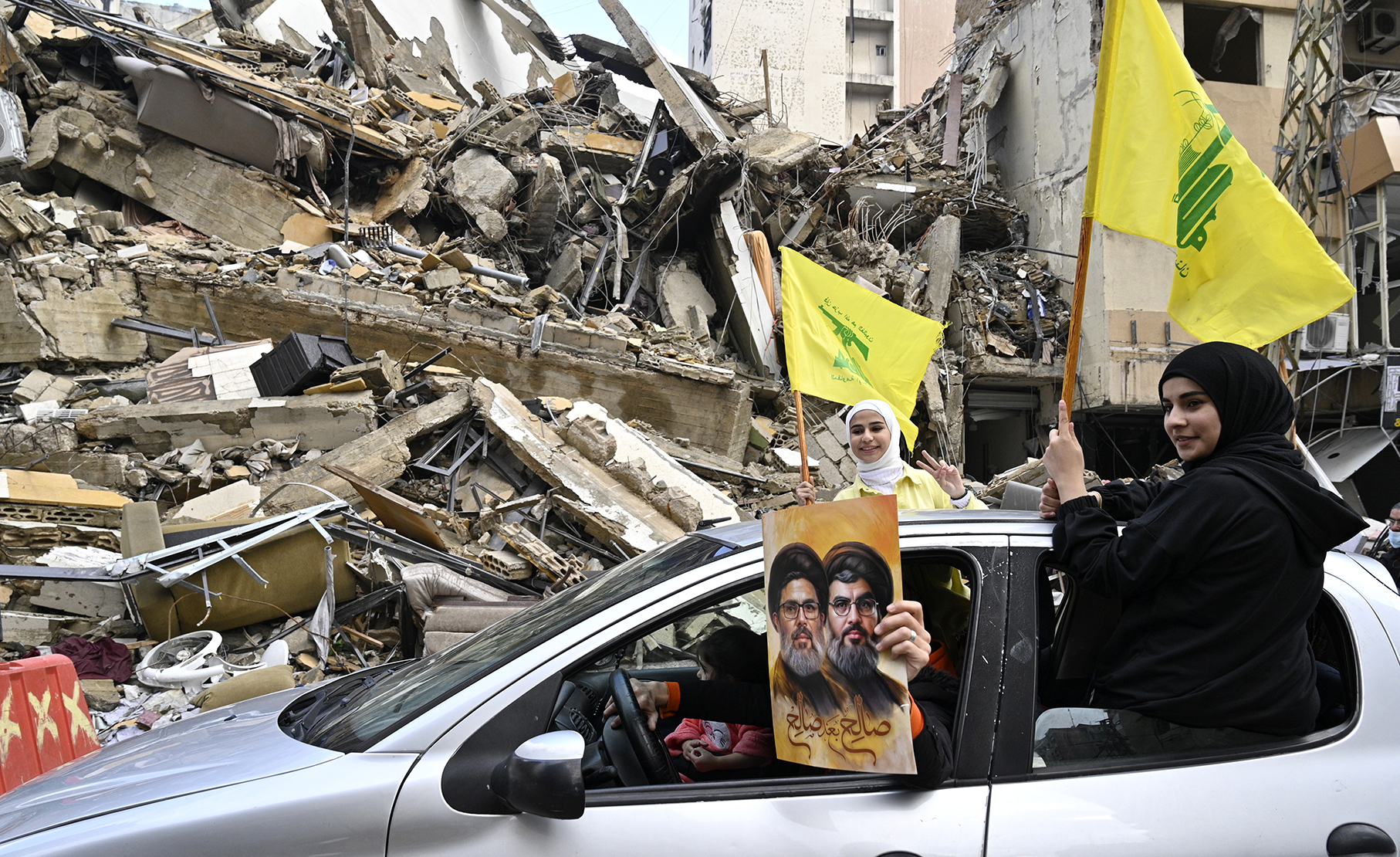
 People celebrate in the Dahieh district in southern Beirut, Lebanon, after the ceasefire with Israel came into effect on 27 November 2024. (Photo: EPA-EFE / Wael Hamzeh)
 Israeli jets hit an underground complex that was used to produce surface-to-surface missiles and store precision weapons, the Israeli military said.
Iranian Foreign Minister Abbas Araqchi said on Wednesday that Tehran reserved the right to react to Israeli airstrikes last month on Iran, but also welcomed Tuesday’s ceasefire agreement in Lebanon and hoped it would be permanent.
Israel says it destroyed Hezbollah missile site near Syria
The Israeli military said on Wednesday it had destroyed one of Hezbollah’s top strategic missile sites near the border with Syria, hours before an Israel-Lebanon ceasefire took effect.
The Israeli jets hit an underground complex that was used, with the help of Iran, to produce surface-to-surface missiles and store precision weapons, the military said.
“The site was located in an underground compound near the Syrian border. Due to its proximity, the site was a central point through which thousands of weapons components and even terrorist operatives were smuggled from Syria and Lebanon,” the military said.
Iran welcomes Lebanon ceasefire, reserves right to react to Israeli air strikes
Iranian Foreign Minister Abbas Araqchi said on Wednesday that Tehran reserved the right to react to Israeli airstrikes last month on Iran, but was also taking account of other developments in the region.
Araqchi told reporters during a trip to Lisbon that Iran welcomed Tuesday’s ceasefire agreement in Lebanon and hoped it would be permanent. The ceasefire between Israel and Iran-backed Hezbollah took effect on Wednesday under an agreement brokered by the United States and France.
Asked whether the ceasefire could lead to an easing of tensions between Israel and Iran, he said: “It depends on the behaviour of Israel.”
“Of course, we reserve the right to react to the recent Israeli aggression, but we do consider all developments in the region,” he said.
Israel struck targets in Iran on 26 October in retaliation for an Iranian missile barrage against Israel on 1 October.
Ali Larijani, a senior adviser to Iran’s supreme leader, said in an interview published on Sunday that Tehran was preparing to respond to Israel.
Although Israeli Prime Minister Benjamin Netanyahu said on Tuesday that Hezbollah had been “set back decades”, Araqchi said the armed group had not been weakened by Israel’s killing of many of its leaders since January and by its ground offensive against the group since early October.
He said Hezbollah had been able to reorganise and fight back effectively.
“This is the main reason why Israel accepted the ceasefire ... every time they (Hezbollah) lose their leaders or their commanders, they become bigger in both numbers and their strength,” he said.
His remarks echoed comments by a senior Hezbollah official, Hassan Fadlallah, who said the group would emerge from the war stronger and more numerous.
Separately, Iranian state media said Iran’s foreign ministry had rejected as “baseless” a statement by the foreign ministers of the Group of Seven countries demanding that Tehran cease all support for Russia’s war against Ukraine.
Since Russia’s full-scale invasion of Ukraine in 2022, Moscow and Tehran have deepened their military and economic cooperation.
Israel to tell ICC it will contest arrest warrants — Netanyahu
Israel has told the International Criminal Court that it will contest arrest warrants for Prime Minister Benjamin Netanyahu and his former defence minister Yoav Gallant over their conduct of the Gaza war, Netanyahu’s office said on Wednesday.
The office also said that US Republican Senator Lindsey Graham had updated Netanyahu “on a series of measures he is promoting in the US Congress against the International Criminal Court and against countries that would cooperate with it”.
The ICC issued arrest warrants last Thursday for Netanyahu, his former defence chief, and Hamas military leader Ibrahim Al-Masri, known as Mohammed Deif, for alleged war crimes and crimes against humanity in the Gaza conflict.
The move comes after the ICC prosecutor Karim Khan announced on 20 May that he was seeking arrest warrants for alleged crimes connected to the 7 October attacks on Israel by Hamas and the Israeli military response in Gaza.
Israel has rejected the jurisdiction of the Hague-based court and denies war crimes in Gaza.
“Israel today submitted a notice to the International Criminal Court of its intention to appeal to the court, along with a demand to delay the execution of the arrest warrants,” Netanyahu’s office said.
Court spokesperson Fadi El Abdallah told journalists that if requests for an appeal were submitted, it would be up to the judges to decide.
The court’s rules allow for the UN Security Council to adopt a resolution that would pause or defer an investigation or a prosecution for a year, with the possibility of renewing that annually.
After a warrant is issued the country involved or a person named in an arrest warrant can also issue a challenge to the jurisdiction of the court or the admissibility of the case.
UK foreign minister will still talk to Netanyahu after ICC warrant
British foreign minister David Lammy said on Wednesday he would continue to talk to and meet Benjamin Netanyahu after the International Criminal Court issued the arrest warrant against the Israeli prime minister for alleged war crimes in Gaza.
Lammy told parliament’s foreign affairs select committee he would comply with the ICC’s request to arrest Netanyahu if he entered Britain, insisting he had no choice.
But Lammy said he would continue to talk to Netanyahu and other senior Israeli government officials about issues such as seeking a ceasefire in Gaza and the importance of getting aid into the Palestinian territory.
“I do believe they are important matters that require engagement from those of us in government,” Lammy said. “I can’t see circumstances under which I would not be speaking to the elected representatives of the Israeli government.”
Last week, the ICC issued arrest warrants for Netanyahu and his former defence chief Yoav Gallant, as well as Hamas military leader Ibrahim Al-Masri (Mohammed Deif), for alleged war crimes in the Gaza conflict.
Israel, which condemned the ICC decision as shameful and absurd, said it would contest them.
Lammy said that under British law, he had an “obligation” to pass on the warrant request to a domestic court.
“That doesn’t allow me any discretion,” he said. “I will issue that, transmit that to the courts. Then the courts will make their determination.”
France said on Wednesday it believed Netanyahu had immunity to actions by the ICC, given Israel has not signed up to the court statutes.
UN chief sees Lebanon ceasefire as first ray of hope in conflict
United Nations Secretary-General Antonio Guterres said a ceasefire between Israel and Hezbollah in Lebanon that took effect earlier on Wednesday was “the first ray of hope” in the regional conflict after months of escalation.
“It is essential that those who signed the ceasefire commitment respect it in full,” he said in a short televised statement during a visit to his native Lisbon, adding that the UN peacekeeping force in Lebanon was ready to monitor the ceasefire.
He also reiterated his call for an immediate ceasefire in Gaza.
“I received an auspicious sign yesterday, the first ray of hope for peace amid the darkness of the past months,” he said, referring to the agreement. “It is a moment of great importance, especially for civilians who were paying an enormous price of this spreading conflict.”
No expectations of a swift deal for Gaza after Lebanon ceasefire
Following a deal to end more than a year of fighting between Israel and Lebanon’s Hezbollah, attention has swung back to the battered Gaza Strip, but any hopes of a rapid end to the war there look likely to be dashed.
A ceasefire between Israel and Hezbollah took effect before dawn on Wednesday, bringing a halt to hostilities that had escalated sharply in recent months and overshadowed Israel’s parallel conflict in Gaza against Palestinian Hamas combatants.
Announcing the Lebanon accord on Tuesday, US President Joe Biden said he would now renew his push for an elusive agreement in Gaza, urging Israel and Hamas to seize the moment.
However, there was no sign that Israeli leaders want to ease up on Hamas, which triggered the conflagration last year by attacking southern Israel, with ministers making clear their war aims for Gaza were very different from those for Lebanon.
“Gaza will never be a threat to the state of Israel again… We will reach a decisive victory there. Lebanon is different,” said Israel’s Agriculture Minister Avi Dichter, a member of the inner security cabinet and a former head of the Shin Bet intelligence agency.
“Are we at the beginning of the end (of the Gaza campaign)? Definitely not. We still have a lot to do,” he told a group of foreign correspondents this week.
About 101 Israeli hostages remain captive in Gaza and Israeli Prime Minister Benjamin Netanyahu has vowed both to bring them all home and to eradicate Hamas.
Negotiations between the two sides have long stalled, with each side blaming the other for the impasse. On Wednesday, Hamas official Sami Abu Zuhri accused Israel of being inflexible, saying his group still wanted a deal.
“We hope that this agreement (with Hezbollah) will pave the way to reaching an agreement that ends the war of genocide against our people in Gaza,” he said.
Israel and the United States have accused Hamas of failing to negotiate in good faith.
Many Gazans meet Lebanon ceasefire with gloom, some with hope
The war in Gaza has gone on much longer than most people expected. Over 14 months, much of Gaza has been laid to waste and 44,000 Palestinians have been killed, with Israeli forces still launching daily attacks across swathes of the coastal enclave looking to wipe out Hamas.
News that Hezbollah had decided to stop fighting was met with gloom by many Gazans, who feel abandoned and forgotten, although some held hopes that their luck might change.
“They say if it rains in one place, it foretells good things for people in another place. We hope that after Lebanon, efforts will be focused on Gaza to end the war,” said Aya, 30, a displaced woman who now lives with her family in a tent in the central Gaza Strip.
Faint optimism also surfaced in Egypt, which plays a central role in mediating between Israel and Hamas. Two Egyptian security sources said Israel had informed Cairo that if the Lebanese ceasefire held, they would work again on a Gaza deal.
US national security adviser Jake Sullivan said that Biden would start his renewed push for a Gaza ceasefire on Wednesday by having his envoys engage with Turkey, Qatar, Egypt and other actors in the region.
However, Donald Trump will take over as US President in January. He has said he would work to end the war but has offered no plan on how he intends to do so. Palestinians are not optimistic given previous experience with Trump, a strong supporter of Israel.
Both Israeli and US officials have hailed the Lebanese accord because it had forced Hezbollah, which, like Hamas is backed by Iran, to decouple itself from the Gaza conflict.
However, Ofer Shelah, a senior researcher at Tel Aviv University’s Institute for National Security Studies think tank, said this delinking might ultimately make it harder to end the bloodshed in Gaza.
“There’ll be no real pressure now on Israel over Gaza,” Shelah told Reuters.
He said it might not serve Netanyahu’s purposes to make peace with Hamas any time soon because it could tear apart his government, which is packed with war hawks – some of whom have denounced the Lebanon deal and want to take over Gaza.
“I think it’s in his political interest for the war to go on because the end of the war in Gaza could really threaten this coalition,” said Shelah.
Ceasefire angers families of Israeli hostages
The families of Israeli hostages also expressed anger that Netanyahu had agreed to a separate ceasefire in Lebanon, saying Hezbollah, which had suffered huge losses over the past year, might have applied pressure on Hamas to free the hostages in return for an end to the fighting.
Hamas wants Israel to release Palestinian prisoners in return for the remaining hostages – seized in the 7 October 2023 Hamas-led attack which also killed about 1,200 people in southern Israel. It has also demanded that Israeli forces withdraw from the enclave, and flatly rejects demands that it disarm and disband.
Reflecting the gulf in positions, Israeli Agriculture Minister Avi Dichter said it was unthinkable that Hamas could have any future role in Gaza, or that the Israeli military might soon quit the territory.
“We are going to stay in Gaza for a long time,” he predicted.
Lebanon’s Berri reprises key mediator role in ceasefire deal
Lebanese parliamentary speaker Nabih Berri reprised his role as a key interlocutor between Hezbollah and the United States as Washington sought to mediate an end to the war with Israel, drawing on decades of experience to help clinch the deal.
It has underlined the sway the 86-year-old still holds over Lebanon, particularly the Shi’ite Muslim community in which he has loomed large for decades, and has been seen as a steadying influence since Israel killed Sayyed Hassan Nasrallah, the head of the Iran-backed Hezbollah, in September.
Addressing Lebanese in a televised speech on Wednesday, Berri said Lebanon was closing “a historical moment that was the most dangerous that Lebanon has ever experienced”, and appealed to Lebanese to show unity for the sake of Lebanon.
Berri rose to prominence as head of the Shi’ite Amal Movement during Lebanon’s 1975-90 civil war. He has served as parliamentary speaker – the highest role for a Shi’ite in Lebanon’s sectarian order – since 1992.
Hezbollah’s new leader Sheikh Naim Qassem endorsed Berri as a negotiator, calling him the group’s “big brother.”
US envoy Amos Hochstein met Berri repeatedly during numerous visits to Beirut aiming to broker an end to the hostilities which were fought in parallel with the Gaza war and escalated dramatically in September.
It echoed the role Berri played in helping to bring an end to the last major war between Hezbollah and Israel in 2006.
Diplomats say his role has been all the more important because Lebanon is without a president, its cabinet has only partial authority, and there are few ways to access Hezbollah, which is branded a terrorist group by the United States.
“When you come to Lebanon now, he is really the only person worth meeting. He is the state,” a Beirut-based diplomat said.
He rose to global prominence in 1985 by helping negotiate the release of 39 Americans held hostage in Beirut by Shi’ite militants who hijacked a US airliner during Lebanon’s 15-year civil war.
His election as speaker after the civil war coincided with Nasrallah’s rise to leadership of Hezbollah. Together, they led the “Shi’ite duo,” a reference to the two parties that dominated Shi’ite political representation and much of the state.
A diplomat who frequently visits Berri said: “He’s the trusted partner of Hezbollah, which makes him very important, but there is also a clear limit to what he can do, be it due to Hezbollah or Iranian stances.”
Israeli fire has hit areas where Berri’s Amal Movement holds sway, including the city of Tyre.
Born in 1938 in Sierra Leone to an emigrant merchant family from Tibnine, Berri was raised in Lebanon and was active in politics by the time he was at university.
Many in the once downtrodden Shi’ite community applaud Berri for helping improve their standing in a sectarian system where privileges were skewed towards Christians and Sunni Muslims.
A lawyer, Berri took the helm of Amal after its founder, Imam Musa Sadr, disappeared during a visit to Libya.
Berri was behind the military rise of Amal, which fought against nearly all the main parties to the civil war including Hezbollah, which later became an ally.
After the civil war, Berri’s Shi’ite followers joined the state apparatus and security agencies en masse, and he appeared to move in political lockstep with Hezbollah.
When a 2006 US embassy cable raised questions over his true feelings towards Hezbollah on its publication in 2010, he dismissed it, declaring that Nasrallah “is like myself”.
In 2023, Berri’s Amal fighters joined Hezbollah in firing rockets against Israel in solidarity with Gaza when Israel began its offensive after Hamas’s 7 October 2023 attack on southern Israel.
Foreign envoys began visiting Beirut and meeting Berri to try to halt exchanges of fire across the Israel-Lebanon border, and sought to convince Hezbollah to withdraw north of the Litani River running some 30km north of the frontier.
Berri told one foreign official “it would be easier to move the Litani River south to the border than to push Hezbollah north of the Litani,” a source close to Berri told Reuters.
But Berri’s opponents have also criticised him as being part of the sectarian elite that steered Lebanon into economic ruin in 2019, when the financial system collapsed after decades of state corruption.
Others blame him for refusing to call a parliamentary session for lawmakers to elect a president, leaving the top Christian post in government empty for more than two years.
Berri’s role as a diplomatic conduit has irked Hezbollah’s political rivals, such as the Christian Lebanese Forces, who say any negotiations must be carried out by Lebanon’s president. DM
Read more: Middle East crisis news hub
Comments
Scroll down to load comments...