




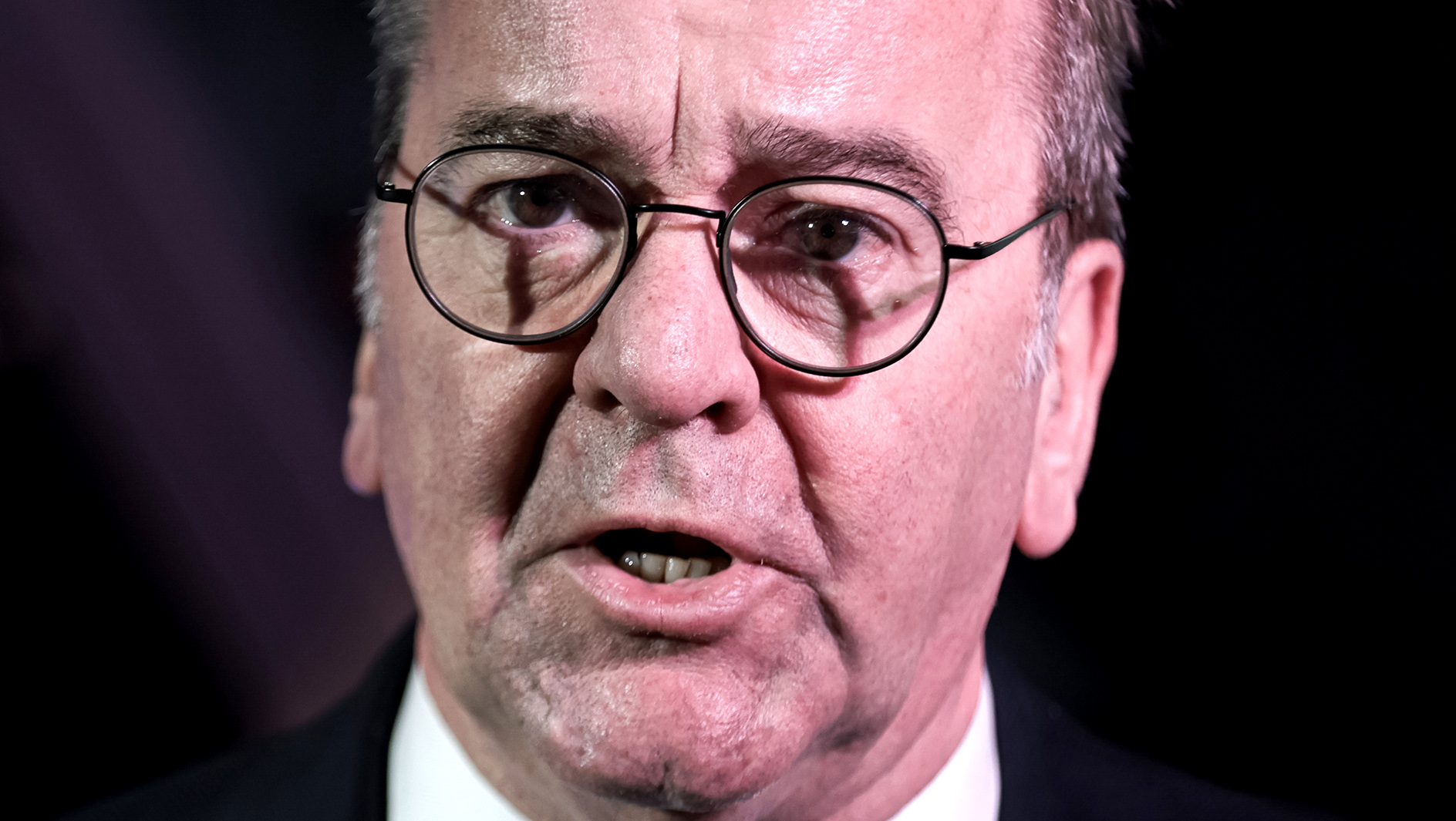
 German Defence Minister Boris Pistorius. (Photo: Leonhard Simon / Getty Images)
 Britain and its allies will not be intimidated by Russian cyberthreats into stopping support for Ukraine, British cabinet office minister Pat McFadden said on Monday.
North Korea is expanding a key weapons manufacturing complex that assembles a type of short-range missile used by Russia in Ukraine, researchers at a US-based think-tank have concluded, based on satellite images.
Europeans will ramp up support for Ukraine’s defence industry – Germany
Five European countries will step up their support to strengthen Ukraine’s defence industry as the country heads into the third winter at war, Germany’s defence minister said after meeting his French, British, Polish and Italian counterparts on Monday.
“Our target must be to enable Ukraine to act out of a position of strength,” Boris Pistorius told reporters in Berlin.
Russia will not intimidate us with cyberthreats, UK minister tells Nato
Britain and its allies will not be intimidated by Russian cyberthreats into stopping supporting Ukraine, British cabinet office minister Pat McFadden said on Monday, urging Nato to work closer together to stay ahead in “the new AI arms race”.
In the latest Western warning about Moscow stepping up cyberattacks on nations backing Ukraine, McFadden said the US-led military alliance, businesses and institutions must do “everything they can to lock their own digital doors” to protect themselves from what he called an increasingly aggressive Russia.
Addressing a Nato Cyber Defence Conference in London, McFadden called for allies to double down on their support for Kyiv against Russian President Vladimir Putin, who he said was trying “to deter our support for Ukraine with his threats”.
“We will not join those voices of weakness who want to give Putin a veto over our help for Ukraine,” McFadden said without offering details.
“While no one should underestimate the Russian aggressive and reckless cyberthreat to Nato, we will not be intimidated by it and we will never allow it to dictate our decisions or policies. And we will do everything we can to defend our countries against it.”
Moscow did not immediately comment on McFadden’s remarks. It has previously denied that it carries out cyberattacks, and officials have cast such accusations as attempts to incite anti-Russian sentiment.
McFadden said Nato needed to find ways to strengthen its collective cybersecurity, and he unveiled plans by Britain to set up a new Laboratory for AI Security Research to help create better defence tools and organise intelligence.
The laboratory, supported by an initial £8.22-million in government funding, will bring together academic and government experts to assess the impact of AI on national security and better understand its use by Russia.
“Seventy-five years after its foundation, it is clear we need Nato more than ever,” he said.
McFadden, whose role as the Chancellor of the Duchy of Lancaster includes responsibility for national security, also said he, alongside senior national security officials, would be “sitting down with British businesses to discuss how they can boost their security” in a few days.
McFadden said AI could be weaponised against countries supportive of Ukraine since Russia launched its full-scale invasion in 2022.
North Korea ‘expands plant supplying missiles used by Russia’
North Korea is expanding a key weapons manufacturing complex that assembles a type of short-range missile used by Russia in Ukraine, researchers at a US-based think tank have concluded, based on satellite images.
The facility, known as the February 11 plant, is part of the Ryongsong Machine Complex in Hamhung, North Korea’s second-largest city, on its east coast.
Sam Lair, a research associate at the James Martin Centre for Nonproliferation Studies (CNS), located at the Middlebury Institute of International Studies at Monterey, said the plant was the only one known to produce the Hwasong-11 class of solid-fuel ballistic missiles.
Ukrainian officials say these munitions – known as the KN-23 in the West - have been used by Russian forces in their assault on Ukraine.
The expansion of the complex has not been previously reported.
Both Moscow and Pyongyang have denied that North Korea has transferred weapons for Russia to use against Ukraine, which it invaded in February 2022. Russia and North Korea signed a mutual defence treaty at a summit in June and have pledged to boost their military ties.
North Korea’s mission to the United Nations did not respond to a request for comment.
The satellite images, taken in early October by the commercial satellite firm Planet Labs, show what appears to be an additional assembly building under construction as well as a new housing facility, probably intended for workers, according to the analysis by researchers at CNS.
The KN-23 was first tested in May 2019, and is designed to evade missile defences by flying on a lower, “depressed” trajectory, experts have told Reuters, making them potentially useful for Russia as it seeks ways to penetrate Ukraine’s air defences.
Russia has fired thousands of missiles since the invasion. Leaning on North Korea for additional supplies could ease the strain on its own production facilities, Lair said.
Joseph Dempsey, a military analyst with London’s International Institute for Strategic Studies, said North Korea’s expansion of short-range ballistic missile facilities would likely be motivated mainly by a desire to boost the country’s own arsenal.
He said it was unclear to what extent Pyongyang may have expanded production capacity to meet the demands of its new cooperation with Moscow.
More than 10,000 North Korean troops have been deployed to the Russian region of Kursk, where Ukraine launched a major cross-border incursion in August, according to Washington, Kyiv and Seoul.
The troops will fight as part of Russia’s airborne unit and marines, with some already participating in battles in the Ukraine war, a South Korean lawmaker who sits on the parliamentary intelligence committee said on Wednesday.
Russia has not denied the involvement of North Korean troops in the war.
Romanian far-right Nato critic set to contest presidential run-off
A hard-right critic of Nato who has praised Russia is set to face a centre-right opposition leader in a presidential election run-off in Romania that could undermine its pro-Western stance after a shock outcome in the first-round vote.
Independent hard-right politician Calin Georgescu (62) won 22.94% of votes in Sunday’s poll, the electoral authority said. Centre-right contender Elena Lasconi, leader of the opposition Save Romania Union, lay second with 19.18%.
The outcome was a huge shock, as pre-election opinion polls had made leftist Prime Minister Marcel Ciolacu the frontrunner. Ciolacu said he would resign as party leader following the result, but would remain in the role of prime minister until a parliamentary election scheduled on 1 December.
The candidate of the centre-right Liberals, Ciolacu’s coalition partner, also failed to secure a place in the election run-off, which will be held on 8 December.
Asked about the election outcome, Kremlin spokesman Dmitry Peskov said: “I would not make any predictions yet. We probably cannot say that we are that familiar with the world view of this candidate as far as relations with our country are concerned.
“For now, we understand very clearly the current leadership of Romania, which is not a friendly country to us. We will of course watch how the electoral processes develop and who wins.”
Russian drones, missiles attack Ukraine’s east, south and capital
Russian missiles damaged residential buildings in Ukraine’s eastern city of Kharkiv and Odesa in the south, and a blizzard of drones caused temporary power cuts in the Mykolaiv region and targeted Kyiv, Ukrainian officials said on Monday.
Russia, which is making territorial gains in Ukraine’s east, is conducting nightly attacks on faraway cities using missiles as well as cheaply produced “suicide” drones and low-cost “decoy” drones, which tie up Ukrainian air defences.
Of 145 drones used overnight, Ukraine shot down 71 and lost track of 71 more, likely due to electronic warfare measures used against them, the air force said.
Residents of the capital could hear the buzzing engines of attack drones flying over the city for several hours overnight. The sound of automatic gunfire erupted occasionally as air defences tried to shoot them down.
President Volodymyr Zelensky called on Kyiv’s Western allies to step up pressure to prevent the components needed for the weapons systems from reaching Russia.
“These Russian attacks on Ukrainian life can be stopped,” he said. “With pressure, sanctions, blocking the occupiers’ access to the components they use to create the tools of this terror, arms packages for Ukraine, and a resolve that must be unwavering.”
A Russian missile attack on Kharkiv injured at least 23 people and damaged more than 40 buildings on Monday morning, the regional governor and national police said.
Another missile attack on Odesa also damaged residential buildings and injured 10 people, Ukraine’s interior ministry said.
The overnight drone attack targeted energy infrastructure in the southern region of Mykolaiv, causing power cuts while industrial facilities in the southeastern Zaporizhzhia region were also struck, their authorities said on Monday.
Russia has continuously pummelled Ukraine’s power grid and infrastructure since launching its full-scale invasion in 2022. Moscow says it does not target civilians, but the UN has verified the deaths of almost 12,000 Ukrainian civilians, and officials in Kyiv say the total is likely to be much higher.
The latest Russian onslaught on energy infrastructure renewed Ukrainians’ fears of long winter blackouts, although there were no casualties or significant damage reported in either Kyiv or the surrounding region.
UK imposes biggest sanctions package on Russian ‘shadow fleet’
Britain is imposing the biggest sanctions package against Russia’s shadow fleet, targeting 30 vessels, foreign minister David Lammy said on Monday, urging G7 allies to stand with and equip Ukraine for as long as it needs.
Britain and other Western nations are keen to make sure Ukraine is in the strongest possible position to defend itself this winter.
Lammy said before a meeting of G7 foreign ministers in Fiuggi, Italy, he was sure Kyiv would get “the funds and the military equipment and kit to get through 2025”.
He told reporters Britain’s latest round of measures against Moscow represented the “biggest” package of sanctions against the Russian shadow fleet – ships which Britain says try to avoid Western restrictions on Russian oil.
“We are determined to ensure that both the ships, the enablers of those ships thwarting European and UK sanctions are hurt at this time,” he said.
Britain’s assessment was that Russian President Vladimir Putin showed “no signs at all of wanting a negotiation” to end its war with Ukraine.
Publishing details of the sanctions, Britain said the new measures would bring the number of oil tankers under UK sanctions to 73.
Britain also said two Russian insurance companies, AlfaStrakhovanie and VSK, also faced sanctions, and it would continue to challenge vessels over their insurance credentials when they passed through UK waters.
Russian man jailed for burning Qur’an sentenced in separate treason case
A Russian man serving time in prison for burning a copy of the Qur’an was found guilty by a court on Monday in a separate treason case and sentenced to 14 years in prison.
A regional court in Volgograd in southwestern Russia said it had convicted Nikita Zhuravel (20) of state treason for corresponding online with a member of the Security Service of Ukraine and for acts “directed against the security of the Russian Federation”.
Zhuravel’s case drew attention last year when Chechen leader Ramzan Kadyrov published a video showing his son Adam, then 15, beating and kicking Zhuravel while he was in prison in Chechnya awaiting trial for burning a Qur’an in Volgograd, his hometown.
Kadyrov, a close ally of Russian President Vladimir Putin, has cast himself as a staunch defender of the Islamic faith in the overwhelmingly Muslim republic, where Zhuravel was transferred after what Russian investigators said was public pressure from Chechens.
The office of Russia’s Prosecutor General said last month that Zhuravel had also been accused of sending footage of a freight train carrying warplanes, and information about the movements of a car linked to a Russian military base to a representative of Ukrainian intelligence.
Zhuravel had pleaded guilty to the crime, the court said in a statement on Telegram on Monday, adding that he had been opposed to what Moscow calls its special military operation in Ukraine. It published a video showing armed guards leading Zhuravel, with close-cropped hair and a short beard, down the courthouse staircase in handcuffs.
Zhuravel is serving a three-and-a-half-year sentence following his conviction in February under Russia’s law against offending religious believers. Investigators said he had confessed to publicly burning the Qur’an in a stunt paid for by Ukrainian intelligence.
It was not clear under what circumstances the alleged confession was made. DM