




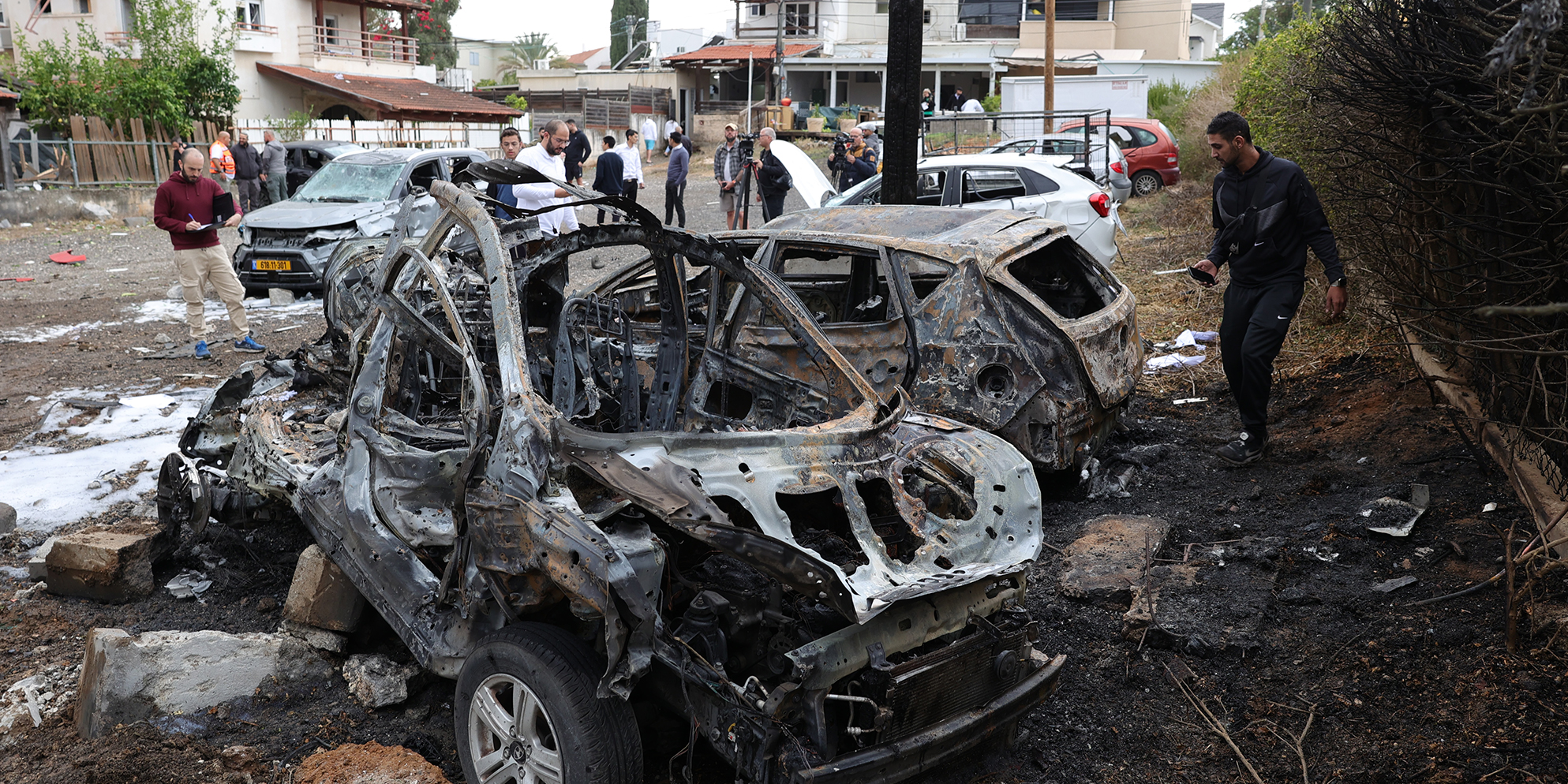
 Damaged cars after a rocket fired from Lebanon hit a residential neighbourhood in Petah Tikva, central Israel, on 24 November. (Photo: Abir Sultan / EPA-EFE)
 Lebanon’s Hezbollah movement fired heavy rocket barrages at Israel on Sunday, with Israeli media reporting that a building had been hit near Tel Aviv, after a powerful Israeli airstrike killed at least 29 people in Beirut the day before.
UAE authorities arrested three people suspected of murdering an Israeli-Moldovan rabbi in the Gulf country, said the Emirati Interior Ministry on Sunday.
Israeli army orders Gaza City suburb evacuated
The Israeli military issued new evacuation orders to residents in areas of an eastern Gaza City suburb, setting off a new wave of displacement on Sunday, and a Gaza hospital director was injured in an Israeli drone attack, said Palestinian medics.
The new orders for the Shejaia suburb posted by the Israeli army spokesperson on X on Saturday night were blamed on Palestinian militants firing rockets from that heavily built-up district in the north of the Gaza Strip.
“For your safety, you must evacuate immediately to the south,” said the military’s post. The rocket volley on Saturday was claimed by Hamas’ armed wing, which said it had targeted an Israeli army base over the border.
Footage circulated on social and Palestinian media, which Reuters could not immediately verify, showed residents leaving Shejaia on donkey carts and rickshaws, with others, including children carrying backpacks, walking.
Families living in the targeted areas began fleeing their homes after nightfall on Saturday and into Sunday’s early hours, said residents and Palestinian media — the latest in multiple waves of displacement since the war began 13 months ago.
In central Gaza, health officials said at least 10 Palestinians were killed in Israeli airstrikes on the urban camps of Al-Maghazi and Al-Bureij since Saturday night.
Adding to the miseries of Gaza’s 2.3 million people, most of whom have been repeatedly displaced, heavy winter rain flooded hundreds of tents across the enclave, spoiling food and sweeping away plastic and cloth sheeting that had protected them against the elements.
“We ran in the middle of the night, the rainwater flooded the tent, the food is gone, the kids screamed and I am afraid they will get sick,” Rami (37), a Gaza City man displaced at a former soccer stadium, told Reuters via a messaging app.
The Palestinian Civil Emergency Service said thousands of displaced people were affected by the seasonal flooding and demanded new tents and caravans from aid donors to shield them.
In north Gaza, where Israeli forces have been operating against regrouping Hamas militants since early last month, health officials said an Israeli drone dropped bombs on Kamal Adwan Hospital, injuring its director, Hussam Abu Safiya.
“This will not stop us from completing our humanitarian mission and we will continue to do this job at any cost,” said Abu Safiya in a video statement circulated by the health ministry on Sunday.
“We are being targeted daily. They targeted me a while ago but this will not deter us,” he said from his hospital bed.
Israeli forces say armed militants use civilian buildings including housing blocks, hospitals and schools for operational cover. Hamas denies this, accusing Israeli forces of indiscriminately targeting populated areas.
Kamal Adwan is one of three hospitals in north Gaza that are barely operational as the health ministry said the Israeli forces had detained and expelled medical staff and prevented emergency medical, food and fuel supplies from reaching them.
In the past few weeks, Israel said it had facilitated the delivery of medical and fuel supplies and the transfer of patients from north Gaza hospitals in collaboration with international agencies such as the World Health Organization.
Residents in three embattled north Gaza towns — Jabalia, Beit Lahiya and Beit Hanoun — said Israeli forces had blown up hundreds of houses since renewing operations in an area that Israel said months ago had been cleared of militants.
Palestinians say Israel appears determined to depopulate the area permanently to create a buffer zone along the northern edge of Gaza, an accusation Israel denies.
Israel’s campaign in Gaza has killed more than 44,000 people and uprooted nearly the entire population at least once, according to Gaza officials, while reducing wide swathes of the narrow coastal territory to rubble.
The war erupted in response to a cross-border attack by Hamas-led militants on 7 October 2023 in which gunmen killed around 1,200 people and took more than 250 hostages back to Gaza, according to Israeli tallies.
Hezbollah rocket lands near Tel Aviv after big Israeli strike on Beirut
Lebanon’s Hezbollah movement fired heavy rocket barrages at Israel on Sunday, with Israeli media reporting that a building had been hit near Tel Aviv, after a powerful Israeli airstrike killed at least 29 people in Beirut the day before.
Israel also struck Beirut’s Hezbollah-controlled southern suburbs, where intensified bombardment over the past two weeks has coincided with signs of progress in US-led ceasefire talks.
Hezbollah, which has previously vowed to respond to attacks on Beirut by targeting Tel Aviv, said it had launched precision missiles at two military sites in Tel Aviv and nearby.
Police said there were multiple impact sites in the area of Petah Tikvah, on the eastern side of Tel Aviv, and that several people had minor injuries. Television footage showed an apartment damaged by rocket fire in Petah Tikvah, and video from the medical service MDA showed cars burning.
The Israeli military (IDF) said Hezbollah had fired 170 rockets at Israel on Sunday, of which many were intercepted. At least four people had been injured by shrapnel.
Video obtained by Reuters showed a projectile exploding as it smashed into the roof of a building in the northern Israeli city of Nahariya.
The Israeli military warned on social media that it planned to target Hezbollah facilities in southern Beirut before strikes which security sources in Lebanon said demolished two apartment blocks. Afterwards, the IDF said it had hit command centres “deliberately embedded between civilian buildings”.
On Saturday, it had carried out one of its deadliest and most powerful strikes on the centre of Beirut.
Lebanon’s health ministry on Sunday raised the death toll from 20 to 29. It said 84 people had been killed in all on Saturday, taking the death toll to 3,754 since October 2023.
The IDF did not comment on Saturday’s strike in the capital or say what it had attacked.
Israel went on the offensive against the Iran-backed Hezbollah in September, pounding the south, the Bekaa Valley and Beirut’s southern suburbs with airstrikes after nearly a year of hostilities ignited by the Gaza war.
The Israeli offensive has uprooted more than one million people in Lebanon.
Israel says it aims to secure the return home of tens of thousands of people evacuated from its north due to rocket attacks by Hezbollah, which opened fire in support of Hamas at the start of the Gaza war in October 2023.
US mediator Amos Hochstein highlighted progress in negotiations during a visit to Beirut last week, before travelling to meet Israeli Prime Minister Benjamin Netanyahu and Defence Minister Israel Katz, and then returning to Washington.
European Union foreign policy chief Josep Borrell said on Sunday a US ceasefire proposal was awaiting final approval from Israel.
Diplomacy has focused on restoring a ceasefire based on UN Security Council Resolution 1701, which ended a 2006 Hezbollah-Israel war. It requires Hezbollah to pull its fighters back around 30km from the Israeli border, and the Lebanese army to deploy in the buffer zone.
The Lebanese army said on Sunday at least one soldier had been killed and 18 more injured in an Israeli strike that caused severe damage at an army centre in Al-Amiriya near the southern city of Tyre.
The Israeli military said it regretted and was investigating the incident, and that it was fighting against Hezbollah, not the Lebanese army.
Iran preparing to ‘respond’ to Israel, says adviser to Supreme Leader
Iran was preparing to “respond” to Israel, said Ali Larijani, a senior adviser to the country’s Supreme Leader, in an interview published by Iran’s Tasnim news agency on Sunday.
On 26 October, Israeli fighter jets carried out three waves of attacks on Iranian military targets, a few weeks after Iran fired a barrage of about 200 ballistic missiles against Israel. Iran has previously vowed to respond to Israel’s attacks.
UAE arrests three suspects in killing of Israeli rabbi
UAE authorities arrested three people suspected of murdering an Israeli-Moldovan rabbi in the Gulf country, said the Emirati Interior Ministry on Sunday.
A ministry statement did not give further details on the suspects, but said the ministry would use “all legal powers to respond decisively and without leniency to any actions or attempts that threaten societal stability”.
Prime Minister Benjamin Netanyahu’s office earlier on Sunday denounced the killing of the rabbi, Zvi Kogan, as a “heinous anti-Semitic terrorist act”, adding Israel would do everything it could to bring those responsible to justice.
Kogan, who worked in the UAE for the Orthodox Jewish group Chabad, which seeks to support Jewish life for thousands of Jewish visitors and residents in the Gulf Arab state, vanished in Dubai on Thursday. His body was found on Sunday.
Kogan had entered the UAE on his Moldovan passport and was a resident there, said the UAE statement, which was published by the state news agency.
Kogan’s body was found in the Emirati city of Al Ain, which borders Oman, though it is not clear if he was killed there or elsewhere, former Israeli Druze politician Ayoob Kara told Reuters in Dubai.
Kara said he was waiting for the UAE to finish an investigation, but blamed Iran for the murder.
Gunman shot dead, three police wounded near Israeli embassy in Jordan
A gunman was dead and three Jordanian policemen injured after a shooting near the heavily fortified Israeli embassy in the capital, Amman, in Sunday’s early hours, said a security source and state media.
Police shot a gunman who had fired at a police patrol in the affluent Rabiah neighbourhood of the Jordanian capital, reported the state news agency Petra, citing public security, adding investigations were ongoing.
The gunman, who was carrying an automatic weapon, was chased for at least an hour before he was cornered and killed just before dawn, according to a security source.
Jordan’s communications minister, Mohamed Momani, described the shooting as a terrorist attack that targeted public security forces in the country. He said in a statement that investigations into the incident were under way.
Legal threats close in on Netanyahu
Prime Minister Benjamin Netanyahu faces legal perils at home and abroad that point to a turbulent future for the Israeli leader and could influence the wars in Gaza and Lebanon, analysts and officials say.
The International Criminal Court (ICC) stunned Israel on Thursday by issuing arrest warrants for Netanyahu and his former defence chief Yoav Gallant for alleged war crimes and crimes against humanity in the 13-month-old Gaza conflict.
The bombshell came less than two weeks before Netanyahu is due to testify in a corruption trial that has dogged him for years and could end his political career if he is found guilty. He has denied any wrongdoing.
While the domestic bribery trial has polarised public opinion, the prime minister has received widespread support from across the political spectrum following the ICC move, giving him a boost in troubled times.
Netanyahu has denounced the court’s decision as anti-Semitic and denied charges that he and Gallant targeted Gazan civilians and deliberately starved them.
“Israelis get really annoyed if they think the world is against them and rally around their leader, even if he has faced a lot of criticism,” said Yonatan Freeman, an international relations expert at the Hebrew University of Jerusalem.
“So anyone expecting that the ICC ruling will end this government, and what they see as a flawed [war] policy, is going to get the opposite,” he added.
A senior diplomat said one initial consequence was that Israel might be less likely to reach a rapid ceasefire with Hezbollah in Lebanon or secure a deal to bring back hostages still held by Hamas in Gaza.
“This terrible decision has ... badly harmed the chances of a deal in Lebanon and future negotiations on the issue of the hostages," said Ofir Akunis, Israel’s consul general in New York.
“Terrible damage has been done because these organisations like Hezbollah and Hamas ... have received backing from the ICC and thus they are likely to make the price higher because they have the support of the ICC,” he told Reuters.
While Hamas welcomed the ICC decision, there has been no indication that either it or Hezbollah see this as a chance to put pressure on Israel, which has inflicted huge losses on both groups over the past year, as well as on civilian populations.
The ICC warrants highlight the disconnect between the way the war is viewed here and how it is seen by many abroad, with Israelis focused on their losses and convinced the nation’s army has sought to minimise civilian casualties.
Michael Oren, a former Israeli ambassador to the US, said the ICC move was likely to harden resolve and give the war Cabinet licence to hit Gaza and Lebanon harder still.
“There’s a strong strand of Israeli feeling that runs deep, which says ‘if we’re being condemned for what we are doing, we might just as well go full gas’,” he told Reuters.
While Netanyahu has received wide support at home over the ICC action, the same is not true of the domestic graft case, where he is accused of bribery, breach of trust and fraud.
The trial opened in 2020 and Netanyahu is finally scheduled to take the stand next month after the court rejected his latest request to delay testimony on the grounds that he had been too busy overseeing the war to prepare his defence.
He was due to give evidence last year, but the date was put back because of the war. His critics have accused him of prolonging the Gaza conflict to delay judgment day and remain in power, which he denies.
Netanyahu condemns settler violence on IDF in West Bank
Netanyahu condemned on Sunday Jewish settlers who attacked senior Israeli military officers including Major General Avi Bluth, the head of the army’s Central Command in the occupied West Bank.
The Israeli army said that a group of settlers trailed Bluth and other officers in the West Bank city of Hebron on Friday, blocked their exit and hurled abuse at them. It added that five rioters had been arrested.
“All violence directed against IDF officers and soldiers must be dealt with to the fullest extent of the law,” said the prime minister’s office.
Some of the crowd yelled “traitor” at Bluth, who had visited Hebron to attend an annual religious event in the city.
On Saturday, dozens of settlers, some masked, hurled stones at Israeli troops and border police near the West Bank settlement of Itamar, said police.
There has been a general surge in violence across the West Bank since the 7 October 2023 attack by Hamas militants on southern Israel, which triggered Israel’s war against Hamas in Gaza and a wider conflict on several fronts.
Palestinians have been repeatedly targeted by settlers, who want Israel to annex the West Bank. The Israeli military is meant to protect the local Palestinians, but Bluth acknowledged in August that the army had failed to safeguard civilians when settlers went on the rampage in one town.
Palestinians say they are often left to the mercy of the settlers, with soldiers doing little or nothing to rein them in.
Some settler youth groups reject the jurisdiction of the Israeli military in areas that they see as under their control, and have attacked Israeli forces. DM
Read more: Middle East crisis news hub