




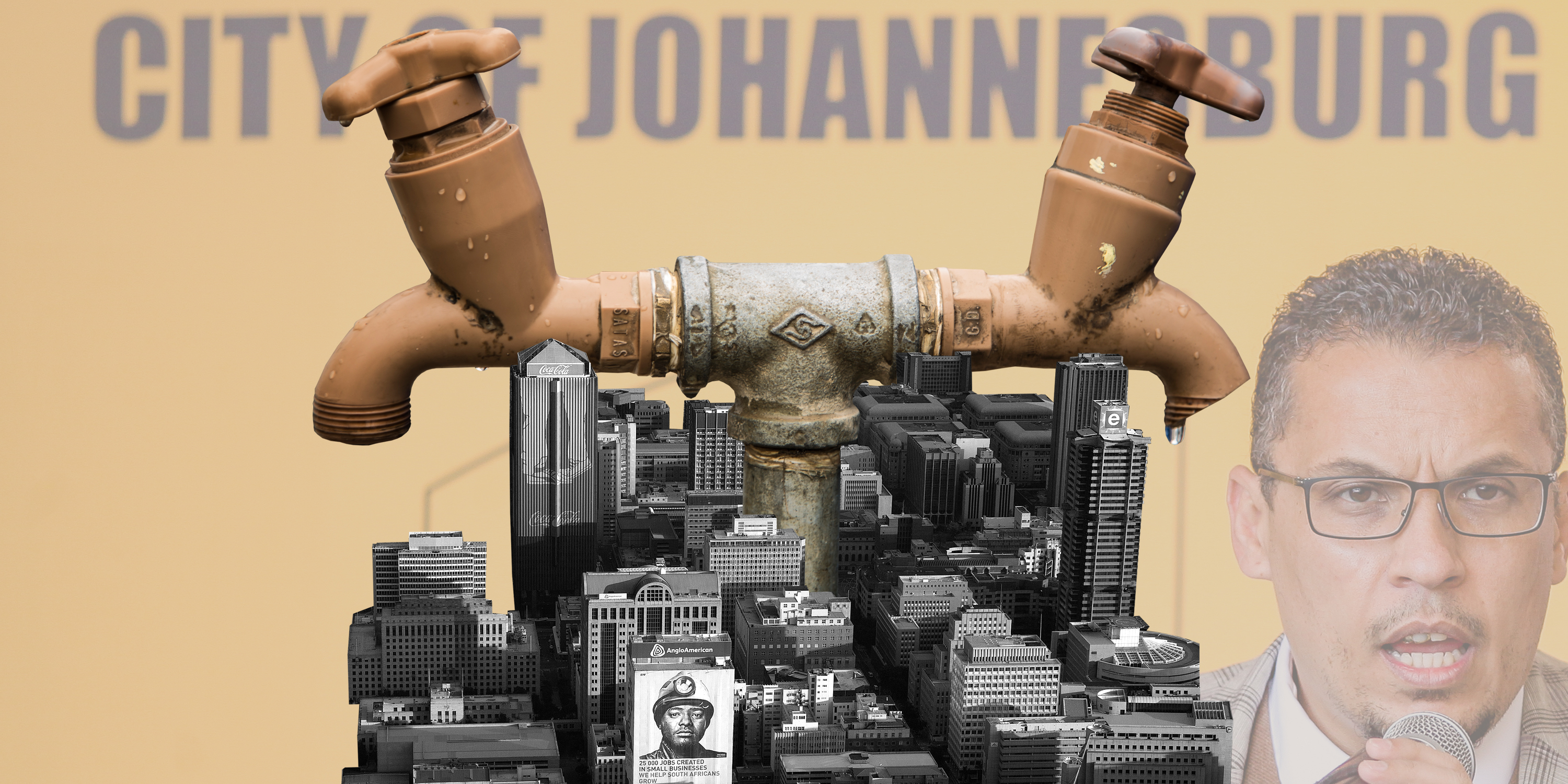
 Aerial view of Johannesburg. (Photo: Dean Hutton / Bloomberg via Getty Images) | Water taps. (Photo: Leila Dougan) | City Manager Floyd Brink. (Photo: Sharon Seretio / Gallo Images)
 A seven-page letter from Johannesburg Water to city manager Floyd Brink on 14 October reveals that water throttling and pressure controls (which slow water to a trickle) are being introduced as the city’s water crisis deepens.
On Monday, the Constitutional Court said it had been unable to conduct physical or in-court cases because of unreliable water supply.
Daily Maverick’s data investigation of Johannesburg Water’s social media reports and residents’ posts has found that thousands of water cuts a month are the norm in the city as the water system reaches the end of its lifespan.
Capital expenditure has given way to consumption spending, so maintenance budgets have been slashed while sufficient new infrastructure has not been built since 1994.
In the past week, the water systems in Midrand and Sandton have been down, along with areas in the southwest of the city, like Coronationville, where the supply is more often off than on, according to daily reports from the community.
Johannesburg Water’s letter to Brink shows how Level 2 and Level 3 restrictions are being introduced, as was announced by Deputy President Paul Mashatile in Parliament on 31 October. According to the letter, higher levels can also include punitive tariffs.
The Office of the Chief Justice said that while the Constitutional Court “has a water tank installed for ablution facilities, this backup water supply lasts for only one working day, and the city is unable to refill it promptly on a daily basis to allow court operations to continue uninterrupted”.
In Johannesburg, residents report that a throttled water supply and night switch-offs are already happening. Johannesburg Water’s letter says the city has 685 pressure-reducing valves, but only 56% are fully functional. It plans to have 80% repaired by next month.
“As of October 2024, we have started repairs and maintenance,” according to the letter. “The focus is on areas with high water losses, and once complete, the pressure will be reduced by one bar below normal. This will result in the immediate reduction of operating pressure, automatically reducing leaks and water lost.”
In 2023/24, the city classified 46.2% of the water supply as “non-revenue”, meaning it is lost to leaks or not paid for.
As the executive manager of WaterCAN, Dr Ferrial Adam, told Daily Maverick, half of Johannesburg’s reservoirs leak, so the water supply will increasingly be switched off at night. The three Gauteng metros all suffer water shortages and interruptions as decades of under-investment in capex come home to roost. (For more about the national plan for Gauteng, see Julia Evans’ report here.)
“Reduction of minimum night flows through advanced pressure management systems has been identified to save 5.9 kilolitres a year,” according to Johannesburg Water’s letter.
“The main purpose of the smart controllers is to reduce pressure at night when demand is low and increase pressure back to normal in the morning for day demand. In areas where we have installed this system, we have noticed a drop in the number of water leaks and a reduction in water losses.”
Old pipes dying
Johannesburg’s water pipes and reservoirs are old and dying from decades of neglect. Johannesburg Water says that since 2016, it has replaced 430km of pipes (a tiny fraction of the overhaul needed). In 2023/24, it has only managed to replace 4.13km of its targeted 15.6km.
In its turnaround strategy, Johannesburg Water blames the maintenance problems on how the city bills and transfers payments to the entity. When he was finance MMC, Joburg’s current mayor, Dada Morero, did not put a gloss on things.
“We are required to inform the entire Joburg family that we need a minimum of R4.3-billion per month to fund the city’s operations and deliver services so we can survive as the people of Johannesburg. Unfortunately, there is no R4.3-billion to survive,” he said. That was in 2023; the city’s finances have deteriorated since then.
On 31 October, Mashatile said the national government wanted the Gauteng metros to introduce water restrictions at levels 2 and 3. At present, they are at Level 1.
What does this mean for you?
Johannesburg Water’s MD, Ntshavheni Mukwevho, set it out in the letter:
- At Level 1, the supply is reduced by 15%.
- At Level 2, the supply is reduced by 22%,
- At Level 3, the supply is reduced by 46%.
- Level 4 is an emergency with no water supply when the Integrated Vaal River System falls below 20%.
The World Bank, with the national government, is stepping in with a massive public education water-saving drive like the 2018 Day Zero campaign in Cape Town.
On 31 October, Morero said Johannesburg was not in danger of Day Zero but that the city’s water supply was tenuous.
“Johannesburg Water must strike a difficult balancing act to handle water consumption that is outpacing supply caused mainly by uncertainty surrounding future population, water and infrastructure demand and budget constraints,” he said. “These place immense strain on our bulk water system and jeopardise the sustainability of the water supply.”
He said Johannesburg Water had a new infrastructure backlog of R28-billion.
The chart from the Gauteng Water Security Dashboard shows that water consumption levels in Johannesburg are way above target and that the Integrated Vaal River System, which supplies Gauteng, is reaching the red zone. This explains why Level 2 and 3 restrictions are likely to be formally announced but are being implemented across many areas.

Water interruptions make life hard.
For two years, Daily Maverick has tracked reader responses to water cuts using our audience engagement method.
What’s clear is that water interruptions are the new load shedding and an increasing number of communities across South Africa are reporting outages and unstable supplies. Many respondents highlighted the physical burden of carrying heavy water containers, especially for older people, and the expense entailed in driving to other areas to access water.
A recurring theme was the financial strain of buying bottled water or installing JoJo tanks, boreholes and other infrastructure, reflecting a shift from municipal reliance to self-funded water solutions.
Respondents frequently mentioned disruptions to daily routines — like doing the laundry less frequently and taking fewer showers — as a direct result of water shortages. Many respondents expressed frustration and even hopelessness, with some mentioning stress caused by uncertainty over the water supply and disappointment at local authorities’ lack of response.
In Gauteng, respondents reported high levels of stress from the frequent and unpredictable nature of outages and noted the physical strain of handling large water containers. They expressed frustration at municipal delays in addressing leaks and restoring the water supply.
In the Western Cape, respondents felt somewhat prepared due to experience but still faced routine disruptions and complained about municipal management, especially with ongoing infrastructure issues and maintenance delays.
In KwaZulu-Natal and North West, respondents described considerable strain, with some regions facing multiday water outages. The lack of response from authorities to reported issues compounded the problem.
How residents of different provinces get around water shortages
Gauteng: Water tanks such as JoJo are widely utilised. Many respondents store thousands of litres to cope with frequent outages. Borehole installations are also standard, showing significant investments to maintain a reliable water supply.
Western Cape: Respondents, familiar with water conservation efforts since Cape Town’s Day Zero crisis, extensively use rainwater and JoJo tanks. They highlighted a cultural shift toward conservative water use, with long-term storage solutions frequently in place.
KwaZulu-Natal and Eastern Cape: Tanks and rainwater systems are often used, but boreholes were mentioned less frequently, probably because of accessibility challenges or resource constraints.
Growing reliance on shared boreholes and water tankers
Gauteng: Respondents frequently rely on swimming pool water and bottled water for non-drinking purposes. Boreholes and backup water tanks are especially popular in suburban and rural areas.
Western Cape: Coastal areas, including Cape Town, are highly dependent on bottled water and occasional municipal tanker supplies, as well as collecting water from natural springs.
KwaZulu-Natal and Limpopo: Respondents with access to boreholes share water with neighbours, showcasing community reliance. Those without boreholes or water tanks sometimes drive to unaffected areas or rely on municipal tankers.
Conservation and reuse
Cape Town and surrounding areas: Because of previous water crises, Western Cape residents are proactive in conservation strategies, including using greywater for flushing toilets, restricting garden watering and collecting rainwater.
Gauteng and KwaZulu-Natal: Residents conserve water by doing the laundry less frequently, reducing dishwashing and only flushing toilets when necessary. Swimming pools are repurposed for non-drinking uses and people buy large amounts of bottled water for drinking.
Free State and Eastern Cape: Water conservation practices include storing water in large containers and minimising household water use, especially during critical shortages.
How to be an active water citizen
Gauteng and Western Cape: These provinces show active community engagement, with residents regularly reporting leaks and outages to authorities, though responses are often slow — some advocate for increased government accountability, reflecting demand for infrastructural improvements.
Eastern Cape and KwaZulu-Natal: Community solidarity is strong here, with neighbours often sharing resources, such as borehole water or JoJo tank reserves. Some residents band together to lobby local authorities for improved water services and quicker maintenance response times.
Q&A with Johannesburg Water spokesperson Nombuso Shabalala
Question: In a letter to the city on 14 October, Johannesburg Water MD Ntshavheni Mukwevho sets out the emergency plans for Johannesburg Water. He speaks of the use of pressure-reducing valves. Please can you explain how these work and how they impact users? Will there be low pressure?
Answer: Pressure-reducing valves (PRVs) are intricate components of the water supply system. The PRVs are installed in line with the pipeline and regulate downstream pressures (for lower-lying areas) and upstream pressures (for higher-lying areas). In simple terms, water is controlled/affected/moved by gravity. Therefore, upstream flow pressure would need to be higher than downstream flow.
Furthermore, pressure is a vital parameter to regulate in pipe systems to ensure sufficient supply over long distances through varying-diameter pipes. On the other hand, it assists in controlling pressure, leading to a reduction in physical water losses, especially in aged infrastructure.
Q: Mr Mukwevho also writes about reducing minimum night flows. Please can you explain how these work and whether they impact users? Is this what is called throttling?
A: Minimum night flow is based on the concept/idea that there is less human activity during late night hours and early morning hours, meaning that people/customers/businesses use less water overnight.
Reducing minimum night flows through advanced pressure management systems has been identified as having a potential savings of 5,918,000 kilolitres per annum. This is done through smart pressure controllers.
The primary purpose of smart pressure controllers is to reduce pressure at night when the demand is low and increase pressure back to normal in the morning for the day’s demand. This can be likened to throttling (which is reduced pressure).
In areas where Johannesburg Water has installed this system, the entity has noticed a drop in the number of water leaks and, thus, a reduction in water losses.
*Daily Maverick used ChatGPT to summarise and categorise reader reports. DM