




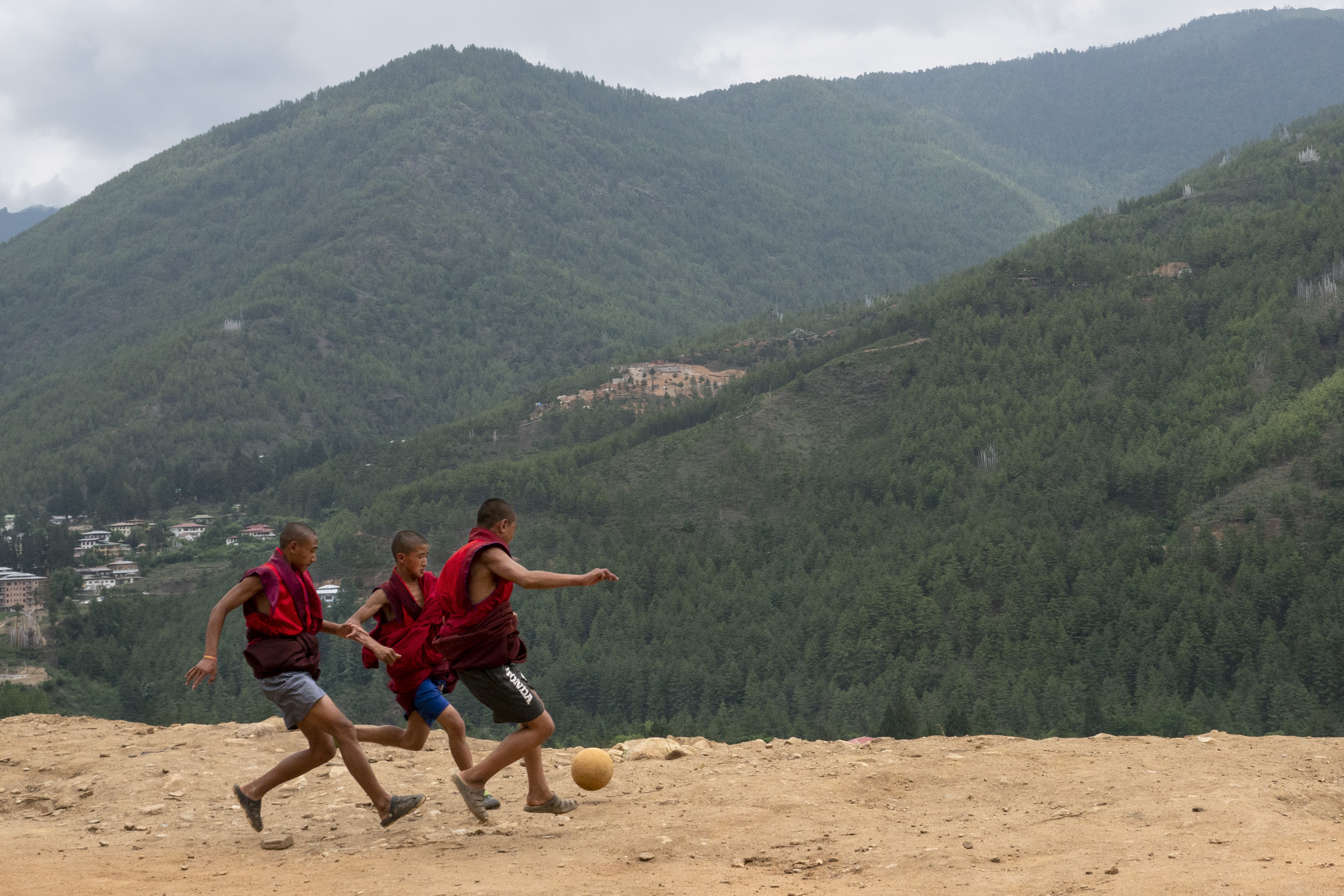
 Bhutanese monks play soccer during their free time at the Dechen Phodrang monastery on June 14, 2018, in Thimphu, Bhutan. Around 250 monks reside at the government run monastery that also doubles as a child care facility for under privileged and orphaned males. The monks average about 10 hours of study a day waking up at 5:00am. Mahayana Buddhism is the state religion. Bhutan is no ordinary place, it is known an open democratic society. Bhutanese society is free of class or a caste system, the country has a very young population: more than half of the population is below the age of 25 years. Perhaps the last great Himalayan kingdom, where a traditional Buddhist culture carefully embraces global developments. The youth in Bhutan today live in a world very different from that known by their parents. Globalization, urbanization and new modes of mass and interpersonal communication have rapidly and radically changed the way young people interact with each other, with their families and with society as a whole. (Photo by Paula Bronstein/Getty Images for Lumix)
The "Gelephu Mindfulness City" (GMC) will lie in a special administrative region with separate rules and laws that will aim to be an economic corridor linking South Asia to Southeast Asia, officials said.
The city will promote walking and cycling to reduce emissions, green spaces for meditation and relaxation, mindfulness-based education, public community activities, healthcare and wellness centres, and eco-tourism.
GMC will be spread over an area of more than 2,500 sq km (965 sq miles) on the border with giant neighbour India and offer space to businesses in finance, tourism, green energy, technology, healthcare, agriculture, aviation, logistics, education and spirituality.
A Bhutanese sovereign development body announced on Monday the launch of a fixed-term deposit programme to raise funds from non-resident Bhutanese to help build an international airport and other foundational infrastructure in GMC.
"This is more than a financial opportunity; it is a call to contribute to and actively shape our shared vision for a thriving, mindful, and resilient Bhutan," Ujjwal Dahal, CEO of sovereign body Gelephu Investment and Development Corporation, said in a statement.
The GMC website last week said it was launching a 10-year "Nation Building Bond" to raise $100 million. But GMC officials told Reuters on Monday that there was no bond issuance to private individuals nor was there a set fund-raising target for the entire exercise, without elaborating.
GMC's goal is to attract investment, develop skills and create jobs in the Buddhist-majority country known for its Gross National Happiness (GNH) index - an economic gauge that counts factors ignored by gross domestic product measures, such as recreation, emotional well-being and the environment.
A country of less than 800,000 people wedged between Asian giants India and China, Bhutan has been struggling to boost its $3 billion economy which is heavily reliant on aid, hydropower and tourism, and was badly hit by COVID-19 restrictions.
Employment woes, with youth unemployment touching nearly 30% in 2022, triggered an exodus of young people seeking opportunities abroad, with thousands moving to Australia alone.
DECADES LONG PROJECT
GMC will be built in phases and is expected to be completed in 21 years, officials said, with private partners investing in roads, bridges, an airport, houses, schools, hospitals and businesses.
Authorities expect about 150,000 people to live there in the first 7-10 years and more than one million when it is complete.
The brainchild of King Jigme Khesar Namgyal Wangchuck, GMC was proposed last year as a city that would encompass "conscious and sustainable businesses, inspired by Buddhist spiritual heritage" and anchored on the values of GNH.
"Mindfulness is at the core of our values-based city and aligns with the ethos and identity of our nation," said Rabsel Dorji, a senior GMC official.
The GMC website says the project is based on Bhutan’s Buddhist heritage and culture, its stress on happiness, well-being and mindfulness. It also incorporates eco-friendly architecture in what is the world's first carbon-negative country - one that absorbs more carbon than it produces.
India, Bhutan’s biggest economic and trade partner as well as donor, is supportive of the project and would extend its roads and railway network to the border to connect GMC, officials said.
GMC is a "smart move" but connectivity could pose a serious challenge to landlocked Bhutan, said Surya Raj Acharya, an infrastructure and urban planning expert in neighbouring Nepal.
"Developing the city as a competitive production hub also depends on connectivity to global logistics," Acharya said, adding that access to ports will depend on Indian infrastructure.
"It should also be attractive to international investors. These are factors not under Bhutan’s control," he said.
(Reporting by Gopal Sharma in Kathmandu; Additional reporting and writing by YP Rajesh in New Delhi, editing by Ed Osmond)
Comments
Scroll down to load comments...