




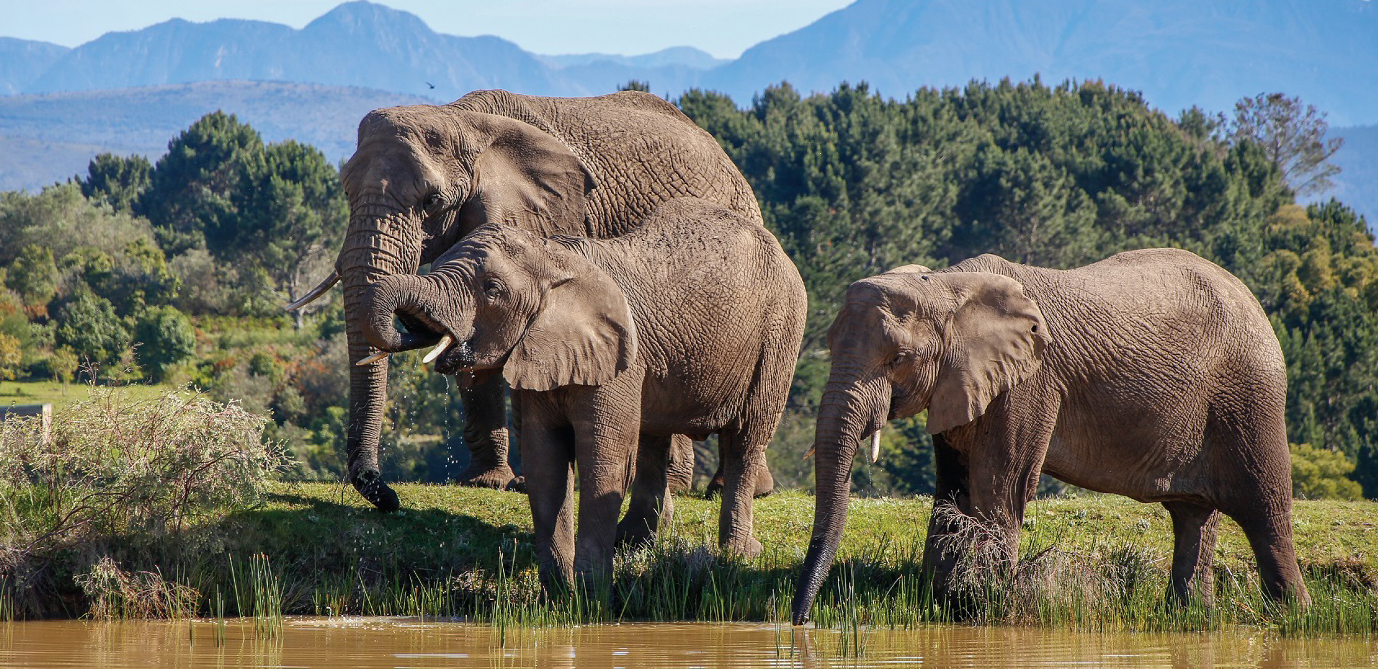
 The Knysna Elephant Park. (Photo: Wikipedia)
 ‘Old foot has his own laws. Forest law. “The same law that makes the day break, that keeps the Seven-star on its course, that makes the moon obey its phases, that decides the path of the sun in winter and in summer, that sends the rain... from the forest floor to the top of the highest tree, this law pulsates through everything like the rhythmical breathing of an almighty Being” – Dalene Matthee, Circles in the Forest, 1985 Wandering among the Afromontane forest and fynbos in the Garden Route National Park’s Knysna forest, is Strangefoot. Her name, given by rangers, comes from her unusually large and wide footprint. Now 50 years old, she’s believed to be the only surviving native Knysna elephant in the forest. She carries the weight of a dwindling legacy – one that conservationists are fiercely debating whether to save or leave alone. The Knysna forest, part of the Garden Route National Park, was once home to 1,000 elephants that historically roamed between Afromontane forest and fynbos in the Outeniqua-Tsitsikamma area. The San people, the original human inhabitants of the southern Cape, were the first people to chronicle elephants' presence in the forest, and often depicted them in their rock art. By the late 1700s European settlers had arrived, and elephants began to retreat due to hunting. The conflict between humans and elephants intensified during the mid-1800s, decimating their numbers further. Today, Strangefoot is the only elephant consistently tracked in the region by South African National Parks (SANParks).The search for evidence
For years, speculation about how many Knysna elephants remained swirled. In 2007, a genetic study by Lori Eggert, Gareth Patterson and Jesús Maldonado, which used faecal DNA, estimated that there were five elephants remaining, but various people came up with different numbers, and ecologist Lizette Moolman noted that genetic sampling with dung can lead to errors, sometimes creating the illusion of elephants that don’t exist. Dr Alida De Flamingh, an evolutionary biologist from the University of Illinois, arrived in the Knysna forest last week to try to understand the historical populations more. She is studying historical specimens such as the elephant in the Diepwalle Forest Legends Museum. Asked about the errors associated with genetic sampling with dung, De Flamingh explained that genetic sampling of high-quality DNA (blood and tissue) is very reliable even for small populations or single individuals and is often used in forensic sciences, but because getting blood or tissue wasn’t possible when Eggert and Patterson did the Knysna elephant census, they had to use dung DNA which, which is prone to errors. SANParks ecologist Lizette Moolman (right) has been working with field ranger Karel Maswati since 2007. (Photo: Julia Evans)
 SANParks ecologist Lizette Moolman checks the camera batteries and swaps the SD card in one of SANParks’ remote camera traps, which it uses to monitor the last remaining Knysna elephant in the Garden Route National Park’s forest. The cameras capture the elephant on average every three weeks. (Photo: Julia Evans)
Karel Maswati, who has been a SANParks field ranger in the Knysna forest for 34 years and has spent his life watching Strangefoot from a distance, told Daily Maverick he hasn’t seen evidence of more than one elephant in the forest in more than two decades. “When I see her, it feels special,” he said. “Because I don’t think there’s going to be any more.” Moolman said that when she started the project she hoped there would be five elephants, but “it was only when I got into the field and listened to Karel and Wilfred [SANparks field rangers] and did that camera trap study that [we found evidence of one remaining elephant]”. In 2014, SANParks launched a more comprehensive scientific study. Led by Moolman, they installed a network of remote camera traps across the Knysna forest to gather data. Between 2016 and 2018, more than 80 cameras were set up across the elephants' historical range, a stretch of about 180km2 between Knysna and George. “Unfortunately our biggest fears came true, and we only consistently trapped one elephant,” she said. That scientific study was published in 2019, and peer reviewed, confirming what many feared. Since the camera trap survey concluded in 2018 SANParks has kept some camera stations active in the elephant range, and has only consistently trapped one in the past seven years – Strangefoot – who they see every three weeks on average. Can more elephants survive in the forest?
“The next question that you probably have is: how is it that you’ve known this for eight years and you haven't done anything?” said Moolman. “It’s not that simple,” she said, explaining that the area is highly fragmented owing to historical farming and commercial plantations, with patches of public roads and highways cutting through the elephant’s range. The Garden Route National Park is also an open-access park, so it’s not fenced, making it difficult to introduce more elephants without risk to nearby communities. “There’s debate about whether the forest can sustain elephants,” Moolman said. “Some believe that if the habitat can’t provide enough nutrition, then bringing in more elephants could lead to further challenges.” However, she pointed out that this research is outdated, and it’s a misconception that Knysna elephants lived solely in the forest, while in reality Strangefoot and her ancestors moved between the forest and the fynbos. Read more: Filmmaker captures breathtaking images of Knysna forest’s elusive elephant cow Ecological studies on Strangefoot’s stress hormone levels, measured from her dung, show her endocrine system is functioning well. When she’s in areas with low human activity, her stress levels are low, but when followed by humans, her stress spikes. To determine whether reintroducing more elephants is feasible, SANParks is hosting workshops to assess habitat suitability, human-elephant conflict potential, and logistical challenges. SANParks ecologist Lizette Moolman with field rangers Wilfred Oraai and Karel Maswati pass a newly set up camera trap to test if the camera angle and height are right for picking up animals, such as the elusive Knysna elephant, on 14 July 2016. (Photo: SANParks)
 Lizette Moolman laughs at a story one of the rangers is telling about field ranger Karel Maswati, whom they call Oom Karel, in the Knysna forest on 21 October 2016. (Photo: SANParks)
The debate: to reintroduce or leave her be
Strangefoot’s solitary existence poses a dilemma for conservationists. Some argue that she should be left alone, while others believe that bringing in more elephants could help preserve her genetic lineage and that leaving a social animal by herself is cruel.The 1994 experiment
This isn’t the first time SANParks has faced this dilemma. In 1994, after years of research, it introduced three orphaned elephants (aged seven to nine years) from the Kruger National Park into the Knysna forest, hoping they would integrate with the local population. But the experiment failed. One elephant died shortly after release due to stress-related pneumonia, while the other two eventually wandered to nearby farmlands, causing damage and conflict with local communities. Five years later the two surviving elephants were relocated to a private reserve. “If we are to reintroduce elephants again, we need to learn from our mistakes,” reflected Moolman. To do this, SANParks would need to secure buy-in from the community. “That [1994] decision was made by outside campaigners and that is exactly what we don’t want to happen right now.” Moolman said they need to find out, through community engagement and risk assessments, if communities and farmers can handle the reintroduction of elephants long-term, which they committed to finishing at the end of 2025. “The biggest question is: Is this socially acceptable for people? Can they live with elephants?” Lizette Moolman and field ranger Karel Maswati retrieve the footage from one of SANParks’ remote camera traps. (Photo: Julia Evans)
 Lizette Moolman has been working with field ranger Karel Maswati since 2007. (Photo: Julia Evans)
What the locals want
SANParks recently conducted a survey that received a 74% response rate from 500 residents, revealing strong support for reintroducing elephants to the Garden Route, with participants stressing the need for expert guidance due to the complexities of the situation. However, SANParks noted a concerning lack of awareness about elephant coexistence among locals, with many unfamiliar with managing potential interactions. This is particularly concerning considering new elephants introduced may not display the evasive behaviour of the lone Knysna elephant. To address these challenges, SANParks plans to host a specialist workshop to discuss risks and benefits with affected communities. Another interesting result from the survey was that locals valued elephants in this area mostly for ecological, cultural and historical values, not for commercial values, noted Moolman. “People felt that these Knysna elephants are so iconic and historic and cultural, that they did not want them to be tainted by commercial endeavours,” she said. One of the remote camera traps set up in the Knysna forest. The cameras are active 24/7 and emit an infrared beam the whole time. When an animal, car or person enters the camera scan zone (from 25m away) and breaks the beam, the camera is triggered to take a photo. It continues taking pictures until whatever triggered it moves out of sight. (Photo: Julia Evans)
Two paths forward
There are two paths for SANParks to consider now that a lone elephant has been confirmed in the area, but as JP Louw, head of SANParks, said: “Fundamentally, there’s no option without a risk.” SANParks said these two options will undergo risk analysis involving a diverse group of specialists, including veterinarians, elephant biologists and wildlife area managers experienced in human-elephant conflict.1 Leave her be
- Risks:Doing nothing risks losing an umbrella species critical for conservation. Strangefoot’s presence holds historical value, and her range provides protected zones that justify conservation efforts;
- There’s also a risk of losing her unique survival knowledge. As Moolman noted, she’s the only elephant familiar with navigating the specific terrain of forest and fynbos – a skill not shared by other populations in South Africa;
- Is it better to leave her on her own? Female elephants typically live in family groups, which raises concerns about her solitary existence. However, SANParks’ study found that her stress hormones fluctuate, indicating that there are places where she’s fairly relaxed. “If she was so lonely to the point where she couldn’t live with it, she probably would have been under chronic stress and not alive today,” said Moolman. “So the question is: Do you leave her where she has somehow become used to it, or you do something and you don’t think it through well enough [and] it doesn’t work?”
2 Reintroduce other elephants
- Ecological benefit: The most immediate advantage of reintroduction is preventing local extinction and restoring their role in influencing biodiversity within the forest and fynbos (although Moolman noted that the forest and fynbos ecosystem seems to be functioning well as it is). Additionally, if an introduced elephant and the Knysna elephant do bond, then the Knysna elephant’s knowledge can be passed on;
- Social benefit: Local surveys show strong support for reintroduction due to the cultural, historical and ecological significance of the Knysna elephants. However, introducing elephants who don’t share Strangefoot’s shy behaviour could disrupt the community’s sense of the elephants’ cultural value, rooted in stories like those of Dalene Matthee;
- Social risk: Fencing is impractical in the area, increasing the risk of human-elephant conflicts. With people living within the elephant range, the key question is whether locals are willing to live with these risks and see the benefit in reintroduction. “At the end of the day it will come down to how willing are people to live with the risks, and [whether] they see the benefit,” Moolman said.
 Lizette Moolman started working with SANParks field rangers in the Knysna forest in 2007. In 2012 she began working on the elephant project. (Photo: SANParks)
SANParks will not tolerate trespassers
On Sunday, 13 October, SANParks issued a J534 fine – typically given for minor environmental violations – to Ryan Davy for trespassing and camping in the park without a permit. Davy has previously advocated for the introduction of a new elephant herd into the forest. JP Louw, head of communications at SANParks, expressed concerns about the impact of human activity on the lone Knysna elephant, noting that her stress levels spike in areas with heavy traffic. “When we track her too closely, her stress mirrors that of an injured bull, showing how evasive she is.” Louw stressed that SANParks’ regulations aim to safeguard both wildlife and public safety. He warned that repeated violations could lead to stricter penalties, including potential jail time. While SANParks remained committed to a responsible, expert-led and community-driven management plan for the Knysna elephant, interference from individuals acting on personal agendas would not be tolerated. DM https://www.youtube.com/watch?v=REeWvTRUpMk