




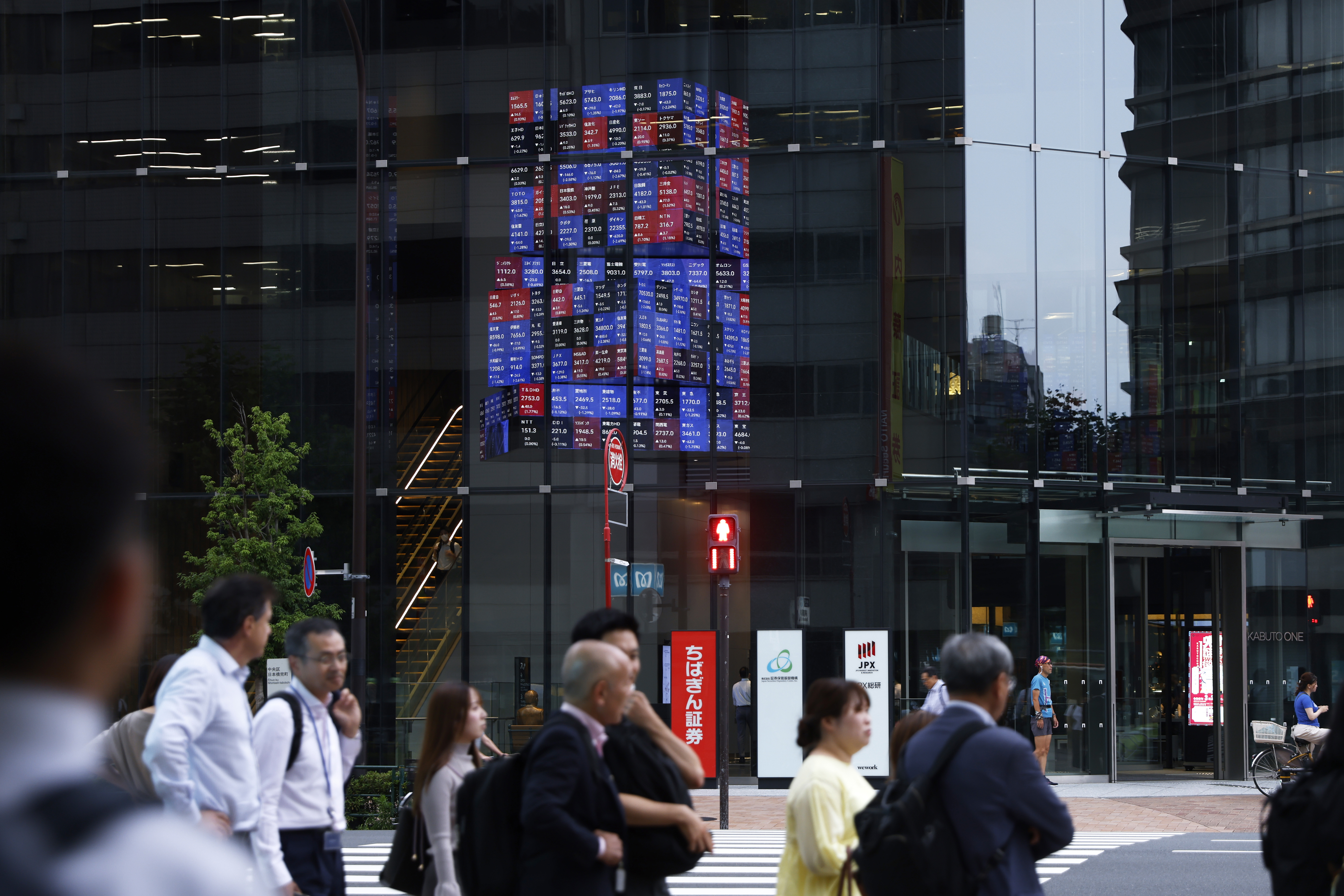
 An electronic stock board displayed inside the Kabuto One building in Tokyo, Japan. (Photo: Kiyoshi Ota/Bloomberg)
 MSCI’s Asia Pacific Index — a gauge for benchmarks in the region — fell for a third session, with equities in Sydney, Tokyo and Seoul all in the red. Greater Chinese stocks slipped as much as 1.3%, bringing losses since a high on 8 October to more than 10%. S&P 500 futures were little changed while Treasuries were also steady in Asia.
A broader weakness in the semiconductor sector was highlighted on Wednesday as Asian chip stocks including SK Hynix Inc. and Samsung Electronics Co Ltd declined. The moves partly reflected a slide in Dutch giant ASML Holding NV’s shares on Tuesday after it cut its 2025 outlook. In the US, Nvidia Corp. lost 4.7%, signalling a slowdown for some of the biggest bellwethers of the industry.
“The European tech pullback spill-over on Wall Street is inevitably set to drag Asia,” said Vishnu Varathan, the Asia head of economics and strategy for Mizuho Bank Ltd. in Singapore. “Optimism on Chinese stimulus appears to have been dulled at the margin, so much so that markets have taken more profits, rather than a bullish position, on Chinese equities.”
A Bloomberg gauge of Chinese property shares gained, bucking the trend in the mainland benchmark, while some dollar bonds issued by Chinese real estate firms rose. The moves come ahead of a Thursday press briefing which is likely to provide more details of measures to support the beleaguered sector.
Any announcements “may only help property stocks for one or two days, but not the overall market,” said Kenny Wen, head of investment strategy at KGI Asia Ltd. “Only the property sector will benefit and investors are still waiting for a several trillion fiscal package.”
Volatility in Chinese stocks has been high since late September, when a series of stimulus measures by the central bank unleashed a burst of optimism that’s now quickly cooling. Expectations are growing to see if authorities are willing to deploy greater firepower to turn around the economy and markets.
In the US, The S&P 500 slipped to around 5,815 and the Nasdaq 100 lost 1.4%. The dollar steadied after climbing to its highest level in about two months after former President Donald Trump defended proposals to dramatically raise tariffs on foreign imports. Separately, Fed Bank of Atlanta president Raphael Bostic said he expects the US economy to slow this year but to remain robust, adding that the downward path for inflation could see some bumps.
Back in Asia, New Zealand’s dollar and sovereign bond yields fell after the annual inflation rate declined sharply in the third quarter, returning to the central bank’s target band for the first time in more than three years.
Elsewhere, three of Southeast Asia’s biggest economies will unveil monetary policy decisions later on Wednesday. Indonesia and Thailand are expected to keep rates on hold, while a cut is seen in the Philippines.
Oil gains
Oil climbed — after falling by more than 4% on Tuesday — as Israel said it would make its own decision on how to attack Iran, keeping open the possibility that energy infrastructure may be targeted.
Crude has had a roller-coaster ride this month, with prices buffeted by tensions in the Middle East, as well as China’s efforts to revive growth in the largest importer. Traders have also been weighing the market’s outlook into next year, with the International Energy Agency flagging prospects for a global glut.
“It looks like dealers simply have their machines tied to oil futures these days,” said Christoph Rieger, head of rates and credit research at Commerzbank AG. “Whether it makes sense to adjust your long-term inflation view on the back of this is a different question.”
In other commodities, iron ore futures were little changed just below $106 a ton in Singapore after swinging between gains and losses. Meanwhile, gold advanced.