




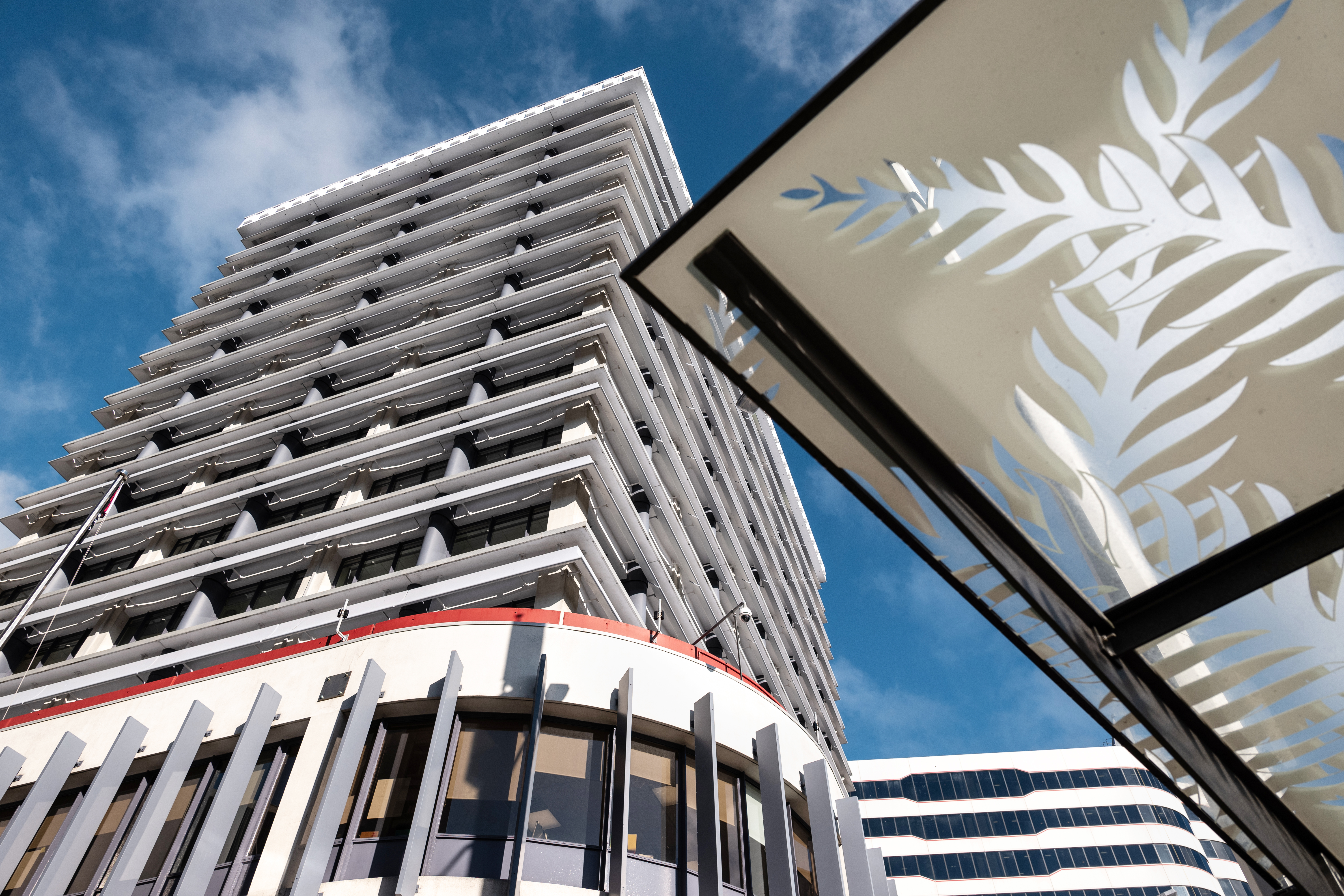
 The Reserve Bank of New Zealand (RBNZ) headquarters, left, stands in Wellington, New Zealand, on Thursday, 9 August 2018. (Photo: Birgit Krippner/Bloomberg)
The Reserve Bank’s Monetary Policy Committee lowered the official cash rate to 4.75% from 5.25% on Wednesday in Wellington, as anticipated by 19 of 23 economists in a Bloomberg survey. The remainder expected a quarter-point move. It is the RBNZ’s second consecutive reduction after it began its easing cycle with a quarter-point cut in August.
“The committee agreed that the economic environment provided scope to further ease the level of monetary policy restrictiveness,” the RBNZ said. Future changes to the OCR will depend on the bank’s “evolving assessment of the economy”, it said.
New Zealand’s economy has stalled, unemployment is rising and house prices are falling as the prolonged period of high borrowing costs curbs demand. Economists say inflation is now slowing rapidly, and some have warned it may undershoot the 2% midpoint of the RBNZ’s 1-3% target range.
“The next move remains conditional on the data as always but there was nothing in today’s commentary to dissuade the market from continuing to price a follow-up 50 basis-point cut in November as the likeliest outcome,” said Sharon Zollner, chief New Zealand economist at ANZ Bank in Auckland. “That seems entirely fair, and is our forecast.”
The New Zealand dollar fell more than a quarter of a US cent after the decision to buy 61.06 cents at 3:20 p.m. in Wellington. Stocks extended gains to be up 1.6% while bond yields declined, with 10-year government securities falling as much as 5 basis points to 4.26%.
The decision was a policy review, which is not accompanied by fresh economic forecasts or a press conference.
Changing stance
The shift to bigger cuts represents another abrupt change of stance for the RBNZ.
It said in May it wouldn’t start easing policy until the second half of 2025, and after its pivot on 14 August Governor Adrian Orr said the bank intended to move “calmly” and at a “measured pace”.
The RBNZ’s latest forecasts in August showed the annual inflation rate falling to 2.3% in the third quarter from 3.3% in the second. That data is due Oct. 16.
“The Committee agreed that monthly price indices signal a continued decline in consumer price inflation,” the RBNZ said in its record of meeting. “Business price-setting behaviour is now more consistent with the Committee’s inflation remit.”
Just 7% of firms expect to hike prices in the final three months of the year, the New Zealand Institute of Economic Research said last week in its quarterly survey.
Gross domestic product declined 0.2% in the three months through June, putting the economy on the brink of its second recession in less than two years. Soft demand is tipped to boost the jobless rate when third-quarter data is published in early November.
“Economic growth is weak, in part because of low productivity growth, but mostly due to weak consumer spending and business investment,” the RBNZ said. “High-frequency indicators point to continued subdued growth in the near term.”
What Bloomberg Economics says...
“Further rapid cuts will be needed if the central bank is going to head off a faster-than-expected deterioration in the labour market. We forecast another 225 basis points of rate cuts by the end of 2025.”
— James McIntyre, economist
Many central banks have begun cutting rates and the US Federal Reserve kicked off its easing cycle last month with a half-point reduction. The Reserve Bank of Australia is a notable exception, holding its key rate steady at 4.35% due to upside inflation risks.
“The committee discussed the respective benefits of a 25 basis-point versus a 50 basis-point cut,” the RBNZ said. “They agreed that a 50 basis-point cut at this time is most consistent with the mandate of maintaining low and stable inflation.”
Current short-term market pricing was also consistent with this decision, it added.
A majority of economists polled before today’s decision expected the RBNZ to follow up with a half-point cut at its final meeting of the year on Nov 27. Investors have almost fully priced in another half-point cut, swaps data show.
“The outlook is broadly consistent with the August Monetary Policy Statement,” the RBNZ said. “Members agreed that an OCR of 4.75% is still restrictive and leaves monetary policy well placed to deal with any near-term surprises.”
Comments
Scroll down to load comments...