




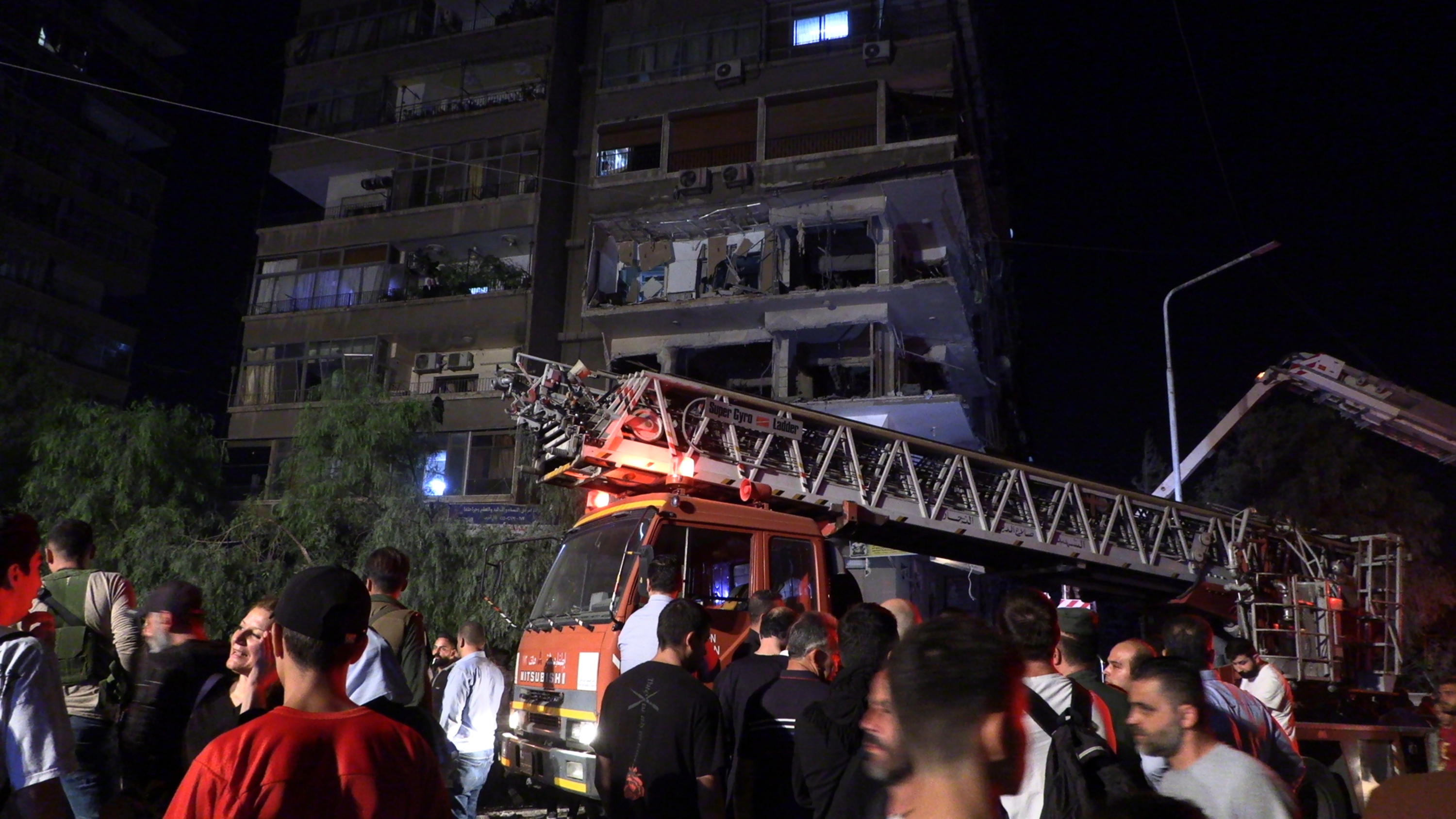
 Syrian rescuers inspect the damage after missiles struck a building in the Al-Mazzeh neighbourhood in Damascus, Syria, 8 October. (Photo: Stringer / EPA-EFE)
 Prime Minister Benjamin Netanyahu said on Tuesday that Israeli airstrikes had killed two successors to Hezbollah’s slain leader, as Israel expanded its ground offensive against the Iran-backed group with a fourth army division deployed into south Lebanon.
Hezbollah’s call for a ceasefire on Tuesday showed the group was on the back foot and “getting battered”, US State Department spokesperson Matthew Miller told a regular briefing on Tuesday.
Israeli strike on building in Damascus kills seven civilians
An Israeli airstrike targeted a residential building in the Mezzah suburb west of the Syrian capital, Damascus, killing seven civilians and injuring 11 others, Syrian state media reported on Tuesday.
Preliminary reports said the seven civilians included women and children, state media reported, citing a military source, adding it also caused “grave” material damage to private properties in surrounding areas.
As per the cited source, the airstrike was conducted through three missiles coming from the direction of the Golan Heights.
State media earlier reported that Syria’s air defences had intercepted “hostile” targets in the vicinity of Damascus.
Israel has been carrying out strikes against Iran-linked targets in Syria for years but has ramped up such raids since last year’s 7 October attack by the Palestinian group Hamas on Israeli territory that sparked the Gaza war.
Israel says it has killed slain Hezbollah leader’s successors
Prime Minister Benjamin Netanyahu said on Tuesday that Israeli airstrikes had killed two successors to Hezbollah’s slain leader, as Israel expanded its ground offensive against the Iran-backed group with a fourth army division deployed into south Lebanon.
Netanyahu spoke in a video released by his office hours after the deputy leader of Hezbollah, which is reeling after a spate of killings of senior commanders in Israeli airstrikes, left the door open to a negotiated ceasefire.
“We’ve degraded Hezbollah’s capabilities. We took out thousands of terrorists, including [Hassan] Nasrallah himself and Nasrallah’s replacement, and the replacement of the replacement,” said Netanyahu, without naming the latter two.
Israeli Defence Minister Yoav Gallant said Hashem Safieddine, the man expected to succeed Nasrallah, had probably been “eliminated”. It was not immediately clear who Netanyahu meant by the “replacement of the replacement”.
Later, Israeli military spokesperson Daniel Hagari said Israel knew Safieddine was in Hezbollah’s intelligence headquarters when fighter jets bombed it last week and Safieddine’s status was “being checked and when we know, we will inform the public”.
Safieddine has not been heard from publicly since that airstrike, part of an escalating Israeli offensive after a year of border clashes with Hezbollah. The group is the most formidably armed of Iran’s proxy forces across the Middle East and has been acting in support of Palestinian militants fighting Israel in Gaza.
“Today, Hezbollah is weaker than it has been for many, many years,” said Netanyahu.
Israel’s military said on Tuesday that heavy airstrikes against underground Hezbollah installations in southern Lebanon over the previous 24 hours killed at least 50 fighters including six sector commanders and regional officials.
The Israeli military said it had sent the 146th Division into south Lebanon, the first reserve division to have been deployed over the border, and was extending ground operations against Hezbollah from southeast Lebanon into its southwest.
A military spokesperson declined to say how many troops were in Lebanon at one time. However, the military had previously announced that three other army divisions were operating there, meaning that thousands of soldiers were likely on Lebanese soil.
Overnight, Israel again bombed Beirut’s southern suburbs where Hezbollah is headquartered and said it had killed a figure responsible for budgeting and logistics, Suhail Hussein Husseini — the latest in a string of assassinations of some of Hezbollah’s top officials.
The Israeli military on Tuesday issued a new evacuation warning for residents, especially in specific buildings in Beirut’s southern suburbs, where Hezbollah has its headquarters.
In northern Israel not far from the Lebanon border, warning sirens sounded regularly throughout Tuesday as authorities said Hezbollah fired almost 200 rockets into Israel.
An Israeli military spokesperson said more than 3,000 rockets had been fired into Israel from Lebanon so far in October, but interceptions by air defences had prevented many casualties and significant damage.
Targets on Tuesday again included Haifa, the northern port city where there were multiple reports of damage to buildings from missile debris. Israel’s military said it had struck the launchers that fired the missiles at Haifa.
The mushrooming Israeli-Hezbollah conflict has killed well over 1,000 people in Lebanon in the past two weeks and prompted the mass flight of more than a million.
Israel’s stated objective is to make its northern areas safe from Hezbollah rocket fire and allow thousands of displaced residents to return.
US says ceasefire call shows Hezbollah ‘getting battered’
Hezbollah’s call for a ceasefire on Tuesday showed the militant group was on the back foot and “getting battered”, US State Department spokesperson Matthew Miller told a regular briefing on Tuesday.
Hezbollah’s deputy leader, Naim Qassem, said in a televised address on Tuesday the Iran-backed group’s capabilities were intact and its fighters were pushing back Israeli ground incursions, despite the “painful blows” inflicted by Israel in recent weeks.
Qassem said the group supported the efforts of Lebanon’s Speaker of Parliament Nabih Berri, a Hezbollah ally, to secure a ceasefire, without providing further details on any conditions demanded by Hezbollah.
“For a year, you had the world calling for this ceasefire, you had Hezbollah refusing to agree to one, and now that Hezbollah is on the back foot and is getting battered, suddenly they’ve changed their tune and want a ceasefire,” said Miller.
“We continue to ultimately want a diplomatic solution to this conflict,” said Miller.
Israel’s defence minister postpones visit to Washington
Israeli Defense Minister Yoav Gallant had cancelled plans for a Wednesday visit to the Pentagon, a Pentagon spokesperson said on Tuesday, saying it looked forward to welcoming him at a later date.
“We were just informed that Minister Gallant will be postponing his trip to Washington,” Sabrina Singh told a news briefing, referring questions about why Gallant cancelled to Israel’s government.
Tehran warns Gulf states not to let airspace be used against Iran
Tehran has told Gulf states it would be “unacceptable” if they allowed their airspace to be used against Iran and any such move would draw a response, said a senior Iranian official on Tuesday, amid concerns about possible Israeli retaliation for last week’s Iranian missile attack.
The official was speaking as Iran’s Foreign Minister Abbas Araqchi headed to Saudi Arabia and other Gulf states for talks.
The comments also followed discussions between Iran and Gulf Arab capitals last week on the sidelines of an Asia conference in Qatar, when Gulf states sought to reassure Iran of their neutrality in any conflict between Tehran and Israel.
“Iran made it clear that any action by a Persian Gulf country against Tehran, whether through the use of airspace or military bases, will be regarded by Tehran as an action taken by the entire group, and Tehran will respond accordingly,” the senior Iranian official told Reuters.
“The message emphasised the need for regional unity against Israel and the importance of securing stability. It also made clear that any assistance to Israel, such as allowing the use of a regional country’s airspace for actions against Iran, is unacceptable,” he said.
Draft law blocking aid agency Unrwa would be a ‘catastrophe’
Draft Israeli legislation that would stop the UN Palestinian refugee agency working in the Gaza Strip and West Bank would be a “catastrophe” if enacted, said United Nations Secretary-General António Guterres on Tuesday, adding he raised his concerns with Netanyahu.
“Such a measure would suffocate efforts to ease human suffering and tensions in Gaza, and indeed, the entire Occupied Palestinian Territory. It would be a catastrophe in what is already an unmitigated disaster,” he told reporters.
The Israeli parliament in July gave preliminary approval to a Bill that would declare Unrwa a terrorist organisation. Israeli leaders have accused Unrwa staff of collaborating with Hamas militants in Gaza.
The UN said in August that nine Unrwa staff may have been involved in the 7 October 2023 Hamas attack on Israel, and had been fired. Then a Hamas commander in Lebanon — killed last month in an Israeli strike — was found to have had an Unrwa job.
Unrwa provides education, health and aid to millions of Palestinians in Gaza, the West Bank, Jordan, Lebanon and Syria. It has long had tense relations with Israel but ties have deteriorated sharply since the start of the war in Gaza and Israel has called repeatedly for Unrwa to be disbanded.
Guterres spoke to reporters a day after the first anniversary of the shock Hamas rampage in Israel, during which some 1,200 people were killed and about 250 taken hostage, according to Israeli figures. More than 100 hostages remain held in Gaza by the Palestinian militant group.
The Hamas attack triggered Israel’s retaliation in Gaza, sparking a humanitarian crisis in the besieged enclave where authorities say more than 41,000 people have been killed.
“There is something fundamentally wrong in the way this war is being conducted,” said Guterres on Tuesday. “Ordering civilians to evacuate does not keep them safe if they have no safe place to go and no shelter, food, medicine or water.”
Israeli strikes on Gaza, Lebanon mourned by Arab Americans
Mohammad Enayah, an automotive engineer living in the Detroit suburbs, said he had lost nearly 100 relatives and friends in Gaza over the last year. He wonders if his home country the US could have provided the weapons that killed them.
Enayah (60) said the US embraced him when he arrived as a 17-year-old student in 1981 and he had built up a good life for himself and his family. But tears spring to his eyes when he views photos of cousins, aunts and uncles who have died in Israel’s assault on the Palestinian enclave since the 7 October 2023, Hamas attack on Israel.
“That’s where I’m torn between how the United States embraced me and how it killed my family, literally,” he said. “This is a group of helpless, defenceless civilians being slaughtered in front of everybody’s eyes ... and nobody can do anything.”
The US military has not been directly involved in attacks on Gaza, and Washington has pushed unsuccessfully for a ceasefire there. But the US is Israel’s largest weapons supplier and has supplied billions of dollars in military aid in the last year as part of a longstanding agreement.
Enayah joined about 100 people who lit candles in a Dearborn park on Monday to mark the first anniversary of the Hamas attack on Israel that killed 1,200 people, according to Israeli figures. DM
Read more: Middle East crisis news hub