




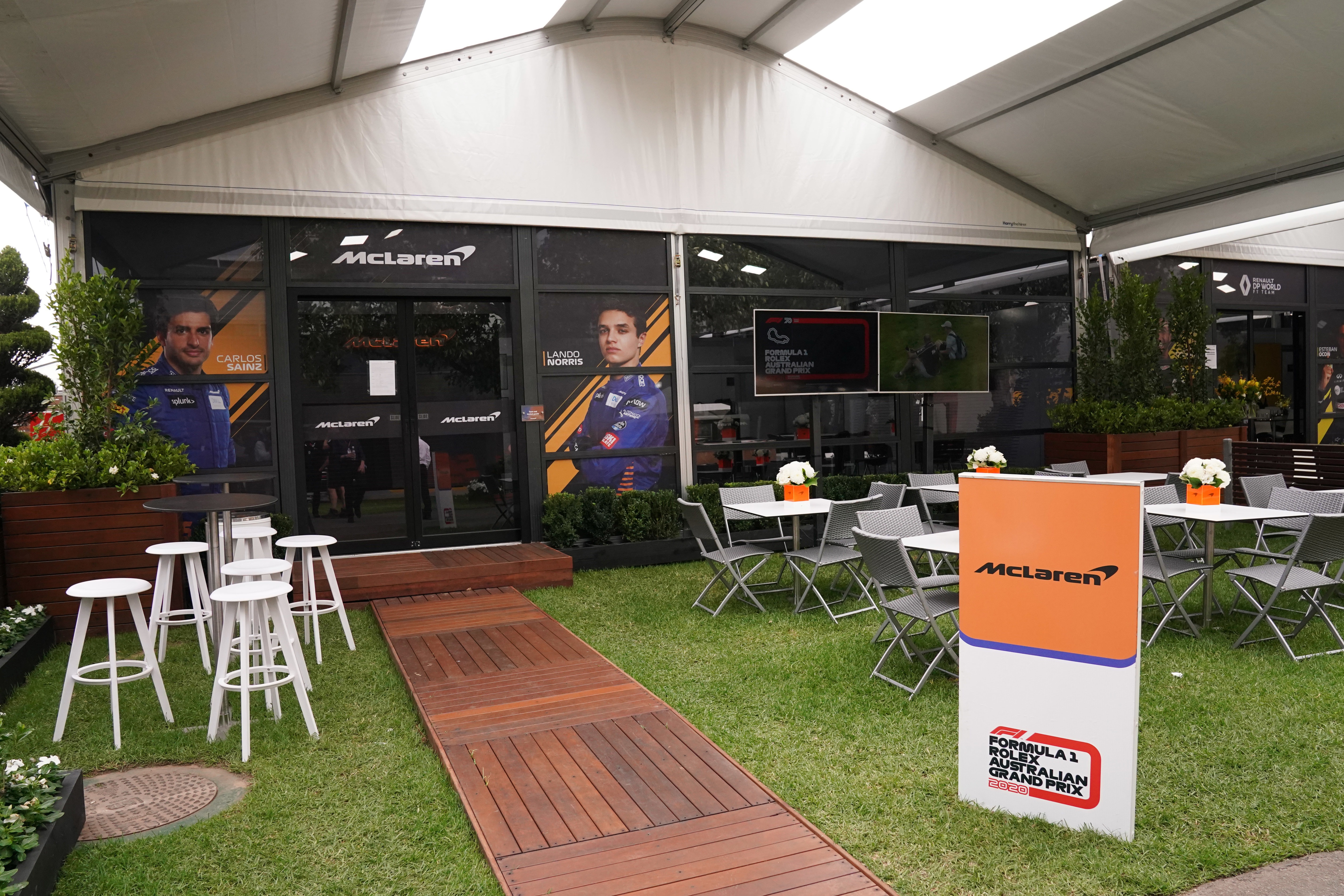
 epa08290868 The empty McLaren headquarters is seen ahead of the Formula 1 Australian Grand Prix 2020 at the the Albert Park Circuit in Melbourne, Australia, 13 March 2020. McLaren Racing announced on 12 March 2020 that they have withdrawn their team from the 2020 Formula 1 Australian Grand Prix, following the positive test of a team member for the coronavirus. EPA-EFE/MICHAEL DODGE AUSTRALIA AND NEW ZEALAND OUT
 The British brand introduced a new supercar, the W1, on Oct. 6, the 50th anniversary of its first F1 constructor’s championship with driver Emerson Fittipaldi, who also won the driver’s championship in 1974. (McLaren last won the team championship in 1998.) Pricing on the car, the successor to the McLaren F1 of the 1990s and the McLaren P1 of the mid-2010s, starts at $2.1 million.
“It’s the ultimate expression of a McLaren supercar,” Michael Leiters, the chief executive officer of McLaren Automotive, said in a statement about the rear-wheel-drive, eight-speed hybrid vehicle.
The W1 joins a spate of new cars including the Bentley Continental GT and Lamborghini Revuelto that use electricity to achieve whopping power while still retaining internal combustion, as consumers’ appetite for pure EVs remains uncertain. The W1 gets 1,258 brake horsepower and 988 pound-feet of torque from an all-new hybrid powertrain that combines a 4.0-liter twin-turbo V-8 internal combustion engine and an electric motor. The combination makes it the most powerful McLaren to date.
Such mixed powertrains are well suited to the type of vehicles the company wants to produce, since they deliver power and speed along with the all-important visceral connection between driver and machine that can be lost with a pure EV, says Jamie Corstorphine, McLaren’s director of product planning. “We believe [these] are the first principles of a real supercar,” he says.
Hybrid technology is not new at McLaren: It started developing it more than 10 years ago with the 903-horsepower P1, which launched in 2013; Porsche’s 918 Spyder and Ferrari’s LaFerrari hybrids also arrived the same year. The $2.3 million McLaren Speedtail hybrid made its debut in 2018. A less expensive hybrid, the $233,000 McLaren Artura, came out in 2021. A hybrid SUV is in the works.
In contrast to the 671-horsepower Artura, which offers 19 miles of electric-only driving, the W1 can drive on electric power alone for less than two miles. An onboard charger will recharge the electric motor in 22 minutes. But despite past public comments from executives hinting that the company is developing electric powertrains, a fully electric vehicle remains far off for the brand. “We do not think that the technology will be sufficiently mature until the end of the decade to deliver a BEV [battery electric vehicle] supercar,” a spokesperson said, citing weight as a core concern.
The 3,084-pound W1 is the fastest road-legal McLaren ever, with a zero-to-124 mph sprint time of 5.8 seconds and zero-to-186 mph in 12.7 seconds. That’s quicker than the Speedtail. Zero to 60 mph is 2.7 seconds; top speed is 217 mph.
Production of the W1 is limited to 399 vehicles; all of them have been allocated to specific customers. Deliveries will start in 2026.