




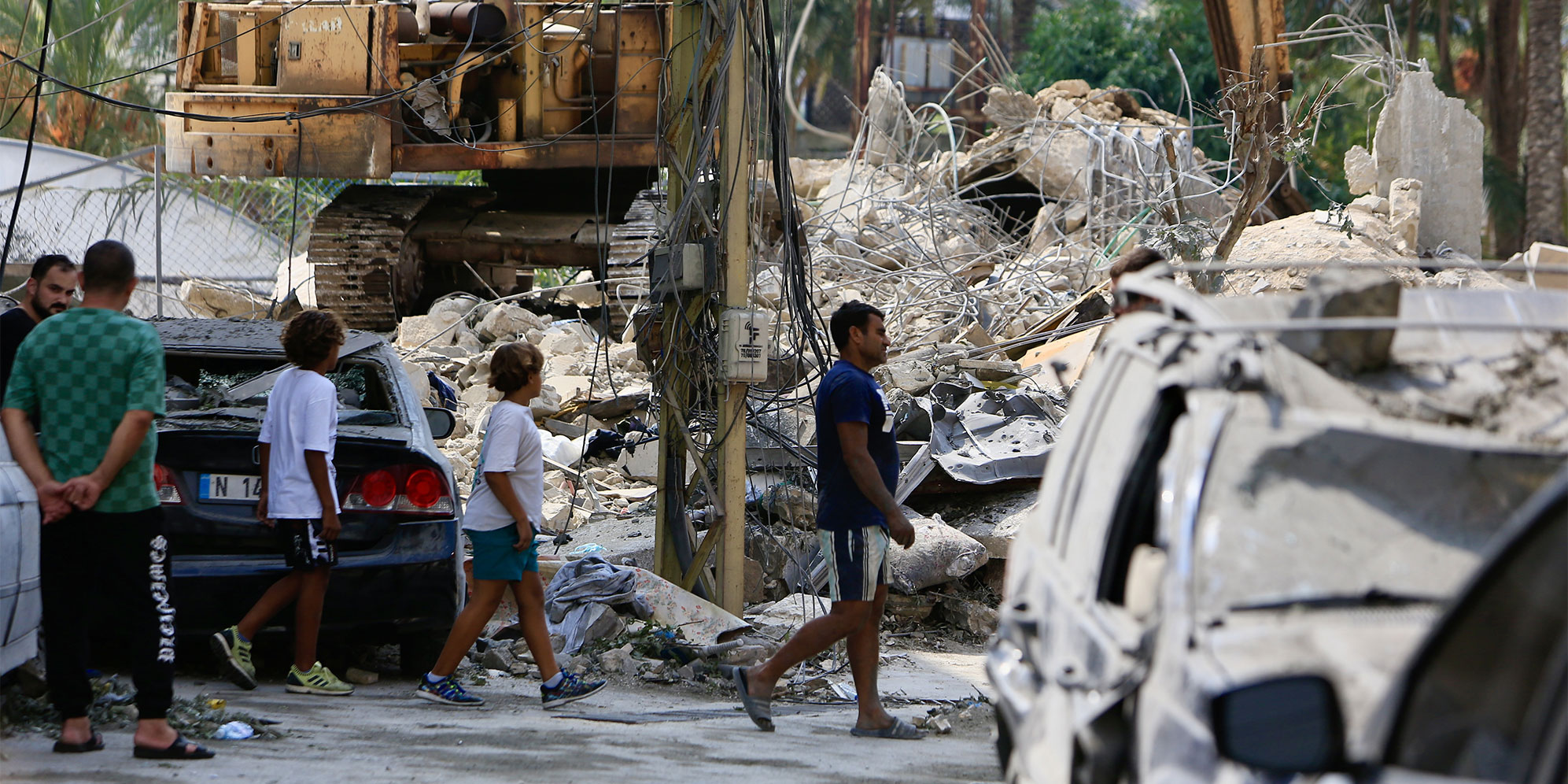
 An excavator clears the rubble at the site of an Israeli military strike in the town of Jiyeh, 23km south of Beirut, on 6 October. (Photo: Stringer / EPA-EFE)
 Thousands of pro-Palestinian demonstrators protested in cities around the world on Sunday on the eve of the first anniversary of the deadly 7 October Hamas attack on Israel that triggered the war in Gaza.
Israel was obstructing search and rescue efforts in an area where senior Hezbollah leader Hashem Safieddine was thought to have been when Israel bombed Beirut’s southern suburbs on Thursday, said a Hezbollah official.
Israeli strikes batter Beirut in heaviest bombardment so far
Israeli air attacks battered Beirut’s southern suburbs overnight and early on Sunday in the most intense bombardment of the Lebanese capital since Israel sharply escalated its campaign against Iran-backed group Hezbollah last month.
During the night, the blasts sent booms across Beirut and sparked flashes of red and white for nearly 30 minutes visible from several kilometres away.
It was the single biggest attack of Israel’s assault on Beirut so far, said witnesses and military analysts on local TV channels.
On Sunday a grey haze hung over the city and rubble was strewn across streets in the southern suburbs, while smoke columns rose over the area.
“Last night was the most violent of all the previous nights. Buildings were shaking around us and at first I thought it was an earthquake. There were dozens of strikes — we couldn’t count them all — and the sounds were deafening,” said Hanan Abdullah, a resident of the Burj al-Barajneh area in Beirut’s southern suburbs.
Videos posted on social media, which Reuters could not immediately verify, showed fresh damage to the highway that runs from Beirut airport through its southern suburbs into downtown.
Israel said its air force had “conducted a series of targeted strikes on a number of weapons storage facilities and terrorist infrastructure sites belonging to the Hezbollah terrorist organisation in the area of Beirut”.
Lebanese authorities did not immediately say what the missiles had hit or what damage they caused.
This weekend’s intense bombardment came just ahead of the anniversary of the 7 October attack by Palestinian militant group Hamas on southern Israel in which some 1,200 people were killed and more than 250 taken hostage, according to Israeli figures.
The target of Israel’s airstrikes across Lebanon and its ground invasion in the south of the country is the Lebanese armed group Hezbollah, Iran’s chief ally in the region.
More than 2,000 people have been killed in nearly a year of fighting, most of them in the past two weeks, according to the Lebanese health ministry. The ministry said on Sunday that 23 people had been killed on Saturday.
The United Nations’ refugee chief said on Sunday that there were “many instances” where Israeli airstrikes had violated international law by hitting civilian infrastructure and killing civilians in Lebanon.
Israel says it targets military capabilities and takes steps to mitigate the risk of harm to civilians, while Lebanese authorities say civilians have been targeted. Israel accuses both Hezbollah and Hamas of hiding among civilians, which they deny.
For days Israel has bombed the Beirut suburb of Dahiyeh — considered a stronghold for Hezbollah but also home to thousands of ordinary Lebanese, Palestinian and Syrian refugees — killing its leader Sayyed Hassan Nasrallah on 27 September.
A Lebanese security source said on Saturday that Hashem Safieddine, Nasrallah’s potential successor, had been out of contact since Friday, after an Israeli airstrike on Thursday near the city’s international airport that was reported to have targeted him.
Israel continued to bomb the area of the strike, preventing rescue workers from reaching it, said Lebanese security sources.
Hezbollah has not commented on Safieddine.
His loss would be another blow to the group and its patron Iran. Israeli strikes across the region in the past year, sharply accelerated in recent weeks, have devastated Hezbollah’s leadership.
Israel’s war in Gaza, launched after the 7 October attacks and aimed at eliminating Hamas, another Iran-backed group, has killed nearly 42,000 people, Palestinian authorities say. The coastal enclave lies in ruins.
Hezbollah began firing rockets at Israel a day after the 7 October attacks and after Israel had begun bombing Gaza, saying it was acting in solidarity with the Palestinian group.
Cross-border fire continued between Israel and Hezbollah for months, but was mostly limited to the Israel-Lebanon border area before the recent upsurge.
Israel says it stepped up its assault on Hezbollah last month to enable the safe return of tens of thousands of citizens to homes in northern Israel.
Israeli authorities said on Saturday that nine Israeli soldiers had been killed in southern Lebanon so far.
In northern Israel, air raid sirens sounded on Sunday and the Israeli military said it had intercepted rockets fired from Lebanese territory.
Thousands stage pro-Palestinian protests worldwide
Thousands of pro-Palestinian demonstrators protested in cities around the world on Sunday on the eve of the first anniversary of the deadly 7 October Hamas attack on Israel that triggered the war in Gaza.
Demonstrations were held in major cities from Jakarta to Istanbul to Rabat, and followed protests on Saturday in major European capitals as well as Washington and New York.
“We are here to support the Palestinian resistance,” said protester Ahmet Unal in Istanbul, where thousands assembled.
In Paris, the Jewish community gathered on Sunday to mark one year since the attack by Hamas.
In Jakarta, the capital of Indonesia, the world’s most populous Muslim-majority country, at least 1,000 pro-Palestinian protesters gathered on Sunday morning near the US embassy demanding that Washington stop supplying weapons to Israel.
In Sydney, thousands of pro-Palestinian protesters gathered ahead of the 7 October anniversary, chanting and waving Lebanese and Palestinian flags amid a heavy police presence.
One person was arrested for waving an Israeli flag with a swastika in the middle of it instead of the Star of David.
In Rabat, thousands of Moroccans marched, calling for a halt to the violence in Gaza and Lebanon, in one of the largest protests in the country since the beginning of the war in Gaza.
Israel ‘obstructing search for Hezbollah’s Safieddine’
Israel was obstructing search and rescue efforts in an area where senior Hezbollah leader Hashem Safieddine was thought to have been when Israel bombed Beirut’s southern suburbs on Thursday, said a Hezbollah official.
Safieddine is seen as a likely successor to former leader Sayyed Hassan Nasrallah who was killed in an Israeli strike on Beirut’s southern suburbs, known as Dahiye, on 27 September.
His fate remains unclear.
The senior Hezbollah political official, Mahmoud Qmati, also said he had no information on reports that the leader of Iran’s elite Quds Force, Esmail Qaani, had not been heard from since the strikes on Beirut late last week.
Asked about reports that Qaani may have been killed in an Israeli strike in Beirut, Israeli military spokesperson Lieutenant Colonel Nadav Shoshani said the results of the strikes were still being assessed.
He said that Israel had conducted an attack late last week against Hezbollah’'s intelligence headquarters in Beirut.
“When we have more specific results from that strike, we will share it. There’s a lot of questions about who was there and who was not,” he told a briefing with reporters.
The Quds Force, the overseas arm of Iran’s Revolutionary Guards, oversees dealings with militias allied with Tehran across the Middle East, such as Hezbollah.
Israel should “let rescue teams do their work”, Qmati told Iraqi state television.
Qmati said that Hezbollah was now being jointly led until it could pick a new leader, which would take time.
“What’s important is that joint command is in place,” he said.
Qmati said Nasrallah’s body remained in Lebanon and that he would be laid to rest in Beirut's southern suburbs, where Hezbollah holds heavy influence, when conditions allowed.
Putting limits on Israel will strengthen Iran, Netanyahu tells Macron
Israeli Prime Minister Benjamin Netanyahu spoke by telephone with French President Emmanuel Macron on Sunday, said his office, and told him that placing restrictions on Israel would just serve Iran and its proxies.
Macron said on Saturday that shipments of arms to Israel used in the war in Gaza should be stopped as part of a broader effort to find a political solution to the conflict.
“Just as Iran supports all parts of the Iranian terror axis, so are Israel’s friends expected to support it, and not impose restrictions that will only strengthen the Iranian axis of evil,” Netanyahu told Macron, according to a statement from his office.
“The prime minister emphasised that Israel’s actions against Hezbollah create an opportunity to change reality in Lebanon to better stability, security and peace in the entire region,” said the statement.
The two leaders agreed to maintain a dialogue on the matter during the French foreign minister’s visit to Israel on Monday, said Netanyahu’s office.
Foreign Minister Jean-Noel Barrot is on a four-day trip to the Middle East. Paris is seeking to play a role in reviving diplomatic efforts as the Gaza war has widened to Lebanon.
Macron told France Inter radio on Saturday that the priority was “to get back to a political solution [and] that arms used to fight in Gaza are halted. France doesn’t ship any.
“Our priority now is to avoid escalation. The Lebanese people must not in turn be sacrificed, Lebanon cannot become another Gaza.”
Woman killed in shooting attack in southern Israel
A gunman opened fire at a bus station in the Israeli city of Beersheba on Sunday, killing one woman and wounding 10 people, said emergency services.
The attacker was killed, said the ambulance service. A witness at the scene told N12 News he saw soldiers fire at the assailant, who media reported was a member of the Bedouin minority in Israel’s Negev desert.
Police described the shooting as a terrorist attack but have not provided details on the gunman’s identity.
Israeli security forces are on high alert across Israel for possible pro-Palestinian street attacks on the eve of the first anniversary of Hamas’ assault on southern Israel last year, which triggered the Gaza war.
Harris reiterates support for Gaza ceasefire as conflict escalates
US vice-president and Democratic presidential candidate Kamala Harris said Washington would continue to pressure Israel and other players in the Middle East to reach a ceasefire deal in Gaza even as advocates say that the US has not thus far used its leverage over its ally.
In an interview with the CBS news show 60 Minutes, Harris said that diplomatic work with Israel was “an ongoing pursuit”, according to a clip released on Sunday.
Harris sidestepped a question in the interview on whether Netanyahu was a “real close ally”.
“I think, with all due respect, the better question is do we have an important alliance between the American people and the Israeli people and the answer to that question is yes,” said Harris.
Harris reiterated Washington’s position to support Israel’s right to self-defence against Iran and Iran-backed militant groups like Palestinian Hamas and Lebanese Hezbollah.
“Now the work that we do diplomatically with the leadership of Israel is an ongoing pursuit around making clear our principles,” said Harris.
“We’re not going to stop in terms of putting that pressure on Israel and in the region including Arab leaders.”
Dozens killed in Gaza as Israeli army launches new incursion
At least 26 people were killed and 93 others wounded when Israeli airstrikes hit a mosque and a school sheltering displaced people in the Gaza Strip early on Sunday, said the Hamas-run Gaza government media office.
Palestinian health officials said at least another 20 people had been killed since Saturday night in northern Gaza after the army sent tanks into areas there for the first time in months and urged residents to leave.
The Israeli military said it had conducted “precise strikes on Hamas terrorists” who were operating within command and control centres embedded in Ibn Rushd School and the Shuhada al-Aqsa Mosque, in the area of Deir al-Balah in central Gaza.
Hamas rejects accusations it uses civilian facilities such as schools, hospitals and mosques for military purposes.
“The mosque has been here for 20 years, and the neighbourhood has displaced people,” said Imam Ahmed Fleet as he retrieved Korans from the debris. “I was shocked when it was struck.”
The Hamas-run Gaza government media office said Israel had struck 27 houses, schools and displacement shelters across Gaza in the past 48 hours.
Medics said an Israeli airstrike killed three Palestinians in Rafah, near the border with Egypt, where Israeli forces have been operating since May.
The army on Saturday issued new evacuation orders in parts of Nuseirat camp in the central Gaza Strip, just north of Deir al-Balah, forcing hundreds of families to leave their houses. The military statement said its forces aimed to operate against Hamas militants who waged attacks from the territory.
Meanwhile, Israeli tanks pushed into the northern Gaza areas of Beit Lahiya and Jabalia overnight, and planes hit several houses, killing at least 20 people, according to medics.
The Israeli military said its forces had encircled the area of Jabalia, the focus of its operations.
In one air strike, 10 people were killed in one house, and five others in another strike on a second home. Residents described it as one of the worst nights in many months.
“The war is back,” said Raed (52) from Jabalia, before he and his family left for Gaza City on Sunday.
“Dozens of explosions from airstrikes and tank shelling shook the ground and buildings, it felt like the early days of the war,” he told Reuters via a chat app.
The armed wings of Hamas, the Islamic Jihad and smaller factions said fighters were engaged in gunbattles with Israeli forces in Jabalia, the largest of the Gaza Strip’s eight historic refugee camps.
The Israeli military said its forces were operating in Jabalia to fight Hamas militants, dismantle military infrastructure and prevent Hamas from regrouping.
Among those killed in north Gaza on Sunday was a local journalist, Hassan Hamad. His death raised to 175 the number of Palestinian journalists killed since 7 October, according to the Gaza government media office.
Airstrikes in Lebanon ‘have violated humanitarian law’ - UN
The United Nations’ refugee chief, Filippo Grandi, said on Sunday that airstrikes in Lebanon had violated international humanitarian law by hitting civilian infrastructure and killing civilians, in reference to Israel’s bombardment of the country.
“Unfortunately, many instances of violations of international humanitarian law in the way the airstrikes are conducted that have destroyed or damaged civilian infrastructure, have killed civilians, have impacted humanitarian operations,” he told media in Beirut.
Grandi was in Lebanon as it struggled to cope with the displacement of more than 1.2 million people as a result of an expanded Israeli air and ground operation that it says is targeting Iran-backed Hezbollah.
Fighting had previously been mostly limited to the Israel-Lebanon border area, in parallel to Israel’s war in Gaza against Palestinian group Hamas.
Grandi said all parties to the conflict and those with influence on them should “stop this carnage that is happening both in Gaza and in Lebanon today”.
Grandi said the World Health Organization briefed him “about egregious violations of IHL in respect of health facilities in particular that have been impacted in various locations of Lebanon”, using an acronym for international humanitarian law.
Unicef chief warns Gaza kids face ‘post-generational challenges’
After a year of military operations between Israel and Hamas in Gaza, the head of Unicef warned that children there would face “post-generational challenges” due to the conflict.
“If you look at Gaza really through the eyes of a child, it is a hellscape,” Unicef’s executive director, Catherine Russell, told CBS News’ Face the Nation on Sunday, noting the toll of family deaths and displacements, as well as the ongoing lack of food and clean water.
“They are so traumatised by what’s happening,” Russell said of the children. “Even if we can get more supplies in there, the trauma that these children are suffering is going to have lifetime and even post-generational challenges for them.”
Russell said it remained “very dangerous” to move humanitarian aid in Gaza. However, she credited her organization with a “success story” of vaccinating thousands of children for polio in the area.
On the latest Israeli military operations in Lebanon Hezbollah, the Unicef director said “the speed and intensity is shocking” and that “it makes it challenging for us” to reach the approximately one million displaced people there.
Iran summons Australian ambassador over ‘biased stance’
Iran’s foreign ministry has summoned the Australian ambassador in Tehran over what it said was his country’s biased stance on Iran’s attack against Israel, reported Iranian news agency Tasnim on Sunday.
Ian McConville was summoned due to his country’s repeated bias, including on Iran’s response to what it called “the Zionist regime”, meaning Israel.
Australia’s embassy in Tehran did not immediately respond to a request for comment on Sunday.
Airline brings home thousands of stranded Israelis
The Israeli airline Arkia said on Sunday it had repatriated 17,000 Israeli citizens over the past four days who were stranded after European carriers halted flights to Tel Aviv due the conflict in the Middle East.
Europe’s aviation safety regulator Easa issued a bulletin at the end of September advising airlines not to use Israeli airspace.
That left thousands of Israelis stuck across the continent. Many made their way to Greece and Cyprus in the hope of getting back to Israel before the start of the Jewish New Year last Wednesday. Flag carrier El Al Airlines said all its scheduled flights were full but it had added flights from both countries and boosted capacity from Paris.
Smaller rival Arkia said it joined the “national effort” and operated an “air train” from Athens and Larnaca by using aircraft from other airlines while Eastern Airlines participated with a Boeing 777 plane. DM
Read more: Middle East crisis news hub