




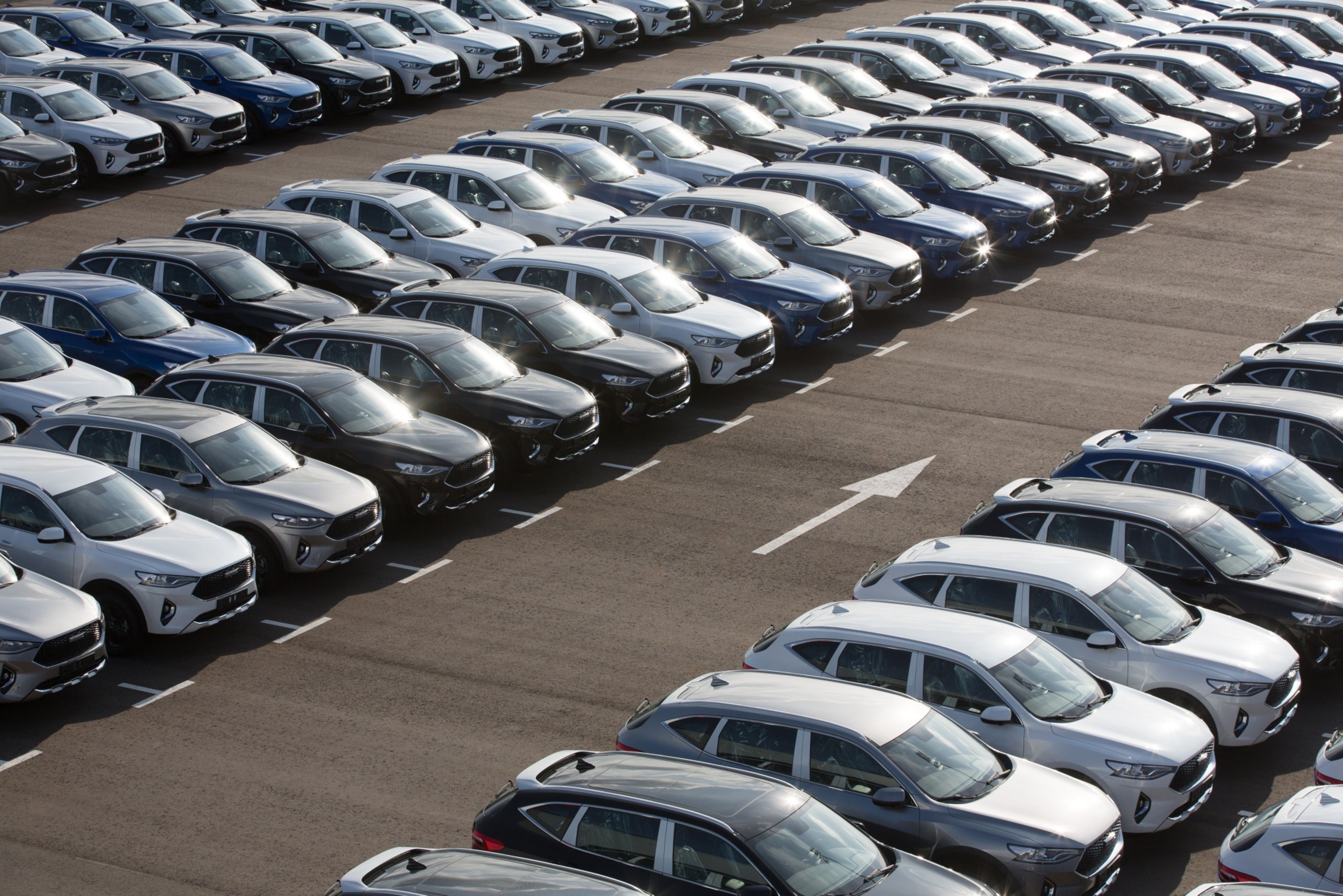
 Completed Haval F7 crossover sport utility vehicles (SUV) sit outside ahead of delivery at the Haval automobile plant, operated by Great Wall Motor Co. Ltd., at the Uzlovaya industrial park, near Tula, Russia, on Monday, Aug. 12, 2019. Photographer: Andrey Rudakov/Bloomberg
Some time back we were in the market for a new car. We needed a reasonably large SUV for long trips with kids during the holidays. Not necessarily a 4x4 (we don’t do off-road), but a robust creature with high clearance and enough room for extended family, luggage and a dog.
There were many contenders. All the usual suspects — from Japanese Fortuners and Prados to European Mercedes and BMW SUVs, from English Range Rovers to US Explorers. The choice was wide and the differences were minor. Most of the cars had basically the same features and were in a similar price range except, unsurprisingly, the German ones.
While we were at one of the showrooms, we noticed a new Haval dealership next door. I wasn’t even sure at the time what country manufactured them (China, for those of you not into cars). So, we popped in for a look.
The Haval H6 was pretty and roomy and kitted out much like many of the others. And then I looked at the price tag.
Surely not. What was the car missing? What was the catch? Was it pre-owned? (No, it wasn’t.) The price was 25% less than its competitors. That’s twenty-five percent. WTF?
There wasn’t a catch and so we bought it, and it has delivered, although there was admittedly some initial reluctance to close the deal. China is, after all, an autocracy with a terrible human rights record and a penchant for stealing IP; perhaps it didn’t deserve our money. But that sort of virtue-buying is a bit silly — most cars use Chinese-made components somewhere (as does a lot of the other stuff we use daily, like our smartphones).
This was a few years ago. Now it seems we are awash, even buried, in Chinese cars. In the city where I live, there are 27 models available from manufacturers BAIC, BYD, Haval, Jaecoo, Chery, Foton, GAC, GWM, LDV and JAC. From compacts to sedans to SUVs to off-roaders to pick-up trucks. From petrol to diesel to hybrids to EVs. How many Chinese cars would you have been able to name 10 years ago? In my case, none.
I went on the hunt for statistics. What I found was startling, not just in terms of the global auto market but also in terms of the geopolitical implications.
The first statistic, most dazzling of all, is that Chinese auto exports have increased by more than 400% in five years, from a little over 1 million units to an expected 6 million units by the end of 2024.
How in the world is that possible? I mean, 10% would be believable. Maybe 20% if you are soaring. But a more than 400% increase? For what is, after all, a major financial commitment on the part of consumers — often the largest a person might make. The 400% in four years did not come from a sudden increase in the car-buying population, obviously. It was gained at the expense of all the other manufacturers. It is a colossal swing by any measure.
Since 2019, when China was a distant third behind Japan and Germany, the country has become the largest exporter of cars globally, manufacturing one-third of all cars in the world and two-thirds of all NEVs (new electric vehicles ie electrics and hybrids). Their colonisation of other countries is accelerating, especially in the developing world, like Brazil and Mexico (Read here).
How did this happen? The obvious answer is price and quality, Sure, but how was that achieved? The explanation can be found in several convergent factors.
First, China’s manufacturing nous, obviously. No one comes close to China in terms of cost and quality in large-scale automated manufacturing capability. And, given the size of its domestic car market, economies of scale are easy to achieve.
Second, China’s embrace of European designers — to name just two, BYD has hired Wolfgang Egger from Audi and Lamborghini, while GAC poached Pontus Fontaeus from Volvo.
Third, China has an integrated supply chain, with some car companies even owning their own roll-on/roll-off ships for international transport.
Fourth, the country has vast internal resources to exploit. Almost everything — from rubber to leather to silicon to plastic to metal to textiles to glass — is sourced and procured locally, giving it a massive cost advantage over its competitors.
Fifth, government support. The Chinese Communist Party (CCP) is serious about moving up the value chain, from the workhorse of the world to the leader of the world. Subsidies and regulatory kid gloves have helped along the way.
Sixth, these companies sell the cars they export for about twice the price they charge in their local market, and their prices abroad are still highly competitive. They are getting rich off high-margin foreign sales, making big profits that can be ploughed back into product development.
I may be out on a limb here but I cannot see a way that any other car manufacturer can challenge China again. It will simply own this global market, with only crumbs left over for companies targeting prestige-brand buyers or national “invented-here” pride. Tariffs may be raised by (for instance) the US but we all know how that ends — they don’t work long-term and eventually get dropped.
Finally, there’s a bigger story, as there always is with surprising statistics and major shifts in economic power such as this.
Most of us fondly believe that some version of the free market fuels and nurtures ingenuity, innovation, incentives and, eventually, delivers better products and services. This has been true for a long time — the US has ridden this wave for nearly a century. Let competition loose and the best will survive and thrive. We consumers reap the benefits.
Chinese companies do actually compete with each other for business. But the market is not unfettered, as it is in the West. The CCP keeps a close eye on it, and national policy is the final arbiter. Those who buck the system are shrunk, shuttered or redirected. It has happened across numerous sectors in the Chinese economy, including well-publicised state interference in tech giants Alibaba and Tencent. The boss is always the CCP, not the market.
If China can knock the stuffing out of its global competitors in this particular race, under the stern eye of Big Brother, surely it is fair to ask whether their way of building industries can teach us something. DM
Steven Boykey Sidley is a professor of practice at JBS, University of Johannesburg. His new book, It’s Mine: How the Crypto Industry is Redefining Ownership, is published by Maverick451 in SA and Legend Times Group in UK/EU. It’s available now.
Comments
Scroll down to load comments...