




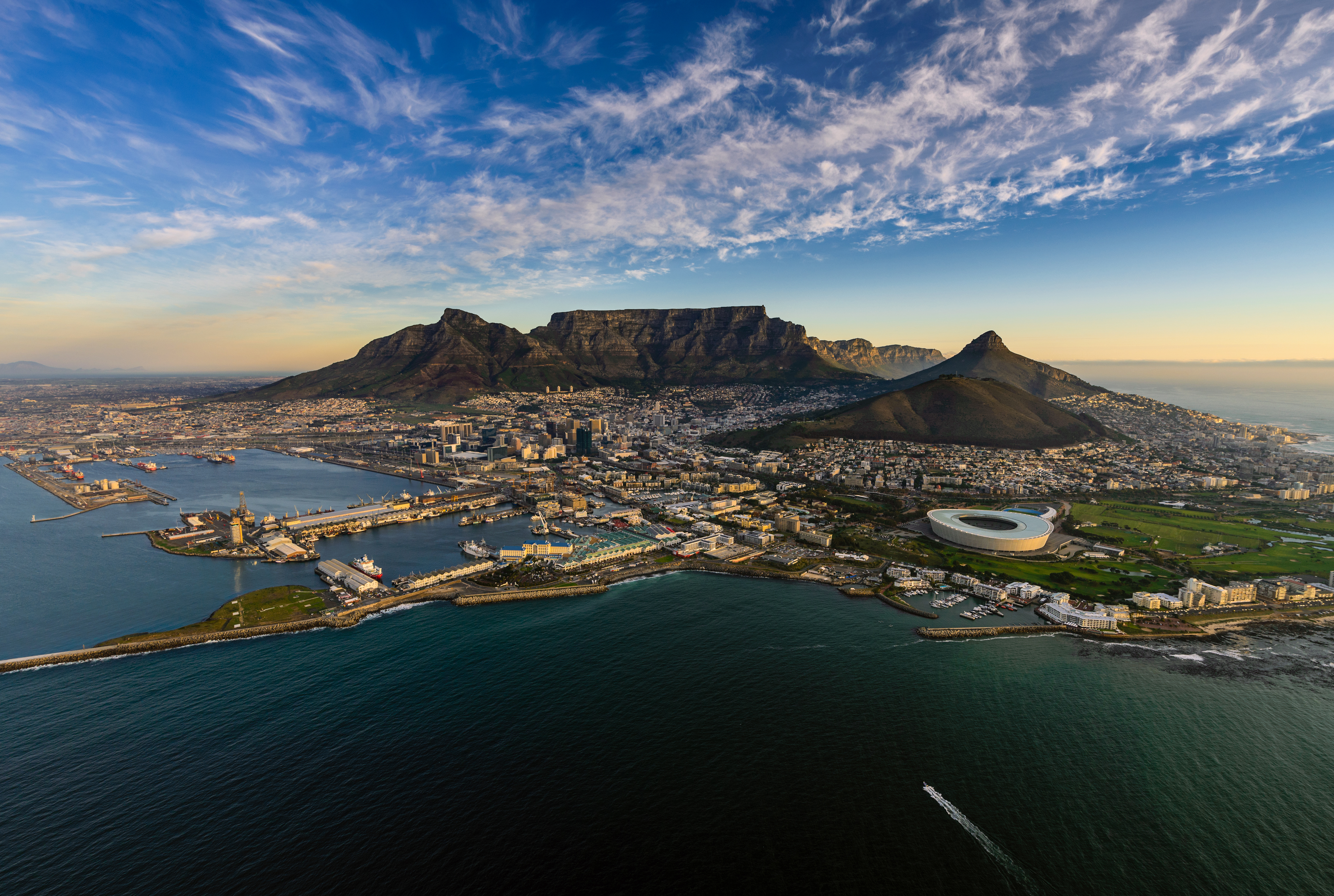
 Cape Town is a magnet for the moneyed. (Photo: iStock)
 It’s official: Cape Town is where the world's superrich prefer to live in South Africa. The city has more centi-millionaires than Johannesburg , and also other cities including Cannes, Prague, Naples, Montreal, Budapest – although currently it has two fewer than Cairo.
The Egyptian capital, placed 90th on Henley & Partners’ list of top cities for centi-millionaires, is set to be overtaken by the Mother City in the coming years, with Cape Town forecast to grow its super-wealthy residents by more than 150%; Cairo is likely to see growth of less than 100%.
Johannesburg, in 100th position on the list, now has 25 centi-millionaires.
Global picture
The world has 54% more superrich individuals than it had in 2013, with the biggest growth in China and the US.
In the past decade, Europe’s economic growth has been sluggish compared with the US. Britain, in particular, has had a decline in its ultra-wealthy population, with many seeking alternative residences because of the combined effects of Brexit, political instability and controversial changes to the non-domicile (non-dom) tax system.
The US now has more centi-millionaires than the entire European continent, and has 15 metropolises on the elite list. The country has grown its centi-millionaires by 81% in just over a decade.
Read more: That’s rich — New York City leads the way when it comes to millionaires
The Centi-Millionaire Report 2024 by wealth and investment migration advisers Henley & Partners, says the bulk of the world’s wealthiest – 29,350 people who are typically the founders of large multinational companies or the heirs to family fortunes – live in three US cities, London and Beijing.
Centi-millionaires are now defined as those who have liquid investable assets of $100-million or more.
The threshold for being considered “super-wealthy” has significantly increased over the past decade, rising from $30-million in the late 1990s to $100-million today.
New York, the Bay Area and Los Angeles are America’s biggest bling magnets, attracting 744, 675 and 496 super-wealthy respectively; the British capital, London, is home to 370, followed by Beijing at 347. Hong Kong, which has just reclaimed its spot as Asia’s top financial centre by knocking Singapore back to second place, lags behind the city state with 320 superrich, compared with Singapore’s 336.
By 2040, the world’s leading tech hubs of Shenzhen, Hangzhou, Austin and Taipei are predicted to have had the biggest growth in centi-millionaires. Cape Town and Marrakech, Morocco are the only African cities forecast to have growth exceeding 150% over the next 16 years.
Emerging markets such as Riyadh, Saudi Arabia and Bengaluru, India are also poised for growth of more than 150%, while established capitals like Chicago, Moscow, Zurich and Madrid are forecast to experience sluggish growth of less than 50% by 2040.
Europe’s centi-millionaire growth has paled in comparison, the report says, increasing by only 26% over the past decade, although it notes that there are pockets of expansion in Malta, Monaco, Montenegro and Poland, which have shown growth of more than 75%.
London’s position as a global financial capital has weakened, as it has dropped to fourth place on the list of centi-millionaires. Paris and Nice are the only French cities in the top 50, with Paris ranking 10th and Nice having 95 centi-millionaires, which reflects broader economic uncertainties and shifting global power dynamics.
The global wealth landscape was heavily concentrated, with a third of the world’s centi-millionaires living in just 50 cities, many of which offer investment migration programmes, said Dr Juerg Steffen, CEO of Henley & Partners, adding that it demonstrated the allure of strategic residence and citizenship planning for the ultra-wealthy.
Wealth accumulation patterns are largely reflected in market performance as centi-millionaires are often founders of multinational companies listed on major indices such as the Fortune 500, S&P 500, CAC 40, FTSE 100 and Nikkei 225, the report says. During the decade, the S&P 500 surged by 162% and the Dow Jones Industrial Average by 135%, which has driven the sharp rise in US centi-millionaires.
Meanwhile, China’s meteoric rise is a testament to its rapid economic growth and the emergence of tech giants and industrial heavyweights.
Read more: More ultra-rich are worth over $100bn than ever before
Steffen said the geography of extreme affluence was shifting: “As this elite group continues to grow and migrate, its influence on global economics, politics and society is likely to be profound and far-reaching.”
Broader market trends have significantly shaped the global wealth landscape. The MSCI World Index, a benchmark for global stock markets, surged 93% over the past decade, driven primarily by US and Asian tech stocks.
Given that centi-millionaires typically invested more than 40% of their liquid wealth in equities, Steffen said that these market movements had profoundly affected their portfolios.
But global prime residential indices have underperformed: several major cities, including London, have seen declines in prime property prices, which may reflect a shift in preferences among the ultra-wealthy towards alternative investment opportunities.
Tying into this report is a new study from Oxford Economics that shows Monaco, Italy, Switzerland and Dubai are just a few of the destinations vying to attract wealthy UK residents ahead of potential changes to the country’s non-dom tax regime.
The study shows that 63% of wealthy investors plan to leave the UK within two years if the Labour government abolishes the tax concession and 67% say they wouldn’t have emigrated to Britain in the first place.
Read more: After the Bell: Who wants to be a billionaire? The true value of the super-rich
The 200-year-old non-dom regime allows people residing in the UK but domiciled elsewhere to avoid paying tax on overseas income and capital gains for up to 15 years. As of 2023, an estimated 74,000 people benefited from this status.
The Labour Party has pledged to abolish the regime.
Britain’s Chancellor of the Exchequer Rachel Reeves has said that scrapping the programme could raise £2.6-billion, but Oxford Economics’ research, done in collaboration with lobby group Foreign Investors for Britain, estimates the changes will instead cost taxpayers £1-billion by 2029/30.
Oxford Economics’ study warns of a potential mass exodus of non-domiciled residents from the UK.
The research, based on surveys of 72 non-doms and 42 tax advisers representing 952 non-dom clients, reports that 98% said they would accelerate their emigration plans if proposed tax reforms were implemented. DM
This story first appeared in our weekly Daily Maverick 168 newspaper, which is available countrywide for R35.
