




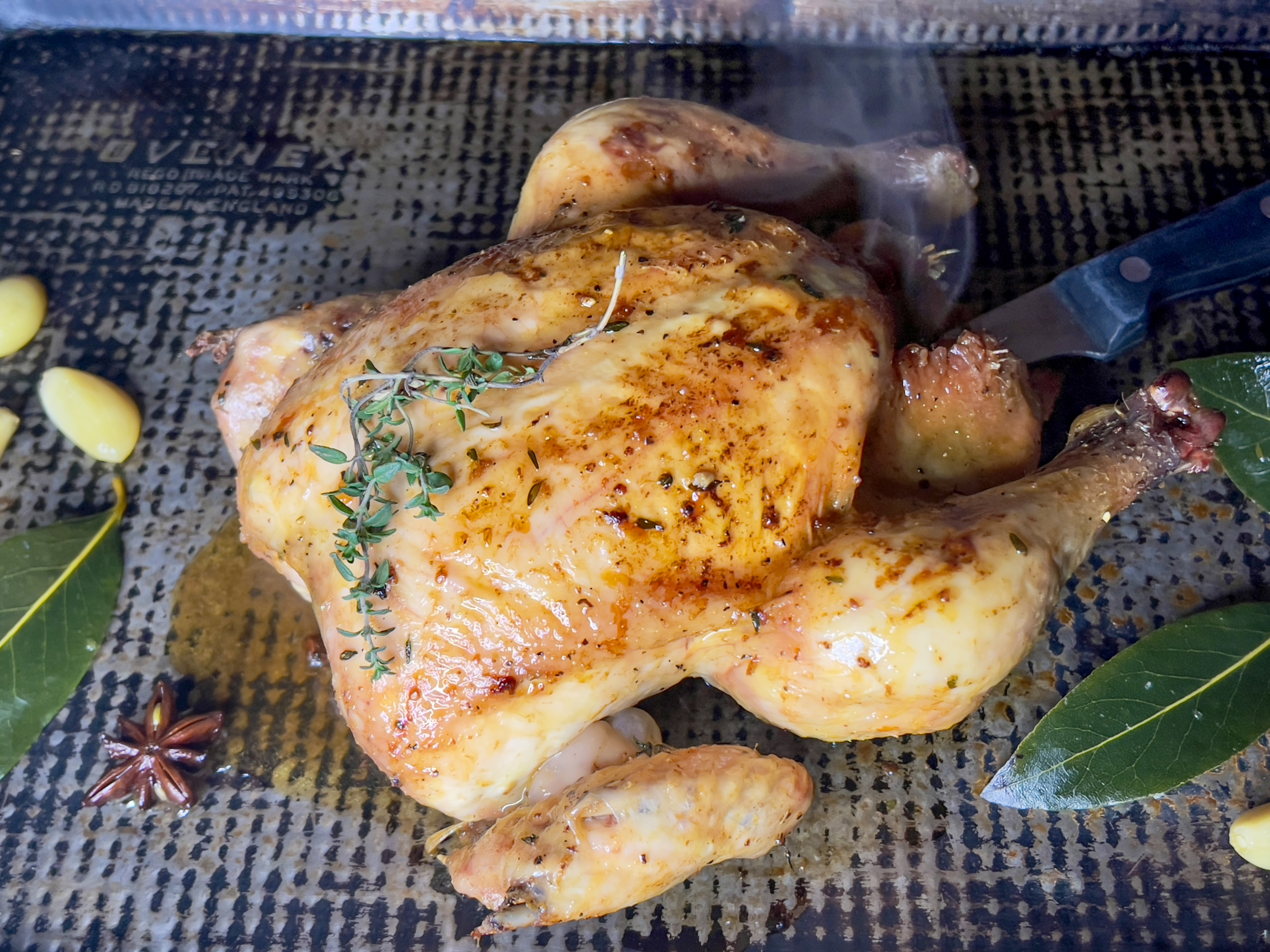
 Succulent bird: A brined chicken after roasting. (Photo: Tony Jackman)
Brining, like any kind of food preservation, started out of necessity in very ancient times, many centuries before the refrigeration available in our very recent times.
We tend to think of periods as recent as the decades of the previous century — remarkable eras such as the Roaring Twenties, the Swinging Sixties, the disco era of the Seventies — as being “long ago”, but really they’re just the other day.
Those of us who were around in some of those times (well, not the 1920s, obviously) shake our heads and chuckle quietly when someone younger says something like “way back in the Nineties” (I’ve heard that more than once). The other day I read a Facebook post shared by a friend that referred to the Nineties as “a bygone era”. 🤦 As if it were the late 1890s and Queen Victoria was still wearing her mourning black.
No, I’m talking about far distant time. How about 2,400 BCE? That’s how long it is, give or take, since brining meat was first introduced in ancient Mesopotamia, to help meat stay fresh and edible for longer. It’s been a part of many world cultures since those remote days.
But we can take such methods and retain them for our own purposes, not so much to preserve foods as to make them more flavourful and, in the case of a whole chicken, to encourage the flesh to remain moist and succulent once it’s been roasted in a very hot oven. Roasting can really dry a bird out, and brining fixes that, ahead of time.
Brining a turkey, come Christmas time or the American Thanksgiving feast, is an excellent way to turn out a very large bird that has divine flavour and stays succulent after that very long cook.
This is not something I have deep experience of, so I did my research (well, I always do my research, even if I know a subject well, just so that I can learn more about it and increase my knowledge).
Sign up to Tony’s weekly newsletter here. It’s free, and in your inbox every Friday afternoon. If it goes to promotions or spam at first, please drag it into your inbox.
The ratio of salt to water for a brine ranges between 5 and 10%, on average. For instance, a “7% brine”, which is a thing, would mean 70g of salt per litre, so 140g for my brine recipe below, which requires about two litres of water.
The argument is that if you’re adding sugar to the brine as well as salt, the ratio should be around ¾ of salt to ½ of the sugar content. But I would say taste preference should also come into play. I put sugar in the brine only because I like the idea of that balance between salt and sugar, while the other ingredients — the herbs and spices, garlic and the like — do the rest of the work of adding lots of flavour to the bird before it is roasted.
That is, if you use sugar at all, because you can brine a chicken in just a salt solution. But I would add sugar, because it aids the browning of the chicken skin, helping you to achieve that perfect golden finish.
But salt and sugar alone are not enough, because in our times the more important reason to brine is to add flavour, and for that we need aromatics. Bring on the herbs, the spices and the alliums (garlic, onion or both), and citrus zest if you like.
This is a meal to plan a day in advance, so that the chicken has time to rest in its brine. So start the day or evening before, and roast it the following day. Having said that, though, you can brine a bird overnight, as my recipe suggests. Just a few hours will do the job, so you can start in the morning if you prefer, but be sure to allow additional time for the chicken to dry out once removed from its brine. My best advice is to brine it overnight.
(Serves 4)
Ingredients
1 chicken, rinsed and dried
For the brine:
2 litres water, or enough to cover the bird
½ cup smoked Maldon salt
¼ cup pale brown sugar
1 head of garlic
3 large bay leaves
4 dried Thai lime leaves
1 star anise
1 Tbsp fennel seeds
1 Tbsp black peppercorns
A handful of thyme sprigs, rinsed
For roasting the chicken:
3 Tbsp butter
1 Tbsp thyme leaves, picked
Garlic salt
Ground black pepper
Method
For the brining, put the water, salt, sugar and all of the aromatics into a large heavy pot (one that has a lid) on the stove. Turn the heat on high and bring it to just before a boil, stirring while the sugar completely dissolves. Turn off the heat and allow it to cool to room temperature.
Prick the bird all over with a bamboo skewer, to allow the brine to penetrate the flesh. Once totally cooled, immerse the chicken in the brine to cover. Put the lid on and refrigerate overnight.
The next day, well before you plan to roast it, remove it from the fridge and take the chicken out of the brine juices to bring it to room temperature. Leave the chicken in the open (I put it in a colander over the sink) for the skin to dry in the open air. Bear in mind that I did this on a cool day. If it’s too hot, air dry it in the fridge, but remember to bring it back to room temperature at least an hour before roasting it.
Preheat the oven to 200°C.
To roast the chicken, melt the butter in a small saucepan and add the thyme leaves. Let it stand to infuse for five minutes or more. Brush the entire skin of the bird with this. Then, season the chicken all over with garlic salt and black pepper. Place it on a rack over an oven pan.
Roast in a preheated oven at 200°C for 15 minutes, then turn the temperature down to 180°C and continue to cook for another 75 minutes, i.e. a total cooking time of 90 minutes, or until the bird is cooked to the bone. Test by inserting a skewer into the thickest part of the breast and thigh/leg; if the juices run clear, it’s done, if pink, cook a little longer until they run clear. Rest for 10 minutes and carve. DM
Tony Jackman is Galliova Food Writer 2023, jointly with TGIFood columnist Anna Trapido.
Order Tony’s book, foodSTUFF, here.
Follow Tony Jackman on Instagram @tony_jackman_cooks.
Comments
Scroll down to load comments...