




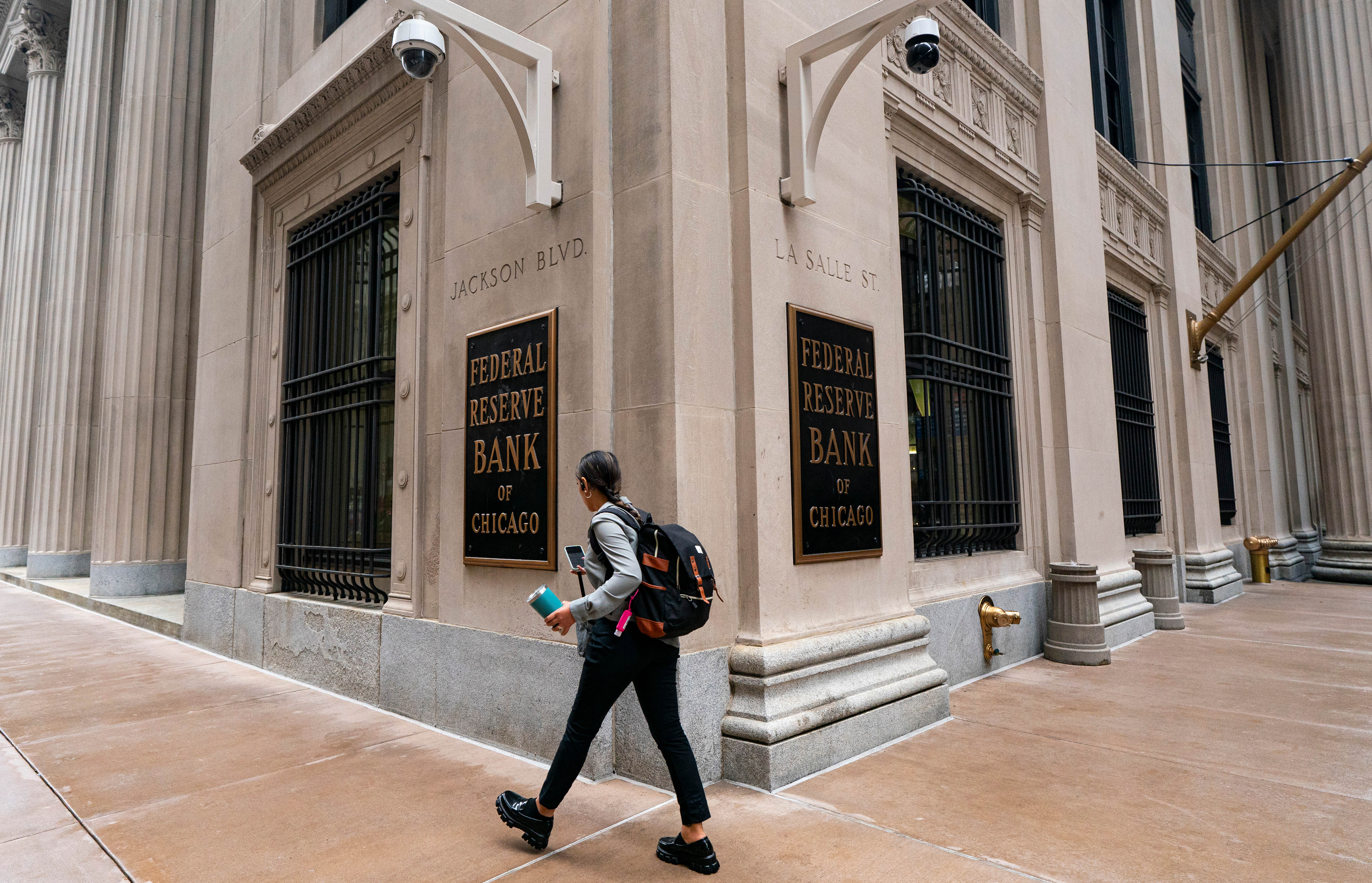
 The Federal Reserve Bank of Chicago in Chicago, Illinois, US, on Thursday, Aug. 15, 2024. (Photo: Al Drago/Bloomberg via Getty Images)
 The MSCI Asia Pacific Index rose as equities in Japan, South Korea and Australia advanced, while mainland Chinese shares slipped. A gauge of global stocks set a fresh peak alongside US shares on Thursday.
The BOJ kept its monetary policy settings steady Friday, signalling it sees no need to hurry with interest rate hikes as it monitors financial markets after its July increase and hawkish views spooked investors. Data released earlier showed the nation’s key inflation gauge accelerated in August for a fourth consecutive month.
“The focus now shifts to Governor Ueda’s press conference,” said Shoki Omori, chief desk strategist at Mizuho in Tokyo. “Depending on the degree of this tone, if the hawkish stance is clearly conveyed to the market, the USD/JPY exchange rate is expected to trend downward.”
Treasury yields were little changed on Friday while an index of dollar strength was locked in a narrow range.
A drop in US jobless claims to the lowest since May signalled the labour market remains healthy despite a slowdown in hiring. This added a boost to risk appetite and eased concerns the Fed may have been too slow to trim borrowing costs when it cut rates by half a percentage point on Wednesday.
The equity gains on Thursday and Friday mark a “delayed euphoric reaction,” to the Fed but one that may retreat, according to Nick Ferres, Chief Investment Officer of Singapore-based Vantage Point Asset Management. “Valuation is already heroic and risk compensation is poor, particularly if the earnings cycle disappoints.”
Over in China, banks maintained their benchmark lending rates for September, as policymakers held off on further monetary stimulus while financial institutions struggled with record-low profit margins. The Securities Times reported on Friday that this week’s Fed rate cut has provided room for China to increase monetary and fiscal stimulus to support the economy.
The European Union and China agreed to intensify discussions to avert looming tariffs on electric cars ahead of a deadline that’s only days away.
Elsewhere, Wall Street banks are divided on the pace and extent of upcoming Federal Reserve rate cuts. JPMorgan Chase & Co. expect another 50 basis point reduction in November, while Goldman Sachs Group Inc. anticipates 25 basis point cuts at each meeting from November to June next year.
In Asia, Taiwan’s property and construction stocks dropped Friday following the central bank’s decision to increase the amount of funds banks must hold in reserve to cool the sizzling property market.
Data set for release include inflation for Hong Kong and foreign exchange reserves for India.
In commodities, gold steadied near a record high while oil was on track for the biggest weekly advance since April after the US rate cut.