




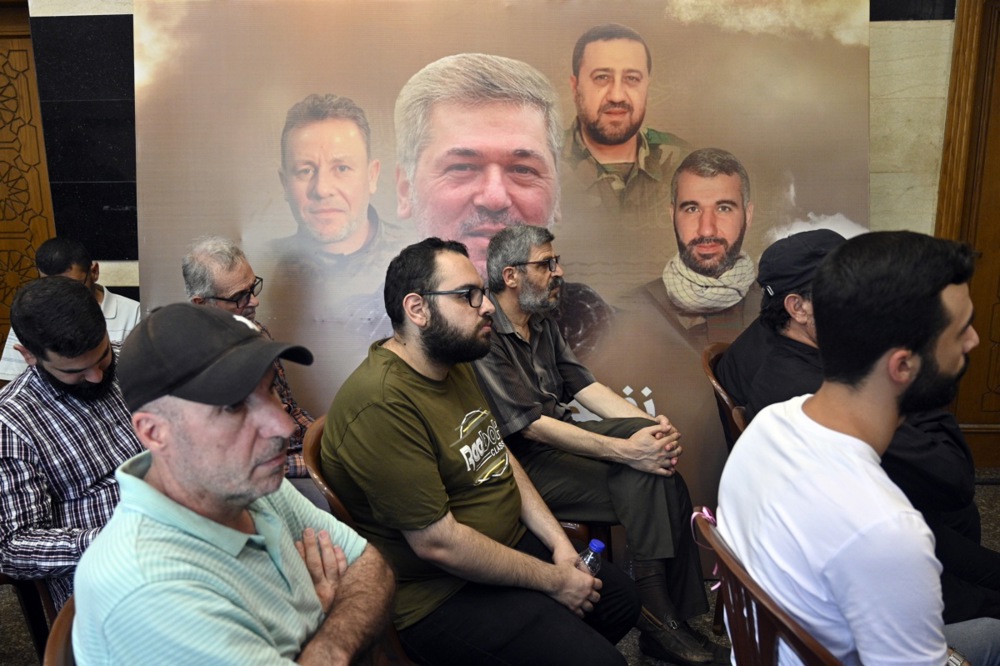
 Supporters of Hezbollah listen to their leader Hassan Nasrallah (not pictured) as he delivers a speech via a screen at a memorial ceremony for senior Field Commander Taleb Sami Abdallah, known within Hezbollah as Hajj Abu Taleb who was killed on 11 June, in a suburb outside Beirut, Lebanon, 19 June 2024. Four Hezbollah fighters, including the senior field commander Taleb Sami Abdallah, were killed after the Israeli attack on a residential building in Jwaya town in the Tyre district, southern Lebanon on 11 June. EPA-EFE/WAEL HAMZEH
 The militant group, backed by Iran, often uses the wireless devices for communication without being intercepted by Israeli forces. The Israeli military declined to comment on the incident when contacted by Bloomberg.
The blast took place mainly in the southern suburbs of the capital Beirut, where Hezbollah has a significant presence. The group said at least three of its members were killed in the blasts.
The cross border attacks between Israel and Hezbollah has worsened in recent months. Israeli politicians, including Prime Minister Benjamin Netanyahu, are increasingly warning that a full-on war is inevitable.
Read More: Israel Says Push to Return Residents to North Is Now a War Goal
Tens of thousands of civilians have been displaced in southern Lebanon and northern Israel because of the skirmishes, which began right ater the Israel-Hamas war erupted in Gaza in October. On Monday evening, the Israeli cabinet said enabling residents displaced by Hezbollah attacks to return home is now a formal war objective, signaling the country is closer to an all-out offensive against Hezbollah.
Lebanon’s Ministry of Health asked hospital staff to report to duty and urged people to donate blood, with Minister Firass Abiad telling AFP news wire that hundreds were injured as a result of the explosions.
One of Beirut’s main hospitals said it was at full capacity and urged people to go elsewhere for treatment.
“There is foul play,” Lebanon’s Telecoms Minister, Johnny Corm, told Bloomberg by phone. “It’s an aggression of course.”
Television footage from Beirut showed a man covered in blood sitting on the ground as many others apparently wounded in the explosions were being carried away. The Lebanese Red Cross said more than 50 ambulances were dispatched to treat the injured.
Shortly after the explosions, Netanyahu and his Defense Minister Yoav Gallant held a security briefing in Tel Aviv, according to the Kan public broadcaster. Local authorities in Israel were alerted to the possibility of an escalation of hostilities with Hezbollah, the report said. Israel’s military did not immediately issue any new security guidelines.
Hezbollah fighters are believed to use low-tech devices, including walkie talkies and pagers, to avoid Israeli intelligence intercepting their communications. Pagers largely stopped being used in the West more than a decade ago.