




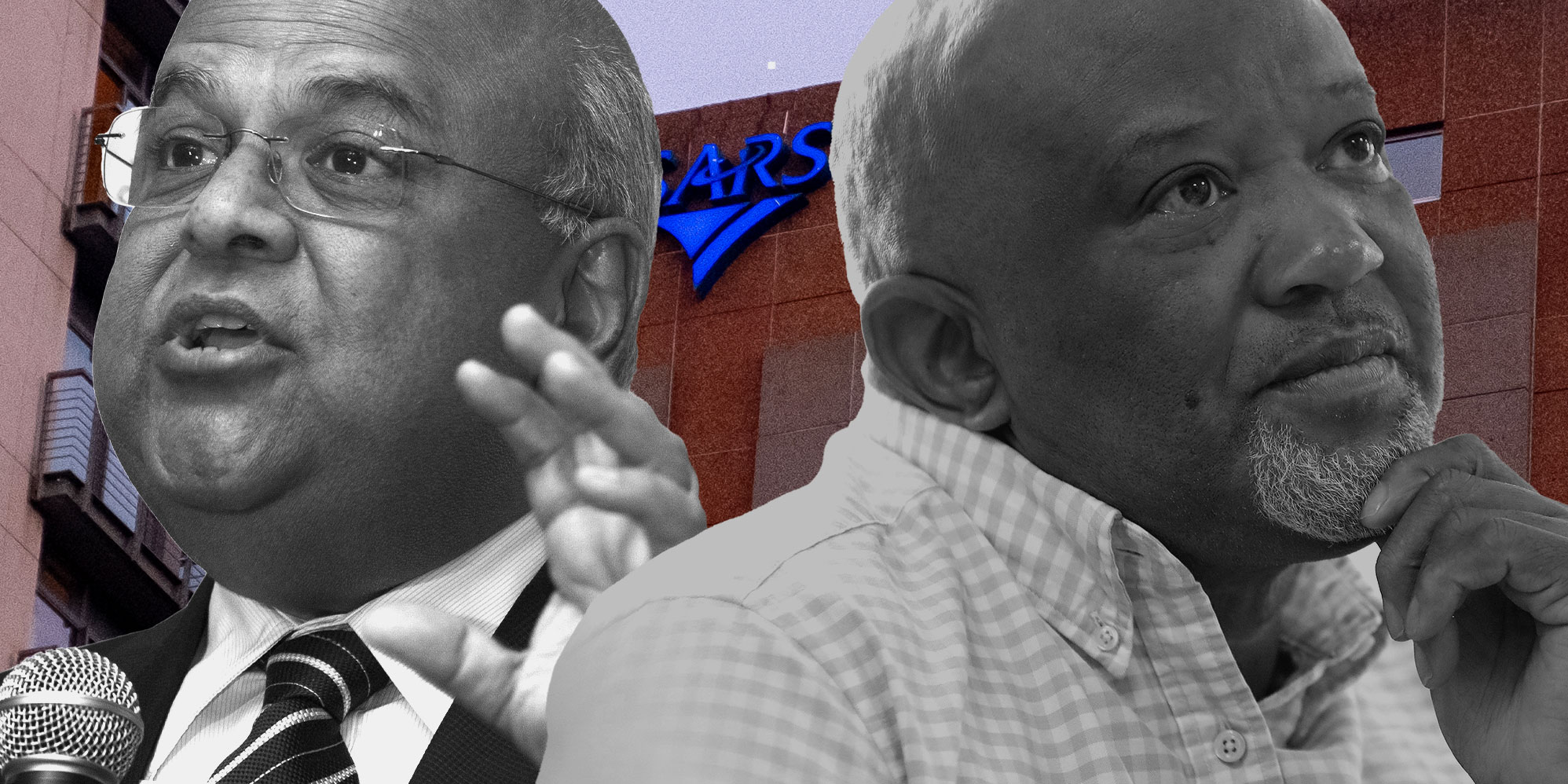
 Illustrative image: SARS builing in Cape Town (background). (Photo: Kyra Wilkinson) | Pravin Gordhan (left). (Photo: Gallo Images / Martin Rhodes) | Former deputy minister of finance Mcebisi Jonas (right). (Photo: Thulani Mbele)
 National treasuries are not designed to be institutions of high drama. They are the heart of the bureaucracy and are supposed to move in predictable patterns. Most of the staff at the National Treasury are meant to be the technocrats working behind the scenes to keep the wheels of government turning.
Regrettably, South Africa’s Treasury became the centre of political theatre. This was particularly so during one momentous week in March 2017 that began with a text message flashing on the phone of the minister of finance, Pravin Gordhan, on the tarmac of London’s Heathrow Airport, instructing him and our team to return immediately to South Africa.
The week ended with Gordhan and his deputy, Mcebisi Jonas, being fired and two new principals being installed at the Ministry of Finance. The very foundation of the National Treasury shook that week.
I first made contact with Gordhan when I was employed at the National Treasury as director responsible for multilateral development finance. Minister Trevor Manuel, deputy minister Gill Marcus and director-general Maria Ramos then headed the Treasury. My responsibilities included the renegotiations of the Southern African Customs Union (Sacu) revenue sharing formula (RSF) and re-engagement with the Bretton Woods Institutions, including the African Development Bank (AfDB).
Gordhan subsequently headed the South African Revenue Service (SARS). On both Sacu and AfDB public finance, engagements between the Treasury and SARS always concluded with a detailed legal interpretation of the Constitution and relevant Acts.
This applied to matters concerning the “tax treatment of South Africans employed at the African Development Bank or the fair application of the Sacu RSF”.
Gordhan’s extensive and detailed knowledge of public finances in South Africa and his eagerness to always know more made him an authority on this subject and he was always prepared for intellectual and strategic conversations in this regard.
His extensive knowledge, wisdom, political experience and welcoming disposition unequivocally shaped policy formulation and implementation in post-democratic South Africa.
I interacted closely with Gordhan during the two terms that he served as finance minister: from 2009-2014 and again from 2015-2017. South Africans are indebted for the way he boldly defended citizens’ constitutional rights to access socioeconomic services by tackling corrupt practices against the state. I have vivid memories of Gordhan, the “freedom fighter turned corruption fighter” when South Africa most needed a principled individual at the helm of public finances.
Agility and resilience
Over the years, Gordhan instilled within me — and I have no doubt, in many of my former colleagues at the Treasury — the qualities of resilience and agility that put me in good stead for the targeted and deliberate attacks aimed at dismantling the solid public finance institutional foundation on which the Treasury is built. Gordhan and others helped to fashion one of the finest Treasury departments in the world.
Strengthening my own agility and resilience served me well during the height of State Capture, particularly when the Treasury became an obvious target. A communicator par excellence, Gordhan was always best qualified to engage with international investors at international roadshows. These international roadshows are typically held following important public finance presentations, like the national budget and the Medium-Term Budget Policy Statement.
In March 2017, Gordhan led a delegation of senior officials from the South African Reserve Bank and the Treasury on an investor roadshow to the UK and the US.
The roadshow included meetings with international fund managers across Europe and the US and senior representatives of all the major international credit rating agencies.
It is now well known that upon arrival in London, following an overnight flight from Johannesburg, official communication from the Presidency was received requesting that Gordhan and the Treasury director-general, Lungisa Fuzile, immediately return to South Africa, following the release of an “intelligence report”.
Notwithstanding this urgent presidential instruction, Gordhan attended all the investor and rating agency meetings scheduled for that day. This act illustrates his principled commitment to his oath of office: “swearing or solemnly affirming that I will be faithful to the Republic of South Africa and will obey, respect and uphold the Constitution and all other law of the Republic”.
Gordhan’s strong family values filtered into the Treasury family, sparking their passion and dedication to excellence in service of the nation.
Minister Gordhan, you shaped and transformed me into the public servant I am today.
You taught me the critical skills needed to find synergy between effective public finance management and advancing socioeconomic transformation. You taught me how to “connect the dots” and act on information gathered.
You were a corruption fighter indeed. South Africans can be proud to have witnessed the actions of such an outstanding individual, who contributed meaningfully to the institutional foundations of our public finance architecture. DM
Anthony Julies is a former deputy director-general at the National Treasury.