



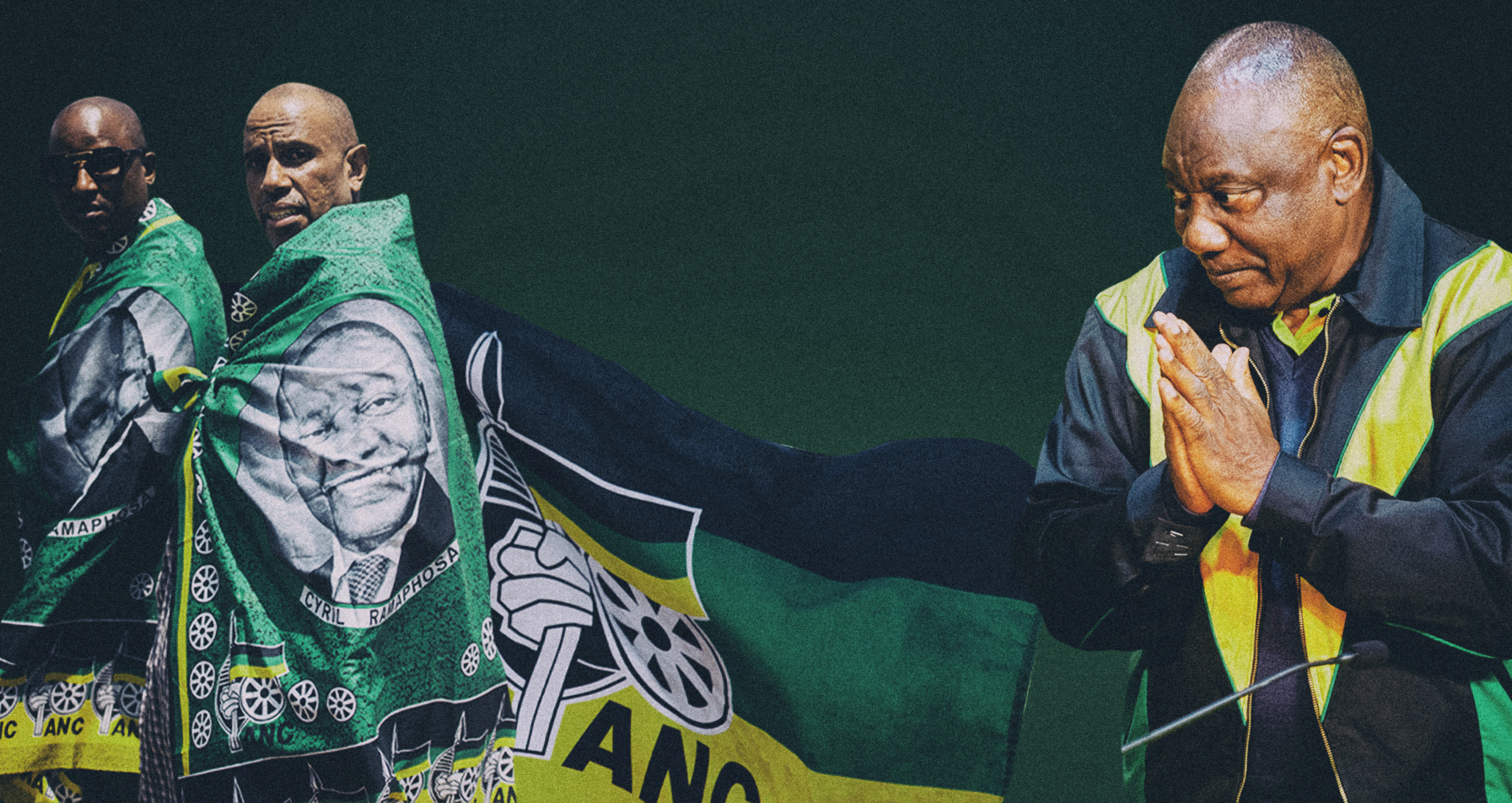
 Illustrative image: ANC supporters. (Photos: Gallo Images / Alet Pretorius | OJ Koloti / Gallo Images) | President Cyril Ramaphosa. (Photo: Gallo Images / Alet Pretorius)
In the lead-up to the 29 May elections, the ANC faced significant challenges. High levels of load shedding over the preceding year, a soaring cost of living and widespread joblessness overshadowed its prospects of retaining its grip on power.
But the reality that the party would lose its majority didn’t kick in until the final votes were tallied, President Cyril Ramaphosa told eNCA’s Annika Larsen in an interview for the three-part series 29 Days in June.
As the results started trickling in, Ramaphosa recalled how he and his comrades waited in anticipation of votes coming from some of the country’s most populated areas and traditional ANC strongholds, including Soweto and Umlazi, which in previous elections had “boosted” the party’s numbers.
Ultimately, the ANC received 40.2% support nationally, a 17 percentage point drop from the 2019 elections.
“I thought this would come one day, but I never thought it would come now,” said Ramaphosa.
The President said various people, including Roelf Meyer, the National Party’s chief negotiator at the talks to end apartheid, had approached him to discuss the prospect of forming coalitions.
“Prior to the election results, I was approached by a lot of people like Roelf Meyer, but I didn’t want to talk because I thought the ANC would win.
“It was the most unbelievable outcome. Even with the entry of the MK party, I knew that they would pick up votes but never to this extent,” said Ramaphosa in the eNCA interview.
However, the ANC’s loss of support had been predicted by polling. The Social Research Foundation suggested the ANC would drop to 45%, while a Brenthurst Foundation poll pegged the party at 43%. A month before the vote, an Ipsos poll found the ANC had 40.2% support.
Read more: Infinite patience no more — the ANC must show it can tackle corruption now, or face further decline
‘If the shoe fits’
Following the declaration of the results, the ANC was forced to think long and hard about its next move. Its options included sitting on the opposition benches, forming a coalition or forming a Government of National Unity (GNU). The latter prevailed, with 11 parties joining.
The leaders of the DA, IFP, PA, FF+, PAC and Good party were all given Cabinet positions. Overall, Ramaphosa gave the DA six Cabinet positions, the IFP two, the PA one, the PAC one, the Good party one and the FF+ one.
The MK party, which came third in the elections after the ANC and DA, never appeared likely to join the GNU, while the EFF, which came fourth, did not join the GNU.
Ramaphosa said he had met its leader, Julius Malema, to speak about how the EFF could participate.
This was even though the Red Berets had on multiple occasions called for his removal, and said that following the elections, the ANC would be “surgically” removed from power.
Ramaphosa said it would have been impossible to form a government with the EFF.
“Our option was to have parties that would subscribe to the key elements that we put in the Statement of Intent and that contained the values, the key principles and those that would subscribe. We said, ‘If the shoe fits you, you can wear it.’
“But then somehow, behavioural tactics like those that were displayed in some of those negotiations just demonstrated to us that the shoe didn’t quite fit [the EFF]. Statements like ‘We are going to finish you off’ and all that, that did not come across as being collegiate, being prepared to work together, because you cannot want to work with someone who is hell-bent on your destruction.”
Read more: GNU talks were on a knife-edge — Alan Winde on how Floyd Shivambu ‘saved South Africa’
It took two weeks to negotiate the GNU and Ramaphosa said the days leading up to its formation had caused much anxiety and uncertainty among his colleagues in the ANC. Some thought the inability to immediately form a government would lead to instability in the country.
“I was rather calm through it all because I somewhat knew what needed to be done, that the ANC must be the one to provide leadership,” he said.
Ramaphosa said he told them to “relax” as he was confident that there would be no instability because the government from the previous administration was still in place and the country was still functioning.
“I said to them, ‘Let’s take our time and do it perfectly.’ "
Asked about the future of the GNU beyond his tenure as President, Ramaphosa was confident that it would stand firm.
“The GNU does not revolve around a personality. It brings together political parties and institutions, and what we have put together is a system, a structure that is meant to work for the people of South Africa.
“I see this carrying on. It may well mutate into a different form as time goes on, but for now, it is a government of unity that is going to drive the prosperity that the people of South Africa seek.” DM
Comments
Scroll down to load comments...