




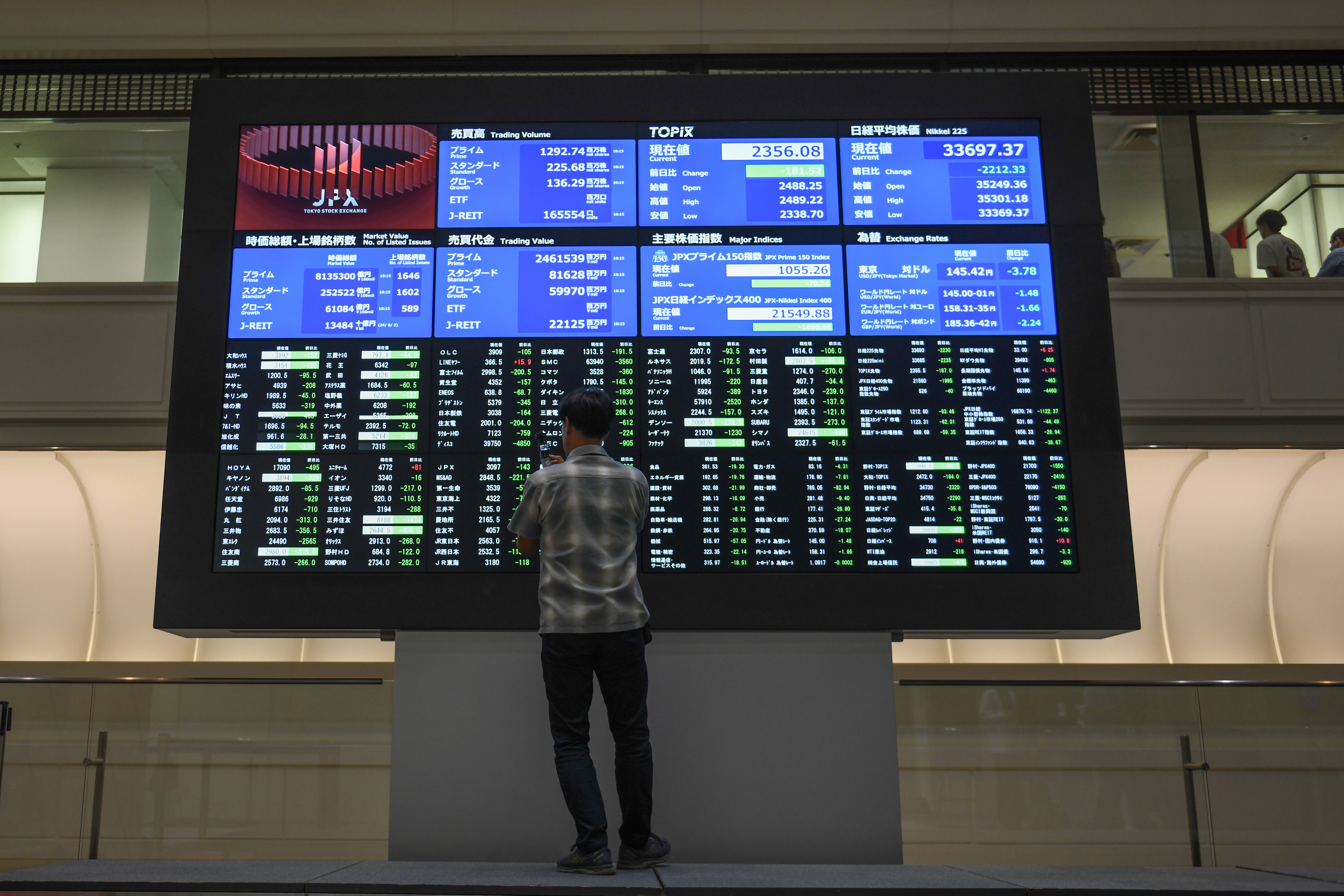
 An electric stock board at the Tokyo Stock Exchange (TSE) in Tokyo, Japan, on Monday, 5 August 2024. (Photo: Noriko Hayashi/Bloomberg)
Shares in Tokyo climbed while those in Australia and Hong Kong fell. South Korean and mainland Chinese shares whipsawed, while US equity futures dropped ahead of Wall Street’s reopening later on Tuesday, following the Labor Day public holiday.
Treasuries were little changed and an index of dollar strength rose. The yen was slightly firmer against the greenback after declining for four straight sessions.
Pimco Japan Ltd. expects the Bank of Japan to raise rates again as early as January, while Julius Baer is preparing for further weakness in the yen despite BOJ hikes.
“Our assumption is that the Bank of Japan policy rate will be half a percent by March next year and the fed funds rate will be 4.5% — that’s still 400 basis points of difference, which is very wide,”said Mark Matthews, head of Asia research on Bloomberg Television. “On that basis we do see the yen weakening.”
The South Korean won weakened after August inflation data showed year-over-year prices rose at the slowest pace since 2021. The Australian dollar fell.
Traders will be looking ahead to American manufacturing data due later Tuesday for clues about the health of the US economy in a busy week of economic reports that will reach a crescendo on Friday with the nonfarm payrolls data.
Markets are pricing a start to the US easing cycle this month, with a roughly one-in-four chance of a 50 basis-point cut, according to data compiled by Bloomberg.
Rates impact
The equity market rally could stall even if the Fed initiates a rate cut, JPMorgan Chase & Co. strategists cautioned, as any policy easing would be in response to slowing growth, while the seasonal trend for September would be another impediment, the team led by Mislav Matejka wrote in a note.
“We are not out of the woods yet,” Matejka said, reiterating his preference for defensive sectors against the backdrop of a pullback in bond yields. “Sentiment and positioning indicators look far from attractive, political and geopolitical uncertainty is elevated, and seasonals are more challenging.”
Traders in Asia will be keeping a close eye on fresh signs of economic troubles in China. Data on Saturday showed Chinese factory activity had contracted for a fourth straight month in August, the latest signal that the world’s second-largest economy may struggle to meet this year’s growth target.
The slowdown in China has highlighted the urgency of fresh government stimulus, while inventories of key raw materials from steel to soybeans are piling up in the nation’s warehouses — evidence that economic activity remains too feeble to clear surpluses.
“The markets may be leaning too dovish into the September Fed meeting,” Valentin Marinov, head of G-10 FX strategy at Credit Agricole CIB. said on Bloomberg Television. “The dollar could recoup some ground once the markets realised that the Fed will move more cautiously.”
In commodities, oil edged higher after Libya declared force majeure at a key oil field amid widening shutdowns that have wiped out close to a million barrels from daily global supplies.
Elsewhere, the US is laying the groundwork for new sanctions on Venezuelan government officials in response to Nicolás Maduro’s disputed reelection in July. The country had ordered the arrest of presidential candidate Edmundo González, an escalation of the government’s crackdown on dissent in the wake of the vote.
Comments
Scroll down to load comments...