




 Photo: Supplied
On 10 June 1980, the South African Defence Force’s 61 Mechanised Battalion Group attacked a complex of Swapo military bases in southern Angola. A long day of bloody fighting ensued during which 13 SADF members died.
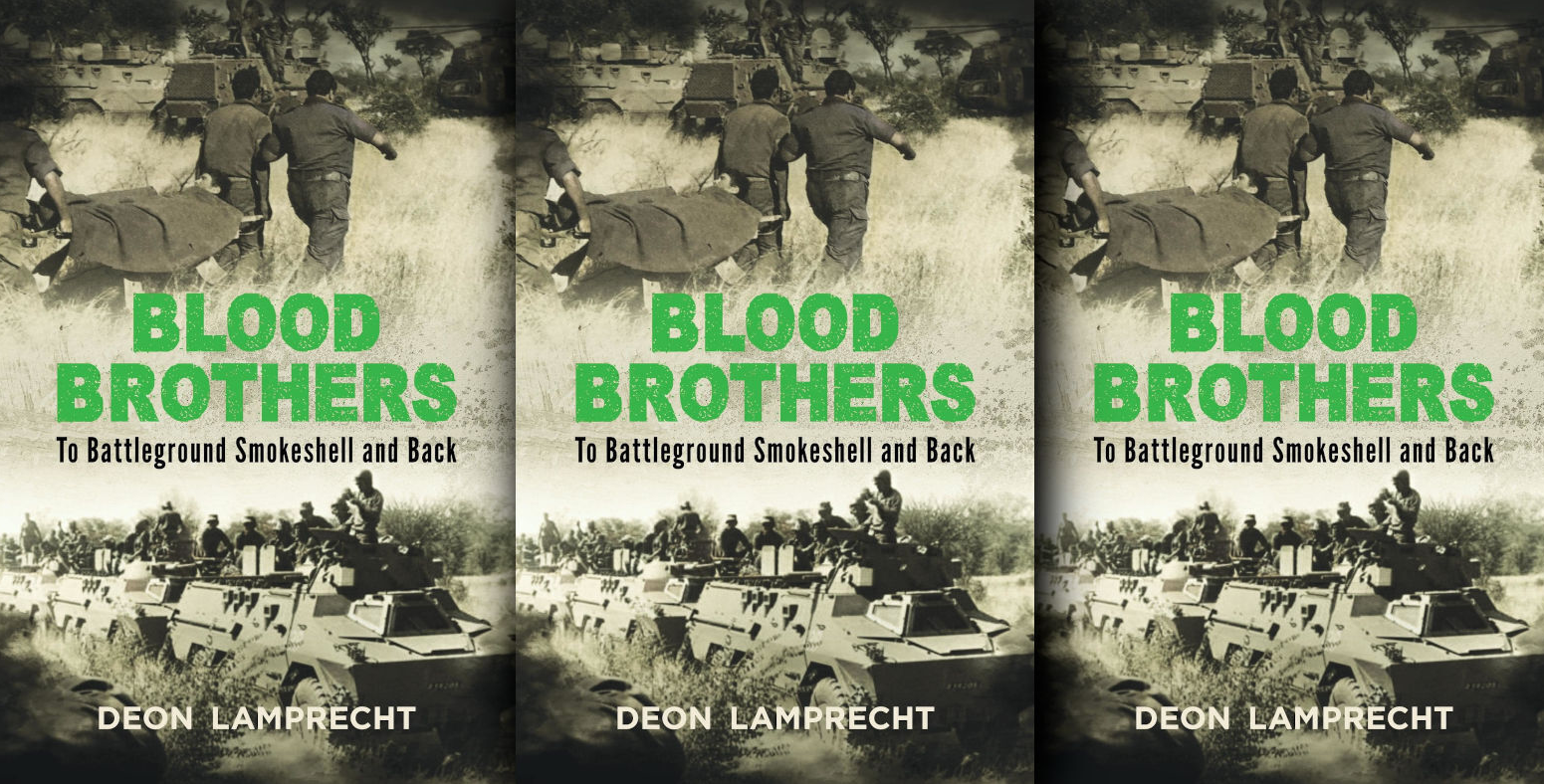
Deon Lamprecht’s Blood Brothers: To Battleground Smokeshell and Back investigates the human cost of war after the last shots have been fired and follows the veterans as they return to the battle site four decades later in search of peace. Read an excerpt.
***
For a long moment time stood still. The Swapo infantry and gunners were as startled as the South Africans, Paul Louw, platoon commander of Bravo Company during Operation Sceptic, recalls: ‘But there were hundreds of them and only 44 of us.’
Some seemed to run, but soon small arms fire was crackling like a veld fire around the Ratels. Only the 23 mm and the 14,5s remained silent: ‘They were set up to fire towards the west but we came from behind, from the east.’
The textbook was now well and truly out the window. Leaving the Ratels and fighting forward on foot, as they were so well drilled to do, was not an option just then. They were in the heart of the enemy position and they had to push through. The troops fired their R1 rifles through the firing ports lining both sides of the hull or tossed hand grenades through the open hatches above their seats.
HP Ferreira, behind the steering wheel of Ratel 21, saw a Swapo sharpshooter in a tree and instinctively swerved to smash down the tree and crush its occupant.
Ratel 21A was the first to suffer a mortal blow when an RPG-7 warhead hit the driver’s front window. ‘Kempie, the driver, was hit by splinters in the face … I believe he was blinded immediately and some glass splinters and other shrapnel probably entered his brain,’ Paul says.
The RPG-7 rocket launcher was another feared weapon. It was light and portable enough to be fired by one man concealed in the bush, simple to maintain and use, and devastating to the men packed into the confines of a Ratel.
‘Kempie’ was Gertjie Kemp, who had joined HP on the family farm near Theunissen during that last brief stint of leave before they returned to the Border.
Then, at a range of only about a hundred metres, the 23 mm and 14,5s opened up, and the men of Bravo Company were in a world of fire and blood.
***
Turning the yellowed pages of his diary, Gareth again seeks confirmation from the words he penned so long ago. The lined pages bear the symbol of the Southern Cross, revealing that it came from one of the tens of thousands of gift parcels handed to troopies by well-meaning tannies – many of them the wives of senior SADF officers or National Party officials.
‘It felt like the earth and bush radiated anger. The bush got thicker … then we veered to the right in line abreast and somebody shouted, “There’s one” and our 20 mm and Browning opened up.’ (The Browning 7,62 mm machine gun was mounted co-axially, next to the 20 mm cannon, in the Ratel turret and was the vehicle’s secondary armament.)
‘Through our sight blocks we saw hundreds of terrs looming up in the bush as we drove and we could hear the AK-47 rounds clattering against the hull.’
Jan Hoevers, the driver of 21B, glanced at his watch when he heard the first whip-like crack of an R1 rifle: ‘It was three minutes past twelve. Then the order to cease fire came through the radio headset and I thought: “What the hell for, the enemy’s right here?” But a moment later the order was reversed and everybody started blasting away.’
The Ratels soon filled up with acrid smoke and Gareth and his buddies were deafened by the sound of their own firing. Red-hot cartridge cases flew around the confined space as they were ejected from rifles.
‘Then I shot my first one. I saw him stagger back and as his hat flew off my memory took a photograph of his face … Madness took hold of us and we chucked M26 hand grenades like automatons as enemy trenches flashed past.’
/file/dailymaverick/wp-content/uploads/2024/08/Screenshot-2024-08-28-205956.png "Smokeshell. Photo: Supplied")
From his driver’s seat, Jan saw an enemy soldier with an RPG-7 rocket launcher fleeing in front of him: ‘My only thought was that if I drove past him, he was going to take us out with that thing from behind. I remember shouting at Willem, my back-up driver: “I’m going to get him!” I chased him down and I remember he looked over his shoulder at me with huge, fearful eyes, then he stumbled and I was over him.’
Later Jan was told that he also drove over a second Swapo fighter. ‘But I never saw a second guy. They said he was concealed under a bush.’
Fortune favoured Jan and his section that day, but not the Ratel on their flank.
‘I saw my best friend Gert Kemp, in 21 Alpha, was on the wrong side of me. He was driving where I should be … and then he got hit first, right through his driver’s window. Bloody hell.’
Behind Jan, in the adrenaline-crazed troop compartment of the Ratel, Gareth remembers laughing at the confused expression of a mate who threw two grenades without remembering to pull the arming pins: ‘He kept shouting: “Why won’t the bloody things explode?”’
Then everything changed. Gareth felt their Ratel turn and he realised they had passed their objective and were heading back for another go.
‘We were standing up in the open hatches and then we heard it: thunderous automatic fire. Something huge shooting and it sure as hell wasn’t ours. And in that moment, you know it’s tickets if that thing hits you. Everybody was terrified.’
Then the familiar command to ‘stap uit’ came over the internal radio speaker.
‘We sure as hell did not want to, but the vehicle stopped and the doors hissed open. And then we did everything according to the book, just as we were trained to do. The Ratel started reversing while Vos, our gunner, laid down overhead covering fire and we sprinted away.’
For a fleeting moment he wondered why he did not see the other sections of Platoon 1 leave their own vehicles to form skirmish lines. Why were they hesitating?
What he did not know was that death was already reaping its grim harvest among the other sections. Soon after Gert Kemp was hit in 21A, Paul’s Ratel 21 was also hit.
But the highest price of the battle at the objective called Smokeshell would be paid by Marco Caforio and his buddies in Charlie section.
***
Marco Caforio never could shake off that feeling of impending doom.
When recalling the events of 10 June 1980, Marco often refers to the superstitious nature of Italians. And he believes he had a guardian angel that day.
His Italian grandfathers fought in World War II: one as a paratrooper and the other – on his mother’s side – as a marine in the fascist San Marco Battalion. And it was the latter who arrived in South Africa with Marco’s parents in 1956.
At home they used to watch as the names of the Border War fallen scrolled down the television screen, Marco explains. ‘And my grandfather would always say: “God must take me rather than my grandson.” On 8 June, the day we left Omuthiya for Angola and Smokeshell, my grandfather suffered a heart attack and died. So that’s why I believe I had a guardian angel.’
Pink Floyd’s ‘Another Brick in the Wall’ was playing in the Ratel when they left Mulemba on the morning of the attack. But during that last advance they soon suffered a setback: ‘I don’t know what we hit, but the rear axle [the six-wheeled Ratels have three axles] broke. We were left stranded while the rest of the platoon kept going.’
Soon, vehicles from further back in the convoy came up to them. It was decided that Marco and his section would transfer to Ratel 9G (Nine-Golf), so 9G effectively became call sign 21C. They scurried to transfer all the extra ammunition and other necessities of war to their borrowed Ratel before setting off after their platoon. All the while Marco’s unease was growing: ‘I told Rob [de Vito] something’s not right.’
They got to the supposed target area, where Paul and the others had passed through shortly before, and briefly left the Ratel to check out the trenches: ‘But there was nothing, they were deserted. We saw no signs of damage from an air raid, no smoke, no movement in the surrounding bush. Nothing. We got back into the Ratel but suddenly the whole vibe had changed, all the okes were quiet now.’
Then, like Paul just ahead of them, they heard the tearing sound of a large cannon and, following the freshly made tracks of the other vehicles, caught up just in time for the charge up the river bank.
‘We went over and drove into an old maize field and then they were everywhere, just as surprised as we were. Some were having lunch and they simply left their mess tins full of food on the lips of the trenches. I started shooting and somebody shouted, “Stop, wait for the command,” but I thought bugger that and, like everybody else in our Ratel, carried on shooting.’
He was shaking, Marco recalls, as he realised this was it, ‘the real thing’. But he and Rob, shoulder to shoulder as they had always been during training, alternately squeezed off shots and tossed grenades as fast as they could. (Below the sight blocks along the sides of the hull were individual firing ports allowing them to fire their rifles from inside the vehicle. But to throw grenades, the riflemen had to use the hatches on top of the hull, briefly exposing their heads and upper bodies to enemy fire and flying shrapnel.)
A grenade hurled by Martin French apparently detonated a Swapo ammunition pile: ‘We felt the ground shake and heard WHUMP! WHUMP! WHUMP! as more stuff exploded. Martin grinned at me in triumph and shouted, “Hey, Marco!”’
He felt the Ratel churn around and suddenly the maize field they had just ploughed through was ahead of them again. Then he, too, heard the demonic roar of the enemy cannon and in the same instant they were hit.
‘It’s like that scene in the movie Saving Private Ryan. You know something terrible is happening but the world has gone utterly silent, as if you’ve just turned deaf. I saw blood coming out of Steve Cronjé’s mouth and ears and he tried to reach the hydraulic doors but collapsed dead before he could do so and I thought, “Fuck, what is going on, what is actually happening?” Your brain refuses to process it.’
But the unthinkable was happening: ‘A shower of green sparks (enemy tracers) were passing through the Ratel, as if somebody was welding inside. I saw Pip [Peter Warrener] crawling from the turret but his leg was gone, and I thought again, “What the hell am I seeing?” And the others must be seeing it too, but why is nobody saying anything? It’s like you’re outside your own body, looking down at yourself and just waiting for your turn to be hit.’
Marco did not realise that he was already wounded: ‘I later heard that one of our own hand grenades detonated inside the vehicle and the shrapnel tore into my hip and leg.’
He started shoving at Rob while screaming, ‘Get out, get out, they’re hitting us!’ And somehow he got out himself.
‘I don’t know how, but we were fit and strong, you know. I went flying through the hatch above my seat like a fish out of a barrel and landed on my back on the ground next to the vehicle. I could feel pieces of shrapnel moving around in my flesh and cutting me every time I moved, and I was bleeding. It hurt like hell but the adrenaline must have helped … I was desperate to find Rob and tell him I was wounded.’
He didn’t know that Rob would not be able to help … his friend and six others inside Ratel 21C were dead or dying. DM
Blood Brothers: To Battleground Smokeshell and Back by Deon Lamprecht is published by Jonathan Ball Publishers (R290). Visit The Reading List for South African book news, daily – including excerpts!
Comments
Scroll down to load comments...