




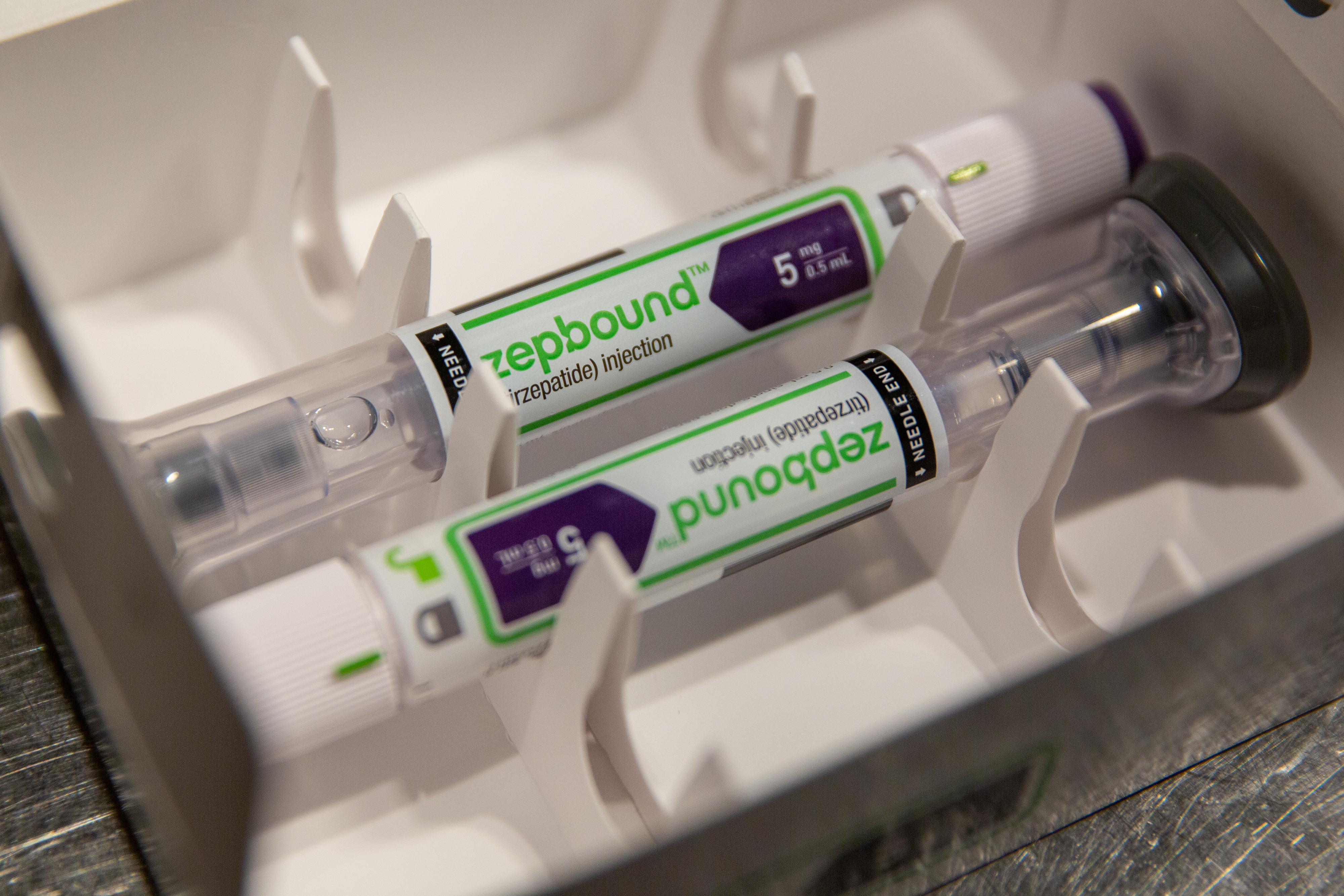
 An Eli Lilly & Co. Zepbound injection pen. Photographer: Shelby Knowles/Bloomberg
Patients with a prescription for Zepbound can purchase a month’s supply of single-use vials through Lilly’s direct-to-consumer site starting on Tuesday, the company said in a statement. The vials are priced at about half of what shots cost, with a higher dose going for $549 a month.
Zepbound is typically sold in an auto-injector pen. With vials, patients need to fill syringes on their own but it saves Lilly production time, allowing more people to get the drug.
The move is part of Lilly’s “all hands on deck” effort to ramp up supply of Zepbound and a similar drug for diabetes called Mounjaro amid widespread shortages, executive vice president Patrik Jonsson said in an interview. It also offers uninsured patients a cheaper option for weight-loss shots that can cost upwards of $1000 a month.
Both Lilly and rival Novo Nordisk A/S have struggled to keep up with insatiable demand for their obesity drugs — a market expected to reach $130-billion by the end of the decade. Zepbound and Novo’s Wegovy have gone in and out of supply since they launched, and the US Food and Drug Administration still considers them in shortage.
While the lower cost could bring down average Zepbound prices in the near term, the additional volume from vials “could prove to be a positive offset” to Lilly’s sales, analysts from Morgan Stanley said in a note.
The vials’ price may also raise pressure on Novo. This is a lever that Novo can’t pull for its own drug for the time being because it has had difficulty making enough of the active ingredient in its drugs, semaglutide. For Lilly, the complexity of making its injector pens has bottlenecked supply.
President Joe Biden, who has taken steps to lower drug prices, hailed Lilly’s price cut as “a welcome first step,” according to a statement on Tuesday.
“I am pleased to see one of these manufacturers, Eli Lilly, taking steps to lower their price by offering a direct-to-consumer version of their medication for less than half the price they used to charge,” Biden said in the statement.
Lilly shares rose 0.4% in New York on Tuesday and have gained nearly 64% this year. Novo was largely unchanged in Denmark.
Compounded versions
Because of the shortages, the FDA allows compounding pharmacies to make copycat versions of the drugs. While they’re sold as having the same active ingredient as Zepbound or Wegovy, these medicines aren’t as regulated as brand-name drugs and in some cases have landed people in the hospital.
Compounded versions often cost much less than the brand-name drugs. They’re fuelling an estimated $1-billion market that’s in direct competition with Lilly and Novo.
“By offering single-use vials, Lilly improves access for patients, significantly removing the need to consider using a compounder,” BMO Capital Markets’ Evan Seigerman said in a note. Shares of Hims & Hers Health Inc., a telehealth company that sells copycat weight-loss drugs, fell 6.1%.
Earlier this year, patients struggling to fill their prescriptions began urging Lilly to sell the drug in easier-to-produce vials, as it does already in other countries. “They have that ripcord they could pull here to alleviate the shortages,” Dave Knapp, who started a social media campaign to pressure Lilly to #ReleaseTheVials, told Bloomberg News in April.
The company announced during its earnings call in early August that it would launch single-dose vials of Zepbound. On Tuesday morning, Knapp said he was “honestly stunned” that the drugmaker followed through.
“We listen to feedback,” said Jonsson, who is also president of Lilly Cardiometabolic Health and Lilly USA.
The vials are only available through Lilly’s direct-to-consumer platform, LillyDirect, to patients who pay out-of-pocket.
Unlike going through compounding pharmacies, patients and doctors know they’re getting genuine Lilly medicine with the proper dosing, Jonsson said. The company will also include instructions on how to properly inject it.
In addition to alleviating supply pressure, the vials will also help expand access to millions of patients on Medicare, which doesn’t cover Zepbound, and who aren’t eligible for savings coupons, either. The drugmaker offers rebates to those whose commercial insurance plans don’t cover the drug, but not to people on Medicare.
The vials’ cost is “largely similar to net prices as they stand today,” according to Evercore’s Umer Raffat. Net prices are the revenues drug manufacturers earn after rebates and discounts provided to insurers. Lilly’s net prices for Zepbound may actually increase over time, Raffat said.
LillyDirect launched last year and now serves “thousands” of patients each week, according to Frank Cunningham, group vice president of global value and access at Lilly. Other drugmakers, including Pfizer Inc., have recently launched similar services.
Comments
Scroll down to load comments...