




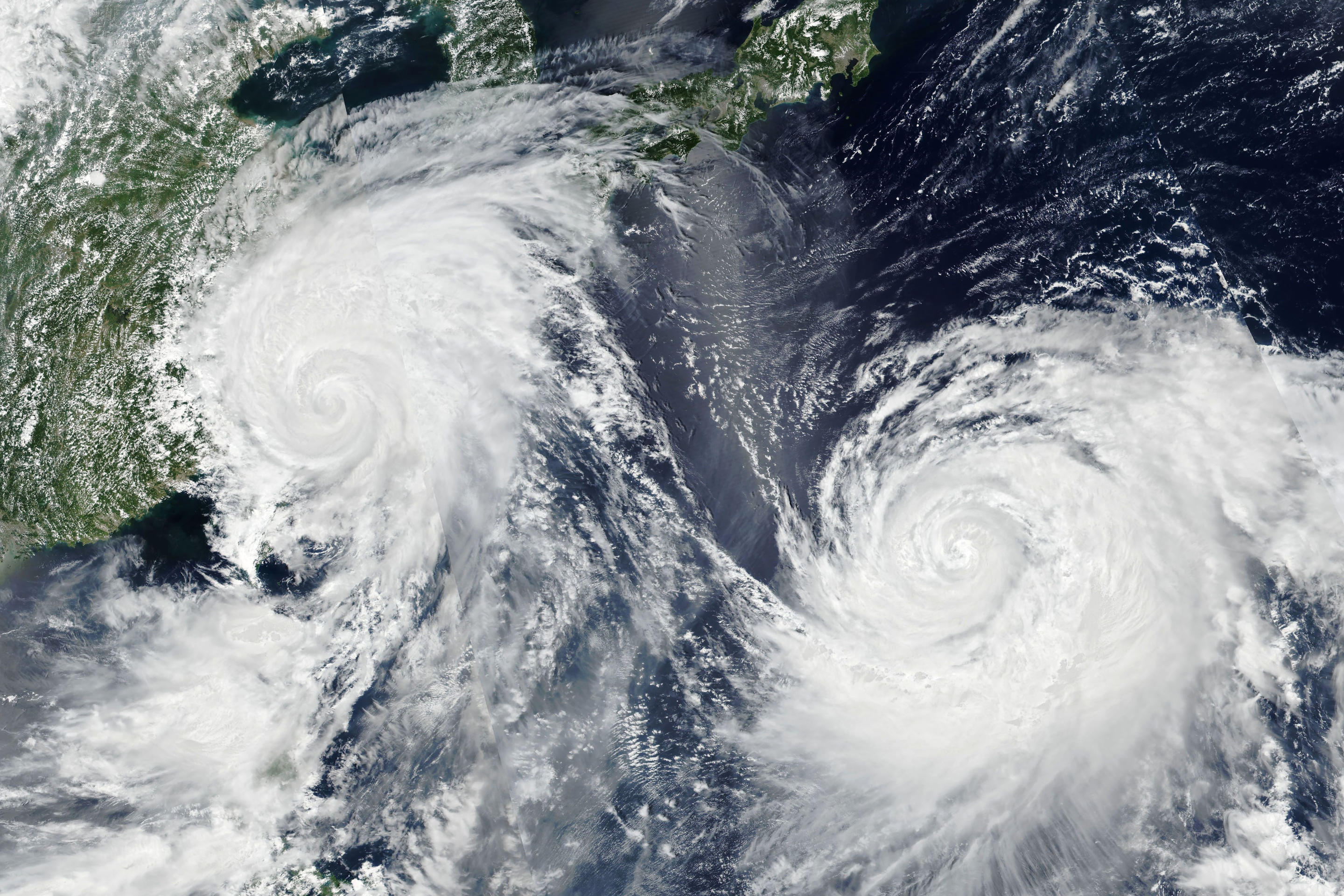
 A handout photo made available by NASA Earth Observatory shows a satellite image of Typhoon Lekima (L) and Typhoon Krosa (R) crossing the Western Pacific Ocean, 09 August 2019, threatening East Asian countries with destructive winds and rain. Typhoon Lekima made landfall near Shitangzhen, in China's Zhejiang province on 10 August 2019 at around 1 a.m. local time. Chinese authorities on 09 August issued a red alert warning residents of strong winds, heavy rainfall and coastal impacts threats in anticipation of the typhoon's landfall. Meanwhile Typhoon Krosa continues to follow a northerly path toward Japan, but its forecasted track remains uncertain. EPA-EFE/NASA EARTH OBSERVATORY HANDOUT HANDOUT EDITORIAL USE ONLY/NO SALES
The storm, currently south of Kyushu island, had maximum sustained winds near its center of 95 knots (176 kilometers) an hour, the Japan Meteorological Agency said in an update. It’s forecast to approach southern Kyushu through to Thursday, before making landfall, the agency said.
The JMA will consider issuing an emergency warning in some areas given the scope for strong winds, waves, and a storm surge in Kagoshima, the prefecture at the island’s southern tip, it said. The southern part of Kyushu may get 500 millimeters of rain in the 24 hours through to 6 a.m on Thursday.
Shanshan has been churning toward Japan at a slow pace this week, leading to long periods of rain and winds in impacted areas, the weather agency said.
Transport operators are already taking precautionary measures. Japan Airlines Co. said it would cancel 112 domestic flights on Wednesday, and a further 60 on Thursday. All Nippon Airways Co. said 80 flights would be canceled.
Kyushu Railway Co. said it would adjust some local services between Wednesday and Thursday. Central Japan Railway Co. said the Tokaido bullet train may be impacted between Friday and Saturday — the service connects Tokyo, the capital, on the neighboring main island of Honshu, to western parts of the country.
Kyushu Electric Power Co., which provides power to region, said it will halt two units at its Ohira pumped-storage power station on Wednesday. More than 12,000 buildings in Kagoshima and Miyazaki prefectures have been hit by power outages, according to Kyushu Electric Power Transmission and Distribution Co.
Comments
Scroll down to load comments...