




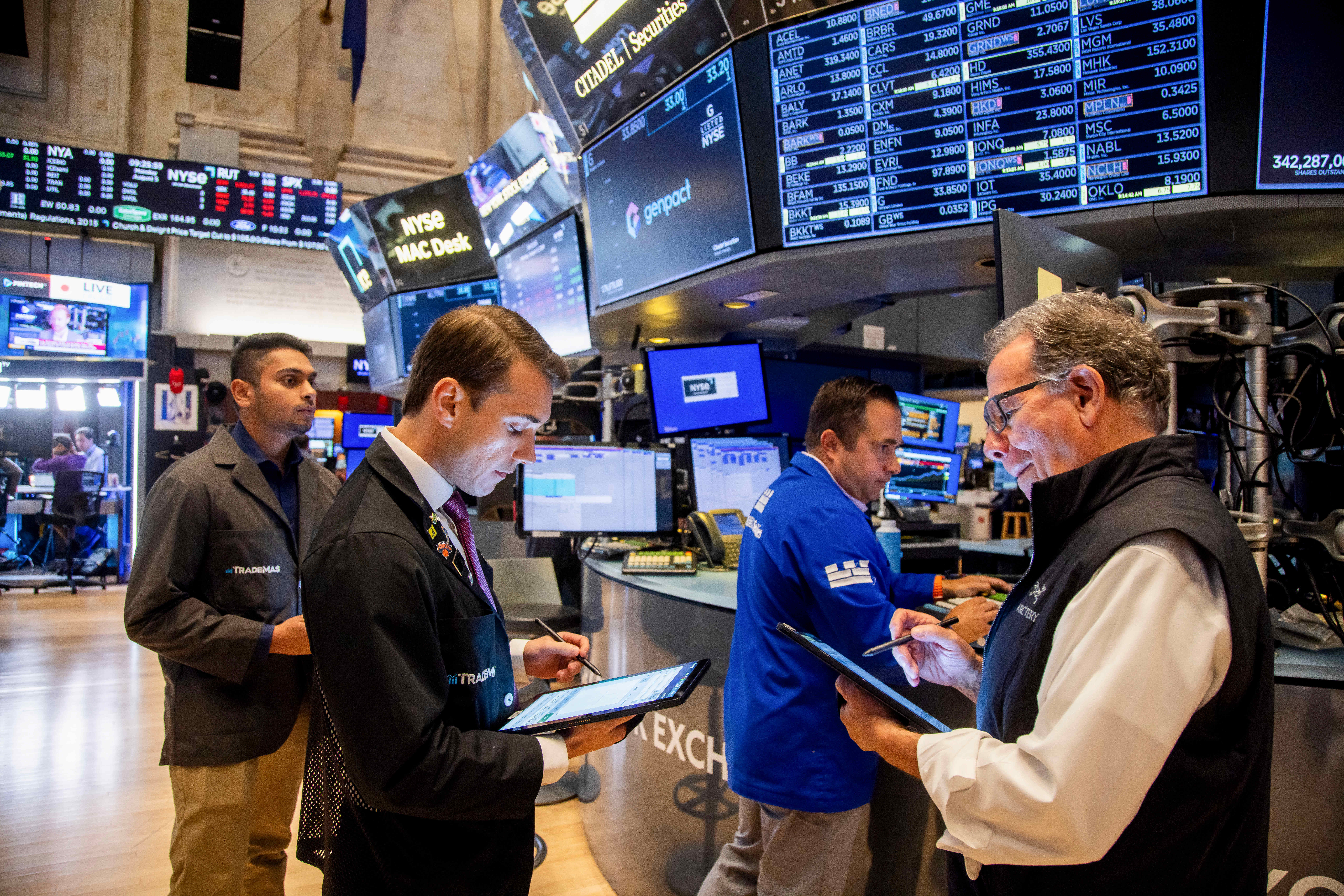
 Wall Street traders keep economy in focus.
That said, Friday brought another set of mixed readings on the economy. US consumer sentiment rose in early August for the first time in five months on more optimistic expectations about their finances as inflation steadied. The caveat is: the rise in sentiment was partially driven by political reasons after President Joe Biden’s decision not to seek re-election. New-home construction sank to the lowest since the aftermath of the pandemic.
“Investors should expect more volatility in the near term as the economic data likely give conflicting signals,” said Jeff Roach at LPL Financial.
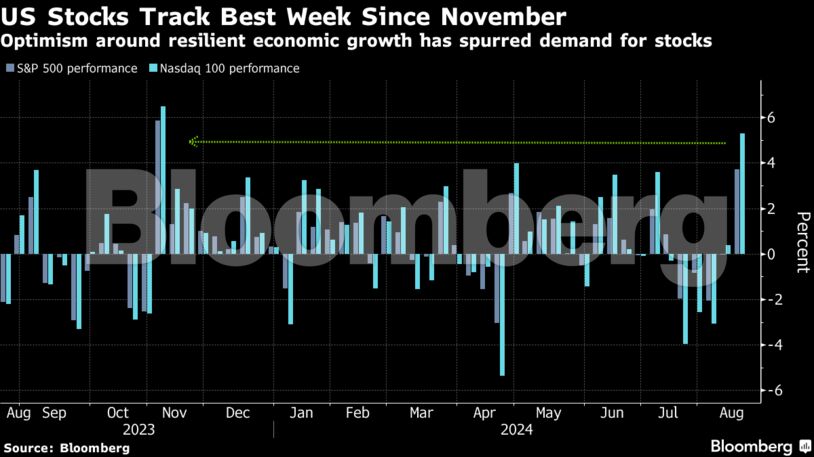
The S&P 500 hovered near 5,550. Most megacaps gained, with Alphabet Inc. leading the charge. Applied Materials Inc. sank after a sales forecast that disappointed investors looking for a bigger payoff from artificial-intelligence spending. Wall Street’s “fear gauge” - the VIX - dropped below 15.
Treasury 10-year yields fell one basis ppoint to 3.9%. The dollar dropped. Gold briefly topped $2,500, bolstered by hopes that the Fed is edging closer to cutting rates. Oil sank, with traders weighing the impact of a slowdown in China against a possible attack by Iran or proxies on Israel.
Fed Chair Powell will speak next Friday at the Kansas City Fed’s Jackson Hole Economic Policy Symposium.
With the central bank on the cusp of lowering interest rates from a more than two-decade high, Powell’s comments will be closely parsed for any hints on how the Fed chief is viewing the economy in the wake of a weaker-than-expected jobs report and further easing in inflation.
“The main message in Powell’s speech will likely be that monetary policy overall has worked as intended, and the current level of rates is restrictive,” said Anna Wong at Bloomberg Economics. “He may say the balance of risk between the Fed’s mandates - employment and inflation - is about even. We expect him to signal a rate cut is coming, but not to indicate whether it will be 25 basis points or 50 bps. That will depend on the August jobs report.”
Five Big Questions for the Fed at Jackson Hole: Bill Dudley
Next week’s Jackson Hole symposium will be the “perfect platform” for the Fed to set policy expectations for September, according to TD Securities’ strategists.
“We look for Powell to signal that given recent progress, the Fed is likely to ease policy next month, without fully committing to the size of the rate cut,” they noted. “We expect a 25 basis-point reduction. The July FOMC minutes will offer a preview around easing discussions on Wednesday.”
While recent data have indicated that a 25-basis point cut in September seems more probable than a bigger reduction, given the Fed’s increasing emphasis on the labor market, the next jobs report will be crucial in determining the final decision, according to Fawad Razaqzada at City Index and Forex.com
“Still any strong hints of a cut in September at the Jackson Hole symposium could send the dollar lower and underpin the gold forecast,” he said.
At Bank of America Corp., Ralf Preusser says the next few weeks will likely determine whether the Fed ends up cutting by 50-75 basis points this year or more aggressively.
“We maintain a bullish bias in US rates, and would see a Jackson Hole-induced selloff as an opportunity to buy,” he noted.
Corporate Highlights:
- Boeing Co. Chief Executive Officer Kelly Ortberg met with union representatives during his first week on the job and said he’s “committed to reset” the relationship the company’s relationship with workers as the US planemaker heads into crucial labor negotiations next month.
- Texas Instruments Inc. is set to receive $1.6 billion in Chips Act grants and $3 billion in loans, the Biden administration announced Friday, marking the latest major award from a program designed to boost American semiconductor manufacturing.
- Rivian Automotive Inc. has paused production of the electric commercial van it makes for Amazon.com Inc. due to a parts shortage in the latest supply chain snafu for the EV maker.
- Bayer AG shares jumped following a significant win for the German company in the long-running cancer litigation over its Roundup weedkiller.
- BHP Group and union leaders in Chile reached a preliminary wage agreement on Friday, setting the stage for a resumption of normal production at the world’s biggest copper mine.
- A combination Covid-flu vaccination developed by Pfizer Inc. and BioNTech SE missed on one of its goals in a final-stage trial, a setback for the companies as they search for lucrative new uses of a technology that succeeded in the pandemic.
- Autodesk Inc. continued to use a controversial sales strategy after promising investors it would stop and ignored internal warnings about the risks of doing so, according to previously unreported internal documents.
This is a modal window.
Some of the main moves in markets:
Stocks
- The S&P 500 rose 0.2% as of 12:24 p.m. New York time
- The Nasdaq 100 rose 0.2%
- The Dow Jones Industrial Average rose 0.2%
- The MSCI World Index rose 0.5%
Currencies
- The Bloomberg Dollar Spot Index fell 0.3%
- The euro rose 0.3% to $1.1002
- The British pound rose 0.5% to $1.2913
- The Japanese yen rose 0.8% to 148.13 per dollar
Cryptocurrencies
- Bitcoin rose 3.1% to $58,451.52
- Ether rose 1.5% to $2,588.38
Bonds
- The yield on 10-year Treasuries declined one basis point to 3.90%
- Germany’s 10-year yield declined two basis points to 2.25%
- Britain’s 10-year yield was little changed at 3.93%
Commodities
- West Texas Intermediate crude fell 1.7% to $76.87 a barrel
- Spot gold rose 1.5% to $2,494.76 an ounce
This story was produced with the assistance of Bloomberg Automation.
Comments
Scroll down to load comments...