




 Wall Street closed down as tech stocks fell yesterday. .
“It may not have been as cool as yesterday’s PPI, but today’s as-expected CPI likely will not rock the boat,” said Chris Larkin at E*Trade from Morgan Stanley. “Now the primary question is whether the Fed will cut rates by 25 or 50 basis points next month. If most of the data over the next five weeks points to a slowing economy, the Fed may cut more aggressively.”
At Evercore, Krishna Guha said the July CPI was not perfect, but it was good enough as it was consistent with a tame read on the Fed’s preferred inflation measure. In addition, the central bank has disavowed data-point dependence, and is looking at the wider outlook and balance of risks, with downside risks to employment dominating since the July employment report.
“This is now a labor data-first Fed, not an inflation data-first Fed, and the incoming labor data will determine how aggressively the Fed pulls forward rate cuts,” Guha noted.
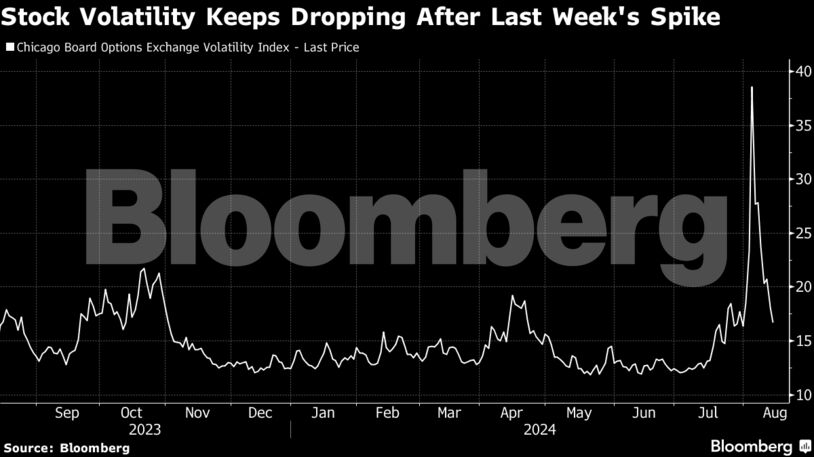
The S&P 500 hovered near 5,450. Wall Street’s “fear gauge” - the VIX - continued to subside, dropping below 17. That’s after an unprecedented spike that took the gauge above 65 last week, a rare level normally signaling utter panic. Treasury 10-year yields declined two basis points to 3.82%.
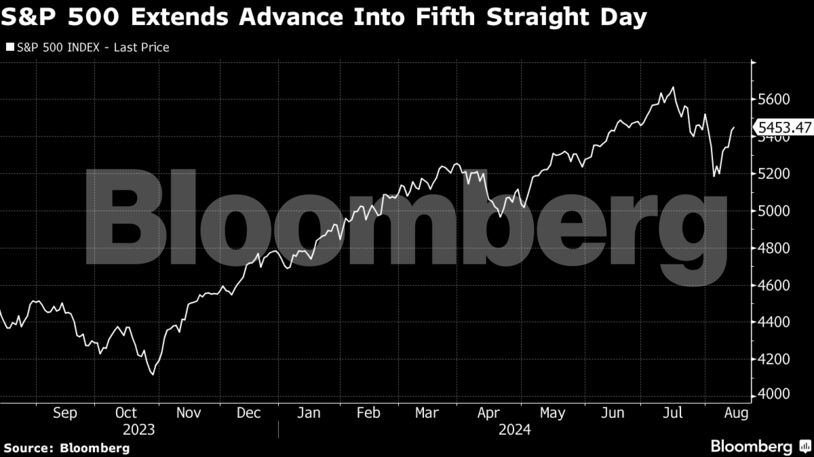
“The stress of the market decline is a fading memory,” said Mark Hackett at Nationwide. “Institutional investors aggressively bought the dip, following the pattern that retail investors have taken since the pandemic. Calming macro fears, the return of share repurchases, and stabilizing momentum provide an improved backdrop for equities.”
The so-called core CPI — which excludes food and energy costs — increased 3.2% in July from a year ago, still the slowest pace since early 2021. The monthly measure rose 0.2%, a slight pickup from June’s surprisingly low reading. Economists see the core gauge as a better indicator of underlying inflation than the overall CPI.
The report comes on the heels of a soft reading on producer prices, which prompted the market to price in a more pronounced “disinflation” trend, according to Florian Ielpo at Lombard Odier Investment Managers.
“The challenge with this report is twofold,” Ielpo noted. “It offers little new information to guide the future decisions of the Fed, aside from potentially supporting a rate cut due to job market concerns. And there is a risk that the markets may have ‘over-anticipated’ its implications. By all means this is a mixed report.”
To Seema Shah at Principal Asset Management, the CPI print removes any lingering inflation obstacles that may have been preventing the Fed from starting the rate cutting cycle in September. Yet, the number also suggests limited urgency for a 50 basis-point cut.
“With today’s CPI print very much in line with consensus expectations, this report supports the disinflation trend and a Fed that will be willing to cut rates in September,” said Rajeev Sharma at Key Wealth. “However, this CPI print does not scream out for a 50-basis point rate cut. Rather, a 25-basis point rate cut for next month is more likely.”
More Comments on CPI:
- Charlie Ripley at Allianz Investment Management:
The bottom line is that the trajectory of decelerating inflation has slowed materially, but likely remains within a comfortable range for the Fed to embark on a series of rate cuts. Now when discussing the magnitude of rate cuts in September, we still believe the labor market will be the linchpin to an outsized cut and further deterioration in the labor market increases the probability of a 50 basis point cut out of the gate.
- Peter Graf at Nikko Asset Management Americas:
The in-line CPI threads the needle of teeing up a September rate cut without setting off alarm bells on consumption and corporate pricing power. It relieves the pressure on Jackson Hole by taking 50 basis point cuts out of the conversation and lets Wall Street go back on vacation until Labor Day.
- Chris Zaccarelli at Independent Advisor Alliance:
The much-awaited Consumer Price Index (CPI) came in line with consensus this morning and it is the ultimate “No News, is Good News” report because the markets have been on edge and the Fed is looking to cut interest rates and nothing in this report should deter them from doing so.
In a not-so-subtle shift, the market has moved from worrying about inflation to worrying about economic growth and although many in the market were calling for a 50 bps rate cut next month, it’s much more likely that the Fed proceeds as planned with a 25 bps cut in September.
- Bret Kenwell at eToro:
Headline CPI figures for July were in-line or slightly below economists’ expectations. Absent an unexpected spike in today’s inflation report, the path appears set for a September cut.
With the mostly in-line results, investors should feel more confident in a September rate cut. However, it’s no longer a question of “if” or “when” the Fed will cut rates, but rather, whether the Fed will cut by 25 or 50 basis points.
Real estate and utilities have been the best-performing sectors so far this month, driven by the recent speculation of lower rates. Today’s report increases confidence in lower rates and could further act as a bullish catalyst for these groups — and equities in general.
The Fed has stressed that its policy is based on a collection of data rather than a single data point. Even if today’s figures were slightly higher than expected, the Fed still could have justified a rate cut next month.
- Skyler Weinand at Regan Capital:
Consumer price inflation is softening and moving closer to the Federal Reserve’s target and we think the Fed cuts interest rates in September, but only by 25 basis points, as a deeper 50 basis point rate cut would cause more harm than good as the Fed would be signaling that they’re worried about the health of the economy.
The Fed wants to show a measured pace in their interest rate movements, which 25 basis point increments show. A 50 basis point rate cut would signify calamity and may actually shock the stock and bond markets. Even though there were loud calls for a deeper 50 basis point rate cut during last week’s stock market volatility, the bar is extremely high for the Fed to cut by 50 basis points.
- Neil Birrell at Premier Miton Investors:
Following on from weaker than expected employment data, US inflation came in as anticipated for July. Whilst this will not have any effect on Fed policy it will allow for a sigh of relief from market participants. Recent volatility has largely been driven by macro news and this is a case of; dull news is good news. It also allows the Fed breathing space as they weigh the economy ahead of their next meeting.
Corporate Highlights:
- UBS Group AG posted higher than expected profit in the second quarter, as investment banking revenue and progress in integrating Credit Suisse helped bolster Chief Executive Officer Sergio Ermotti’s efforts to return capital to shareholders.
- Southwest Airlines Co. said it remained confident in its current leadership team after Elliott Investment Management proposed replacing a majority of directors on the struggling airline’s board in a looming proxy battle.
- Alaska Air Group Inc. and Hawaiian Holdings Inc. said they will again extend closing their proposed $1.9 billion deal to give US antitrust enforcers more time to discuss a potential settlement.
- Mars Inc. agreed to buy Kellanova for nearly $36 billion, bringing together two major food companies in one of the biggest deals of the year.
- Blackstone Inc. is in advanced talks to buy health-care consulting firm Chartis Group from private equity firm Audax Group, according to people familiar with the matter.
Key events this week:
- China home prices, retail sales, industrial production, Thursday
- US initial jobless claims, retail sales, industrial production, Thursday
- Fed’s Alberto Musalem and Patrick Harker speak, Thursday
- US housing starts, University of Michigan consumer sentiment, Friday
- Fed’s Austan Goolsbee speaks, Friday
Some of the main moves in markets:
Stocks
- The S&P 500 rose 0.3% as of 11:43 a.m. New York time
- The Nasdaq 100 rose 0.2%
- The Dow Jones Industrial Average rose 0.4%
- The Stoxx Europe 600 rose 0.5%
- The MSCI World Index rose 0.5%
- Bloomberg Magnificent 7 Total Return Index fell 0.3%
- The Russell 2000 Index fell 0.3%
Currencies
- The Bloomberg Dollar Spot Index fell 0.2%
- The euro rose 0.3% to $1.1022
- The British pound fell 0.1% to $1.2843
- The Japanese yen was little changed at 146.83 per dollar
Cryptocurrencies
- Bitcoin fell 1.6% to $59,634.76
- Ether fell 1.1% to $2,670.63
Bonds
- The yield on 10-year Treasuries declined two basis points to 3.82%
- Germany’s 10-year yield was little changed at 2.18%
- Britain’s 10-year yield declined seven basis points to 3.82%
Commodities
- West Texas Intermediate crude fell 1% to $77.60 a barrel
- Spot gold fell 0.8% to $2,446.19 an ounce
Comments
Scroll down to load comments...