




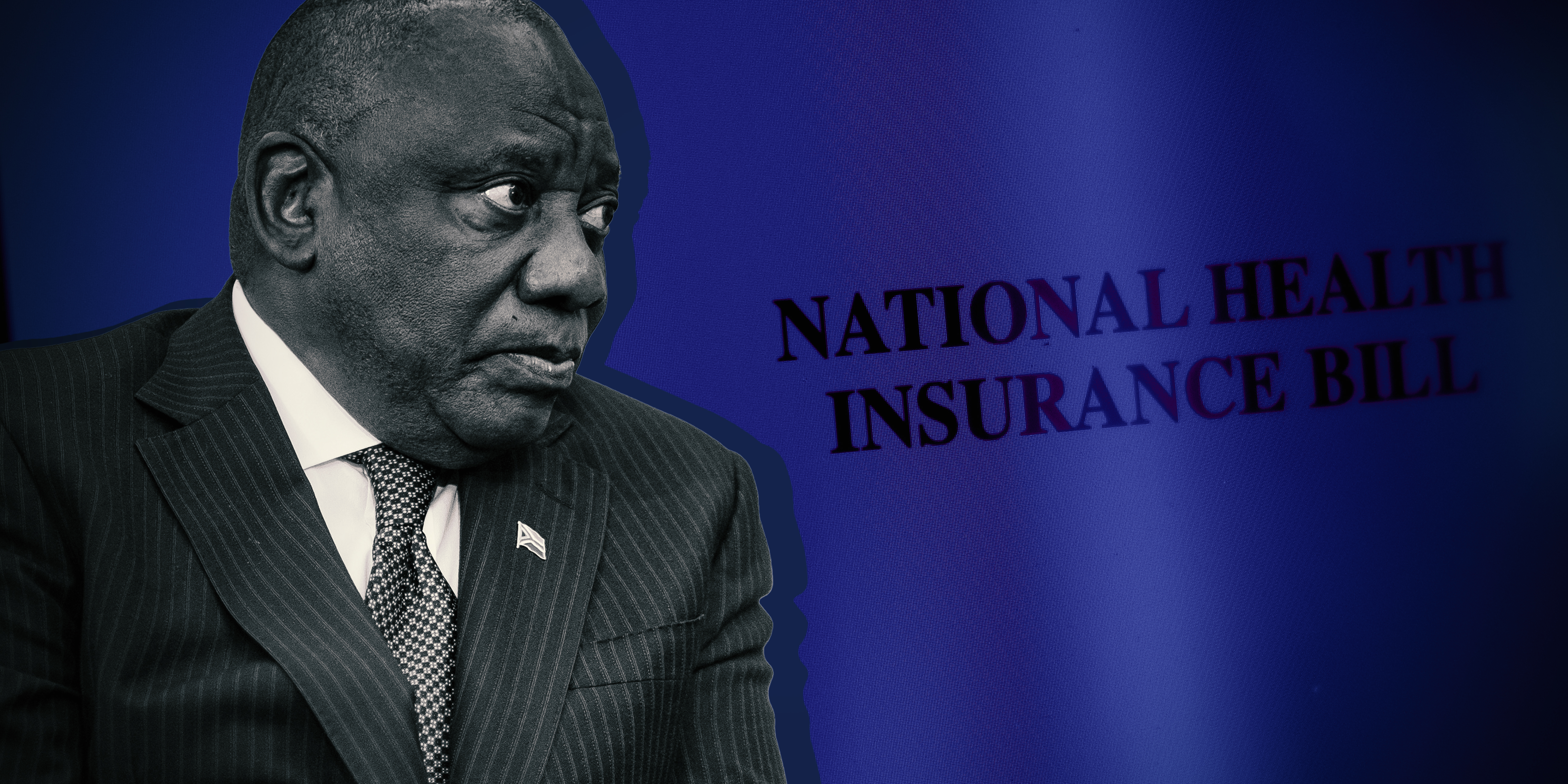
 Illustrative image: President Cyril Ramaphosa signed the NHI Bill into law on 15 May 2024. (Photos: Pete Marovich / The New York Times | Kyra Wilkinson)
 Government and organised business were due to sign the Second Presidential Health Compact on Thursday this week, intended to foster collaboration between the public and private sectors.
But this has now been postponed for a week after SA’s largest private sector organisation, Business Unity South Africa (Busa), announced on Wednesday it would not sign the accord because the latest version explicitly endorses the NHI Act in its current form, which business organisations and some political groups oppose.
This is despite the fact that business organisations, along with a broad sweep of civil society and health organisations, endorsed a previous version of the accord that was drafted before the NHI Act was passed and signed just before the May general elections. The law, which seeks to create, over time, a single government-controlled healthcare insurance system, eventually ousting private health insurance, has yet to be implemented.
“The draft of the compact that was shared with Busa promotes the NHI in its current form as the foundation underpinning healthcare reform. Busa does not agree with this, given the serious differences between us and government as to the appropriateness of the NHI Act, let alone its feasibility as a legislative instrument to underpin universal health coverage,” Busa CEO Cas Coovadia said in a statement.
The previous Presidential Health Summit Compact was released in 2018 under the banner: “Strengthening the South African health system towards an integrated and unified health system”.
“This was an objective supported by business, particularly the focus on immediate opportunities for health improvement, including strengthening supply chain management, health infrastructure planning, accountability, augmenting health system resources, as well as the principle of collaboration in healthcare delivery,” he said.
“While everybody supports universal health coverage, there are ways to achieve it other than implementing an unaffordable, unworkable and unconstitutional NHI, which is essentially a funding model that is impractical, inequitable, and not feasible in the South African context. Furthermore, it is putting the cart before the horse to sign and agree to a compact when structured, formal discussions and engagement with government on the NHI, as a key pillar of universal health coverage, still need to take place,” said Coovadia.
He added there had been “no consultation on the updated wording that fundamentally transforms the compact from health system strengthening to a focus on NHI implementation”.
The Presidency issued a brief statement shortly after the Busa announcement, stating that the signing of the compact would be postponed by a week to 22 August.
Coovadia welcomed the postponement, saying Busa would now engage with the Presidency to “negotiate a health compact that we all agree with”. DM