




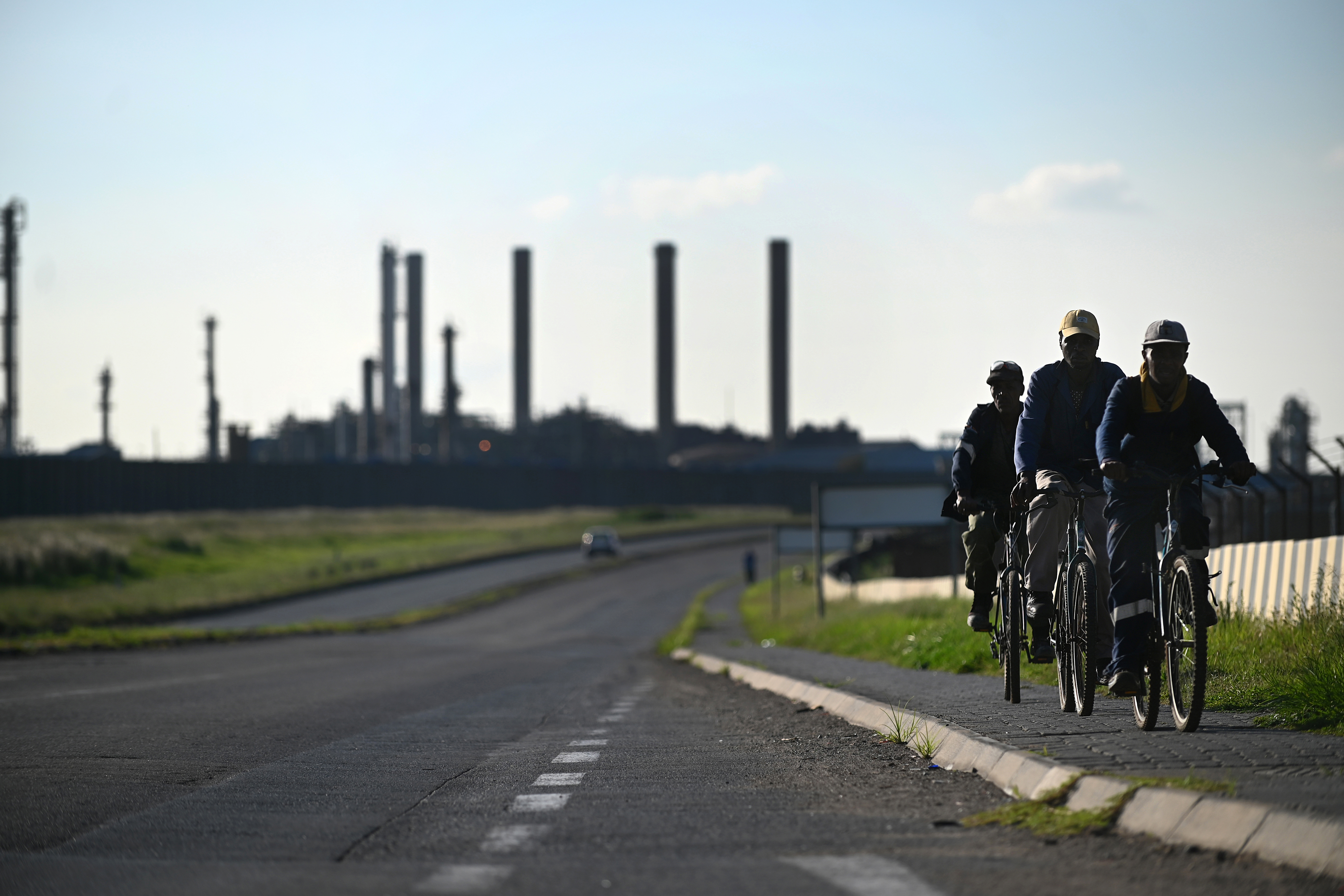
 Workers cycle along a road near the Sasol Ltd plant in Sasolburg, South Africa, on Thursday, Jan. 18, 2024. The air in the South African industrial region known as the Vall Triangle is so contaminated that a town regularly registers the highest levels of harmful particulate emissions on the planet. Photographer: Leon Sadiki/Bloomberg
That’s mainly due to a 45.5 billion-rand impairment net of tax on its Chemicals America ethane value-chain unit, primarily caused by external conditions “including prolonged softer market pricing and outlook.”
The impairment on its polyethylene, chlor-alkali and polyvinyl chloride and wax value chain in the Africa chemicals business was 3.9 billion rand, and it will also write down 5.7 billion rand on the Secunda synthetic-fuels refinery in South Africa.
| Read More on Sasol: |
|---|
| South Africa Gas Users Plan Venture to Secure Supply Before 2026 Sasol Wins $342 Million Settlement After Pipeline-Fee Dispute Sasol Wins Appeal on How to Measure Sulfur Dioxide Emissions Sasol Reaches Short-Term Renewable-Energy Procurement Target |
Sasol is the second-biggest polluter in South Africa, using coal to make most of its products. Its plans to lower emissions include substituting the dirtiest fossil fuel with natural gas, adding renewable energy and potentially green hydrogen.
The company’s $12.8 billion Lake Charles chemicals facility in Louisiana — designed to expand its operational footprint abroad — suffered from mismanagement issues and cost overruns before the facility’s completion at the end of 2020.
“Sasol’s $3 billion in impairments aren’t likely to be the last but the announced total so far will drive a sharp downward revision in consensus, as a sustained weakness in chemicals clouds the outlook,” Salih Yilmaz, a Bloomberg Intelligence analyst, said in a note. “Cuts to coal use will undoubtedly lead to more writedowns.”
So-called headline earnings per share likely fell to a range of 12.28 rand and 21.95 rand, representing a drop of as much as 77% from a year earlier, Sasol said. The average estimate by analysts on Bloomberg is for 40.86 rand.
In late 2020, Sasol sold a $2 billion stake in the US base-chemicals business to form a joint venture with LyondellBasell Industries NV in order to cut debt. It also accelerated an asset-sale program that wrapped up the following year.
When the company reports results on Aug. 20, investors will be looking to Sasol Chief Executive Officer Simon Baloyi — who took over the role this year — for an update on the company’s strategy.
Comments
Scroll down to load comments...