




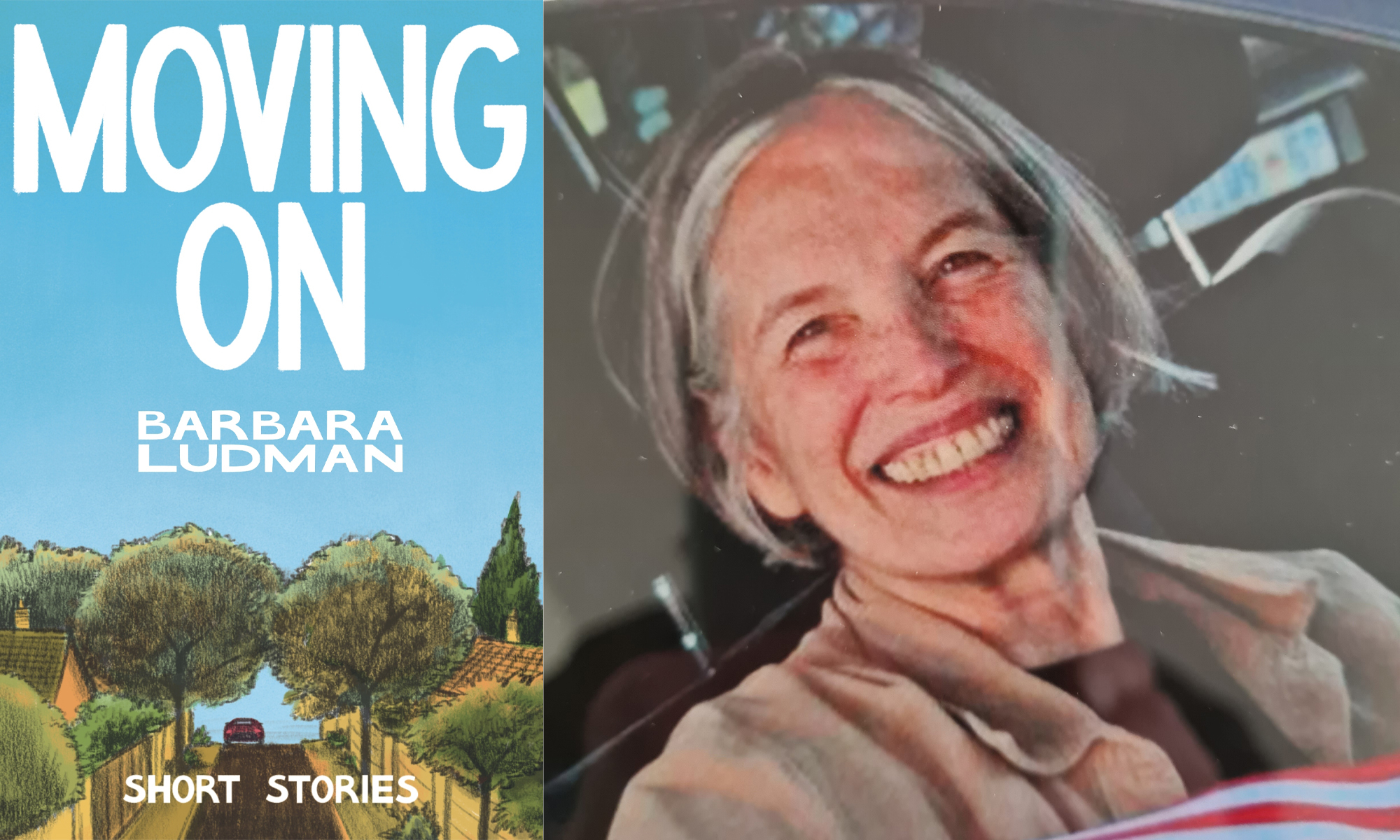
Ferial Haffajee: I know you as a legendary editor, mentor and writing coach now with Scrolla. You’re a fabulous writer too, most recently of a short story anthology called ‘Moving On’. What prompted the book and title?
Barbara Ludman: I wrote the book because I had something to say.
My South African husband David and I were married for decades, and when he died, I pretty much fell apart. Months later someone brought Colm Toibin’s ‘Norah Webster’ to the book club; a novel about an Irish woman widowed in her 40s and doing what I was doing – she dyed her hair pink, I cut mine very short. She joined a choir and so had I. Many more examples proved to me that I was neither nuts nor alone. It was, if anything could be, an aid to healing.
I needed that because the world – from banks to Sars to cellphone companies, and definitely the master of the high court – is really unhelpful to women whose husbands have died.
I was often angry. The last time I was that angry was during apartheid and I had quite a lot to say so I wrote nice novels for teenagers about the Struggle, which I hope empowered them; they were in many school libraries.
After 1994 I was no longer angry; I wrote a couple of short stories that were carried in the Sunday Tribune and Femina, but mostly just did journalism.
But after David died, that changed. Writing is healing, isn’t it?
So, a few years ago I wrote a story and sent it to my friend and colleague Pat Tucker, who edits everything I write, and I said, ‘What do you think?’ And she said, ‘I think you have a book’.
It was initially titled ‘So Now What?’ But Julia Grey told me I couldn’t use that title. Don’t know where ‘Moving On’ came from – maybe from Julia. Not everybody in the book moves on, but most do.
FH: You choose Parkview and Johannesburg as the geography or place-maker that holds the story together. Why? Share with us some of your history with the city.
BL: Parkview has everything: a park, a lake, a high street, and some truly interesting people; the sort of people I wanted to write about. I am one of those irritating people who keep talking about what they’re working on, and my friend and colleague Tanya Pampalone suggested it. I told her I was writing a collection of short stories, and I wanted the people I was writing about to be connected in some way, and she said why don’t you set it in a suburb? Why not Parkview?
I love Johannesburg. It’s a big ugly city, which is what I think cities should be, and it harbours the best and the worst of humanity, almost side by side.
When we first came to Joburg we lived over a health food store in Norwood, and I would look out the kitchen window over red tiled roofs and think I was in Rome. We moved to a corner garden flat in Yeoville in 1978, and in 1992, the day before the referendum was announced, we bought a semi in Bellevue.
When we bought, it was an Italian neighbourhood – when I walked the dog on a Sunday afternoon I could hear opera coming out of the houses. But it didn’t take the banks long to panic, and a few years later – maybe as soon as 1995 – they redlined the area. Nobody could buy or sell. As families grow or shrink, or as jobs change, people move around, but now it was impossible.
Some people just abandoned their houses but most people rented them out.
Eventually the population consisted largely of foreign men married to South African women and afraid to live in the townships out of fear of xenophobic attacks. It was a moving population – at the turn of the millennium, for example, there was a preponderance of Eritreans. At one point we had lots of people from Cameroon. In the last few years, it was mostly Zimbabweans and Nigerians.
There were a lot of problems – mostly littering so bad that eventually Pikitup came every single day, and a teenage gang of robbers who got us all – we knew who they were, and the police and the leader’s mother protected them. But there was a lot of good, too – we had a terrific street committee. My job was to haunt the Civic Centre and find out who owned which deteriorating building and the name of the inspector who had allowed it to get that way.
We all looked out for one another, as neighbours. [As an] example: a few days after David died, a delegation of women who lived on my street came to visit, and after a few minutes of chitchat they handed me a wad of money. I was astonished and embarrassed – I knew they didn’t have spare cash. They explained that there had been a meeting that day about David’s death and my situation and a collection had been taken.
‘You have to use the money on yourself,’ said one woman. ‘Have a facial.’
Another time, we’d stowed ladders along a side passage and one night I heard the scraping as they were pulled over the wall. The next morning my Nigerian neighbours showed up with the ladders – they’d chased the thieves, who’d dropped the loot. They spoke to me quite sternly about how lax I was and insisted I lock the ladders in the cottage. ‘Fine,’ I said. ‘You know where the key is.’
I’d still be there – probably the only whitey left – but my good friend who owned the other semi wanted to buy mine and turn both of them into rooms. From time to time she and I talk about how we miss the sense of community we had in Bellevue.
FH: The narrative of ageing and how to do so runs through the stories. Why? I’ve always thought of you as ageless, by the way.
BL: By my reading, only four of the 10 stories are about older people. One, the gay couple, we track through decades, so at the end, yes, they’re getting on, so that would make five. Amy – who, by the way, is a real person – is youngish – say, around 30 or 35. Harry, whom you also liked, and who was based on David, is pretty old. I’m not any good at ageing – I’ve also always thought of myself as ageless. If I stay away from mirrors I can maintain the illusion.
FH: There’s another narrative – loss. Many characters die but this is a collection of stories of how people move on. Do I read this right?
BL: Yes.
FH: In Muriel’s story, it’s also about being lonely in the big city. This is a health theme in the world. In the US, Japan and Europe, a lot of attention is paid to the pandemic of loneliness. Did this inspire the story? (Muriel lives in Parkview and studies how to commit suicide.)
BL: No – I wasn’t aware of the pandemic of loneliness. My mother-in-law used to tell me that she only had one friend left; that she’d lived too long, and at 85 she refused medication for her heart and died. I was just interested in how one goes about killing one’s self, so I researched it.
FH: How do you write character so boldly and with resonance? I loved each one. I settle on Amy who goes off to live and teach in Kathmandu as my favourite, and then Harry who builds ships in bottles and must learn how to live (and perhaps love) in a retirement estate his late wife chose. How do you make such beautiful characters? Who is your favourite?
BL: Some are actual people who generously sat for interviews and had no problem with the book, or with their lives being fictionalised. My relatives, on whom I based some characters, I didn’t ask permission.
My sister had a truly terrible life, so in one story I gave her mine, plus some adventures friends had on their trek up Africa.
Some are combinations that seem to work – Esther is mostly my aunt Polly but also a bit of a really good friend.
And some characters just fall from the sky. In Bogey and me, I wanted to see what David would be like if he were gay and developed Alzheimer’s. I have no idea who the partner is based on, but there’s a line towards the end that my friend Mac Carim said one day about caring for his wife that brought me to tears and of course, I had to use it. It’s when the partner says, ‘It’s a privilege to care for him now that he needs me.’ It defines the partner and the relationship.
I love all the characters but maybe the impossible daughter who writes haikus (story number nine) is near the top of the list, because of her stubbornness. I wanted to write the mother and daughter working together, helping one another recover, but the daughter simply wouldn’t do it. Whatever I did, she folded her arms and refused to participate. Finally, I just let her get on with what she wanted to do and it really worked well.
Which brings me to something you didn’t ask and will probably sound nuts, but the characters write the stories. Sometimes I have no idea where the stories are going but the characters do, and I have to run to keep up with them.
FH: What’s next?
BL: Lately I’ve been thinking a lot about chaos theory. DM
Moving On by Barbara Ludman is published by Modjaji Books, 2024.