




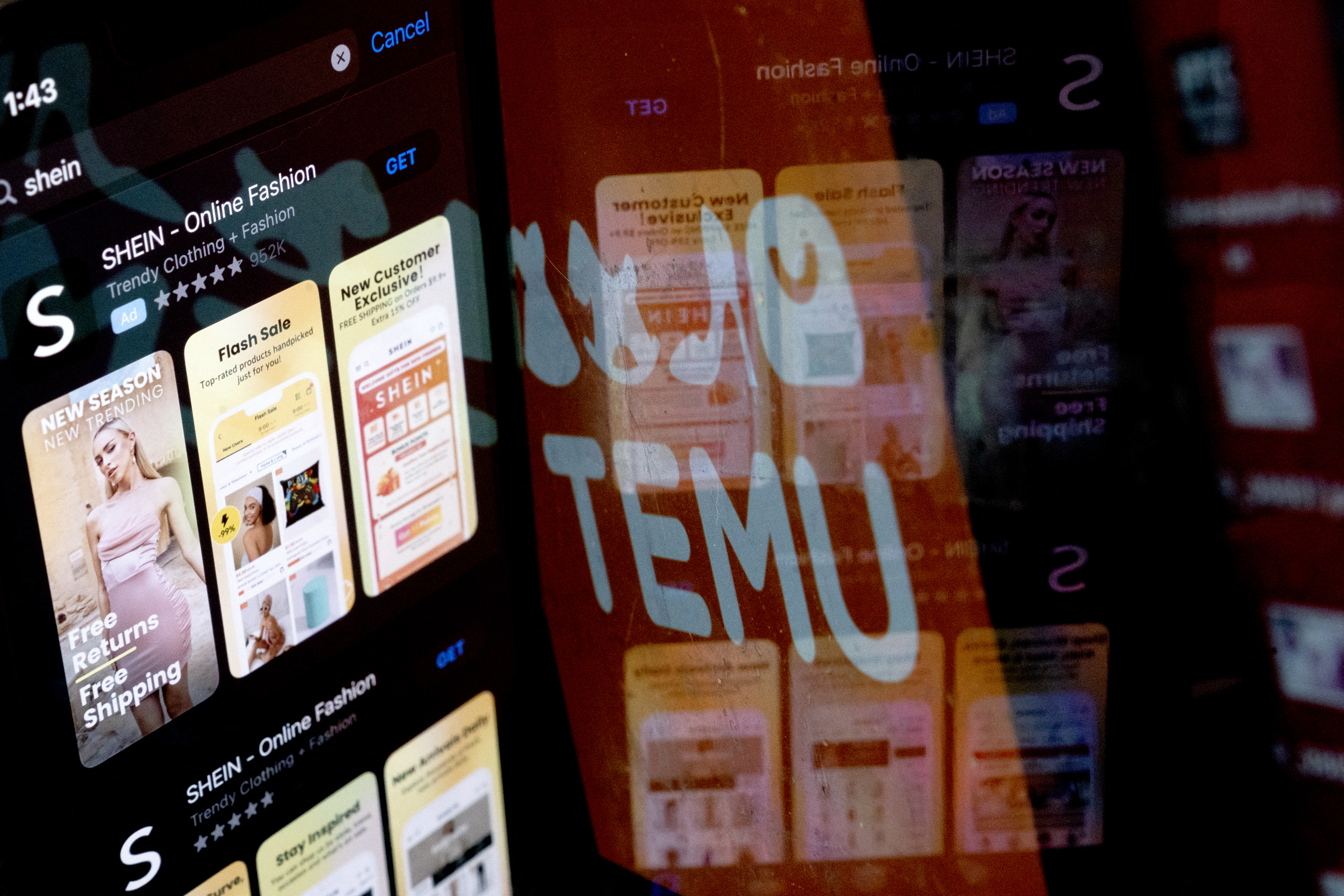
 The Shein app on the App Store is reflected in the Temu logo in Washington, D.C., on 23 February 2023. (Photo by Stefani Reynolds / AFP)
 Temu and Shein customers can loosen up — their cheap imports are safe from the South African Revenue Service (Sars) for a little longer.
The import duties threatened by Sars have not yet been instituted, so small parcels of clothing are still flying under the radar.
New duties had been expected to go into effect on 1 July, as Sars was expected to tighten its grip on all clothing imports to protect local manufacturers and retailers.
Customs duties for imported parcels under R500 are significantly lower, attracting a 20% import duty and zero VAT, compared to larger shipments, which are taxed at 45% and attract 15% VAT.
Known as the “de minimis rule”, the loophole has been exploited by some retailers. Offshore online platforms Temu and Shein, in particular, have been accused of splitting up larger orders into smaller packages in order to qualify for the lower import duties. The companies have also been accused of undervaluing small shipments, which the National Clothing Retail Federation says has given the foreign businesses an unfair advantage at the expense of domestic clothing manufacturers.
The impact on local business is apparent, with South Africa’s biggest online retailer, Takealot, struggling to reach profitability as price-sensitive customers opt for imports from China.
On 24 June, Takealot posted a R253-million annual loss. Takealot has described the consumer environment as “challenging”, which is worsened by the rise of interest rates and high inflation.
Sars has said that in order to create a fairer playing field for all clothing retailers, it would subject all clothing imports to a 45% import duty plus 15% VAT.
Sars has also said it would be working with courier companies, which are using an incorrect customs code for small packages, to ensure the correct duties and VAT are applied.
The revenue service’s commissioner Edward Kieswetter has estimated that the tax losses stemming from import loophole abuse amount to around R3.5-billion. He’s vowed to clamp down on these retailers, who have an “unfair advantage” over local companies.
But Sars has now said it is still in the process of consulting with industry on the implementation of the correct duties on imported clothing.
“Once this consultation is concluded, Sars will officially communicate the date of enforcement,” a spokesperson said.
The National Clothing Retail Federation’s executive director Michael Lawrence told 702 that unless tariff hikes are introduced, jobs will be lost in the local manufacturing sector and mainstream retail sectors because others are forced to pay 45% import duties but not the offshore online retailers.
“So we do have a substantive problem with the fact that this is a commercial disruptor that Sars is playing in a commercial space. They need to get their game right now; you charge the same tax for everyone for all the right reasons.”
“If they can make the tax lower for us, we’ll take that as well,” said Lawrence.
Both Temu and Shein have denied they were skirting South Africa’s laws. In February, Temu issued a statement saying it was “committed to complying with local laws and regulations in the markets where it operates”.
Shein claims that its orders do not benefit from any favourable tax treatment compared to other offline or online retailers.
“Contrary to common misperceptions, we keep prices affordable through our technology-based on-demand business model and flexible supply chain,” Shein said.
“This reduces inefficiency, helps us to lower wastage of material, and reduces our unsold inventory. We pass this cost advantage to our customers.”
There’s growing discontent over the Chinese retailers’ ultra-cheap offerings — both from abroad and at home. Last week, Chinese merchants selling through Temu staged a protest against what they call harsh and unexplained penalties, which can involve hefty fines or withholding payment, saying they are being squeezed for profits as Temu aggressively expands globally.
The dispute centres on “after-sales issues” like missed deadlines or inaccurate product listings.
Analysts warn that tensions could force Temu to offer subsidies to keep merchants from jumping ship to competitors like Amazon and Shein, which could squeeze margins and threaten Temu’s long-term sustainability. DM