



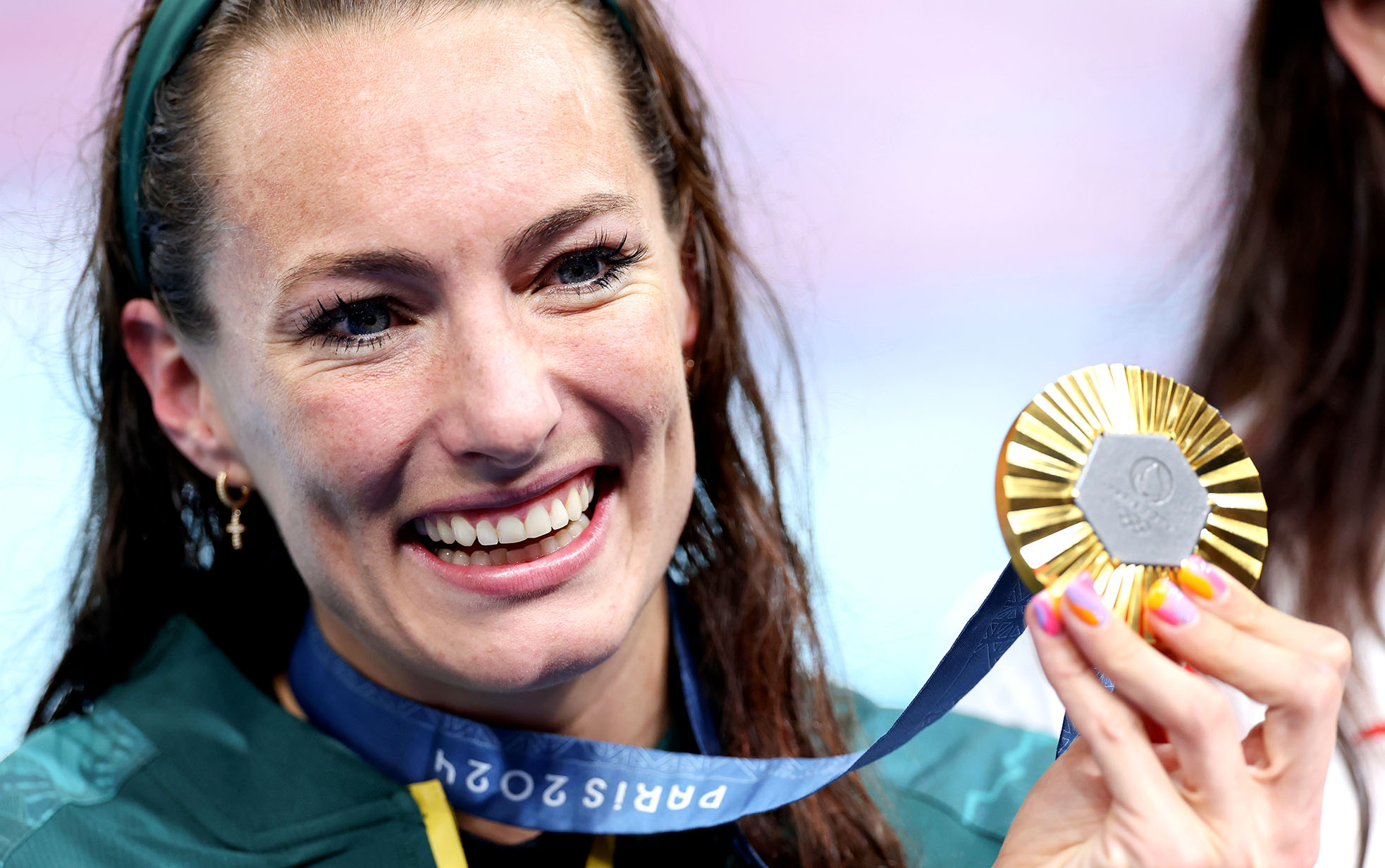
 Gold medallist Tatjana Smith of Team South Africa after the Women’s 100m breaststroke final on day three of the Olympic Games Paris 2024 at Paris La Défense Arena on 29 July 2024. (Photo: Quinn Rooney / Getty Images)
There is an old joke about the need to have faith in what you can do and what you can achieve. Take Beethoven, for example. He was deaf and people told him he could never be a great musician. But he just didn’t listen. (Sorry.)
Some time ago, there was an argument about how long it takes to become highly proficient at any task, skill or sport. The conventional wisdom was that it takes 10,000 hours to, at least technically, become an expert. But this is patently untrue — it’s only 3½ years if you are at your task eight hours per day per week and, yet, the ANC has been in power for 30 years and they are still bad at governing.
The 10,000 hours guide is also misunderstood. The original work was a study of music students by academics Anders Ericsson, Ralf Krampe and Clemens Tesch-Römer in 1993. What they were trying to ascertain was not so much how long it takes a person to become an “expert”, but whether a long period of deliberate practice is what lies behind expert performance, rather than innate ability or talent.
What they discovered was that after about 10,000 hours of practice, music students were indistinguishable from those who notionally had innate ability. But, of course, the idea that all you have to do is practise for 10,000 hours and then, magically, you will become an expert in anything you choose is just wrong.
A grand debate ensued, naturally, and was famously conducted between two writers. The 10,000 hours idea was first popularised by Malcolm Gladwell in his book Outliers, in which he more or less asserted that anyone could become an “expert” in any field after those many hours of deliberate practice.
Gladwell was subsequently challenged by the writer David Epstein in his book The Sports Gene. Epstein used as his illustration someone who deliberately followed the 10,000 hours rule. This person was Stefan Holm of Sweden, who had practised the high jump since he was a little kid and had adopted a regimen of 12 practice sessions per week. Holm won a gold medal at the 2004 Olympics, by which time he estimated he had spent some 20,000 hours in practice. He also reckoned that he had taken more high jumps than any other human.
Sadly, Holm was beaten in the 2007 World Championships by Donald Thomas, who had taken up the sport just eight months earlier. Thomas started his high jump career after a member of the track team bet him he couldn’t clear 6½ feet (1.98m). He cleared it on his first attempt. Thomas, who is Panamanian, went on to have a long and successful career in the high jump.
In his contest against Holm, it helped that Thomas was 1.91m tall, while the Swede measured 1.81m. Pretty obviously, physical make-up partly explains why expertise cannot always be reduced to practice time. But it goes further than that — even Gladwell admitted that 10,000 hours was the average; some people got there faster than others. He was just trying to get away from the idea that talent is everything, and we should bow down to our heroes and think they didn’t have to work to get there; even the talented have to put in the hours.
Just before the opening of this year’s Olympics, Wall Street Journal writer Jason Gay wrote a wonderful tribute to the Games, hoping that they would save the northern summer which has been pockmarked by “election scrambling, political elbowing, infighting, bickering, a genuinely horrifying assassination attempt and a steady pipeline of conspiracy theorising”, ultimately arriving at a great line: The Olympics are “expensive, overwrought and exasperating, and they always overdo it on the promotion, but at the core of the Games is a genuine athletic competition and an uplifting realisation: Every day, you can see the best day of someone’s life.”
Beautiful! But here is the thing: for every winner, there was a whole bunch who never made it to the podium. It wasn’t the best day in their lives. And behind them, there were others who never made it to the Games. And behind them…
***
A painter my wife follows on Instagram, Quang Ho, told of a woman involved in a car crash who felt as though she was hovering several metres above the crash. She was then greeted by her deceased family members. They all said they were proud of her. She said she didn’t understand because she hadn’t accomplished any of her goals in life.
They replied: “You got up every day. And you tried to do the best that you could. And being human, that is all that matters.” She telescoped back into the car, unwillingly, and recovered. But her perspective changed.
Sometimes, it’s just as hard and takes as much practice to be an ordinary human as it does to be a great Olympian. DM
Comments
Scroll down to load comments...