



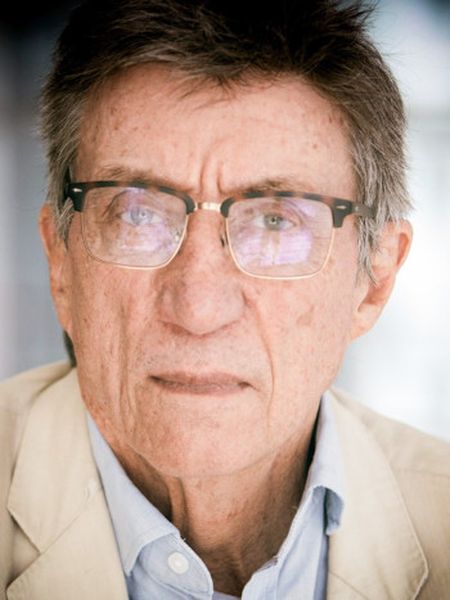
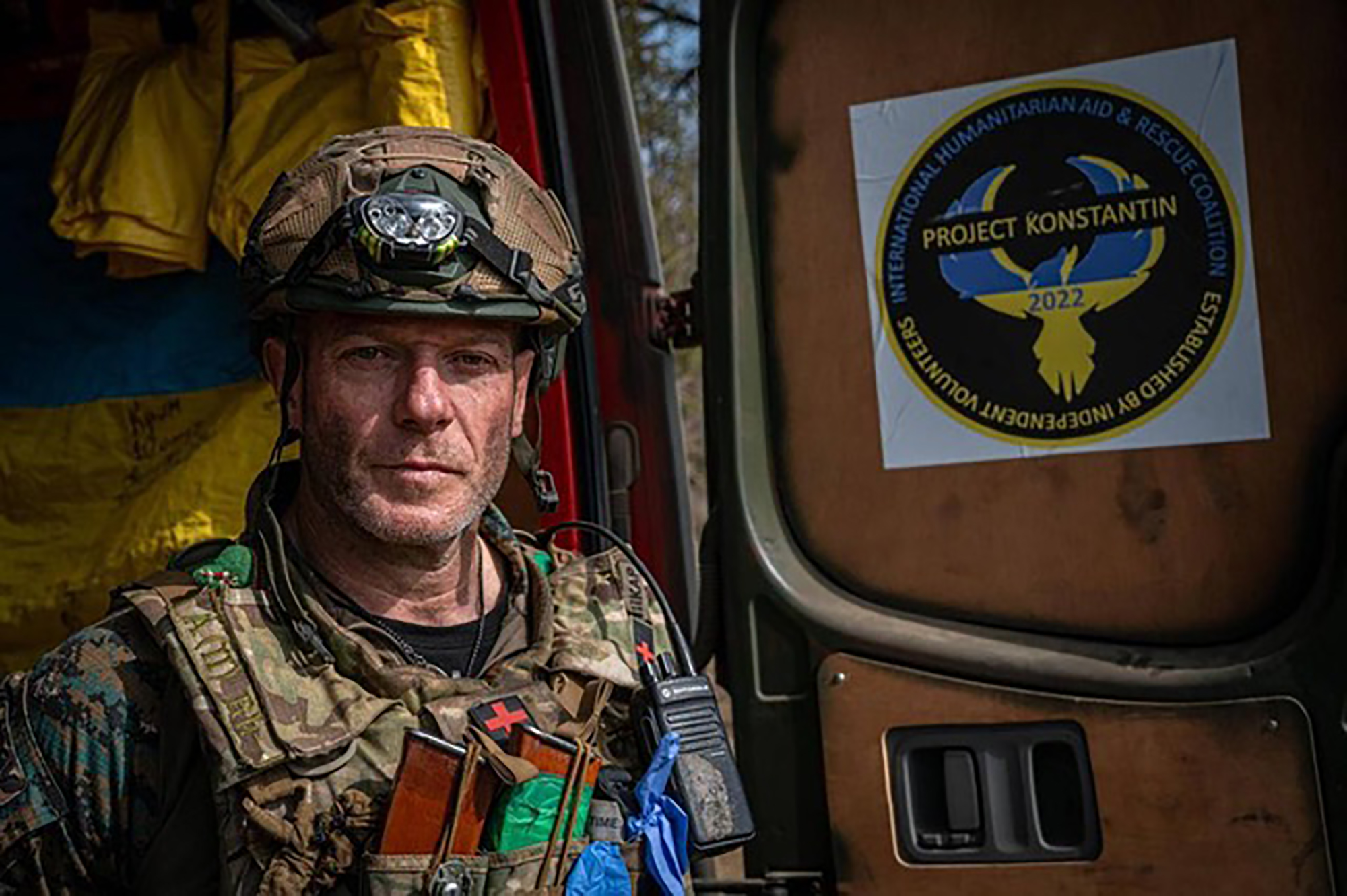
 South African Pete Fouché on the eastern front line in the war in Europe. (Photo: Project Konstantin)
 Pete Fouché was so moved by the plight of Ukraine that he gave up everything — eventually, even his life — to help the country resist the Russian invaders in March 2022.
Fouché (49), a dual South African-British national, would not go to Ukraine until his daughter Nikola, then 13, gave him permission.
He told Ukrainian journalist Olga Butko in an interview in April that he had explained to Nikola: “You are my child and I love you, and I want to stay here close to you, but you are safe.
“Those children out there aren’t safe, and they need everybody to go and help protect them.
“I said, ‘Please will you forgive me, please will you understand, please try to understand.
“She said, ‘Go daddy, go today, be safe and come back. Make sure you come back alive,’ is all she said to me.”
He went, but he did not return.
Read more: War in Ukraine
Fouché was born and raised in Gqeberha (formerly Port Elizabeth), where he served in the SA Police Service’s Flying Squad but moved to the UK about 20 years ago, becoming a carpenter.
When he arrived in Ukraine in March 2022, just weeks after Russia had invaded, he volunteered for the Territorial Defence Forces, the military reserve component of the Ukrainian military which includes local and foreign volunteers, and then became a medic in the 67th Brigade of the Armed Forces of Ukraine.
He and Tetyana Millard, a Ukrainian, created a charity called Project Konstantin dedicated to supporting the Ukrainian military.
It delivered vehicles and other supplies to the military and provided medical training, but focused on evacuating wounded soldiers in the east, the horrific cauldron of fighting where so many soldiers on both sides have died.
Fouché and Millard rescued about 200 soldiers from hellholes like Bakhmut. But on 9 October 2023, Millard was killed in a car accident, and on 27 June this year, Fouché was hit by Russian fire and killed while trying to evacuate a casualty.
It took great courage and considerable time for his comrades to even retrieve his body, so intense is the fighting in the east where Russian drones patrol the skies almost incessantly.
He was brought back to the capital, Kyiv, for a moving funeral service with a military honour guard on 6 July at Maidan Independence Square, the birthplace of Ukraine’s resistance to Russian imperialism.
/file/dailymaverick/wp-content/uploads/2024/07/PeteFouche5.jpeg "Pete Fouché treating a wounded soldier before evacuation. (Photo: Project Konstantin)")
/file/dailymaverick/wp-content/uploads/2024/07/PeteFouche6.jpeg "Pete Fouché in one of Project Konstantin’s improvised ambulances. (Photo: Project Konstantin)")
/file/dailymaverick/wp-content/uploads/2024/07/PeteFouche4.jpeg "Peter Fouché with one of Project Konstantin’s evacuation vehicles. (Photo: Project Konstantin)")
‘Unwavering dedication’
His Project Konstantin colleagues posted a tribute to him under the headline “On the shield”, a reference to the Spartan injunction to its warriors to “Come back with your shield or on it.”
They extolled his “unwavering dedication, endless compassion, and relentless commitment to Ukraine … His heroism knew no bounds. He was actively involved in saving more than 200 wounded Ukrainian soldiers, evacuating civilians from the most dangerous frontline cities, as well as bringing humanitarian aid to people in those towns and cities.”
Fouché was cremated and some of his ashes were scattered on the battlefield where he served and died and some were scattered in Kyiv. His 87-year mother Rose Fouché, now staying with her remaining son and daughter in the UK, will scatter the last of her son’s ashes in Gqeberha.
She too is a remarkable person. In April, she travelled to the front line to meet her son, whom she had not seen for two years. She stayed just a few kilometres from the Russians, says Jana Fourie of Johannesburg, co-director of Project Konstantin.
It was the last time his mother saw him.
She told Butko she was not afraid to be on the front line. “Not at all. I came to see my son, just to show him love.”
“He’s doing wonderful things, looking after people there.”
/file/dailymaverick/wp-content/uploads/2024/07/PeteFouche3.jpeg "Pete Fouché in his bunker in winter. (Photo: Project Konstantin)")
/file/dailymaverick/wp-content/uploads/2024/07/PeteFouche1.jpeg "Pete Fouché preparing for action in his bunker. (Photo: Project Konstantin)")
/file/dailymaverick/wp-content/uploads/2024/07/PeteFouche7.jpeg "Pete Fouché’s equally heroic partner Tetyana Millard. (Photo: Project Konstantin)")
‘Before, I was squeamish’
Millard’s death last October was a grievous blow to Fouché. She was delivering a donated Land Rover equipped for medical evacuation to the eastern front. An hour out of Slovyansk, she swerved to avoid rubble in the road and lost control of the vehicle, which plunged into a lake where she drowned.
“Losing Tetyana was unbelievably even more painful because we had been through so much together,” said Fouché.
“She was my connection to Ukraine. She was emblematic of everything that is Ukraine. She was my foundation and — I always say this — she was my rock.”
Fourie said Project Konstantin began when Millard, who was also living in England, was looking for someone to help her deliver humanitarian aid to civilians still living in and around the bombed-out city of Bakhmut, including her mother, who had refused to move because she said she had nowhere else to go.
“But as they got more involved they found out that you can be as great a humanitarian as you want to be but if you don’t support the military there won’t be any people left to help.”
That was a turning point. Fouché and Millard decided to apply their medical training to begin evacuating military casualties, starting in the Kreminna forest in the east, which was where they spent most of 2023.
It took a while to adapt to the horrors. Fouché told Butko, who brought his mother to see him on the front line, that the lives he saved were forever etched in his memory.
“Seeing that fear in that boy’s eyes … and telling them, ‘You’re going to be okay’.
“And to see that abject fear in somebody’s face when they pull their vest off and they can see blood pouring out of their chest or out of their back.
“And to be able to grab your friend by his arms and look him in the face and say, ‘I’ve got you, I’m going to get you home. We will take you through this. We’re going to get home together. I’m not leaving you behind.’
“It changes you, you become, you almost feel like you are a father and this is your child and you’ve got this responsibility now.
“It’s a gift, it’s a blessing, it’s a skill that you never knew you had.”
Fouché recalled the day he and Millard were evacuating a wounded soldier from the front line. He smelt burning and saw smoke in their vehicle and realised the soldier had excruciatingly painful phosphorus burning in his leg.
Fouché pulled out his combat knife and set to work. “Before I came to be a medic, I was squeamish. I was squeamish with blood.
“The sight of blood scared me. And here I am with my combat knife sawing into this poor man’s leg. We did stop the bleeding and we did get all of the burning phosphorus out of his leg.
“But it was a very painful experience for me, and it was a very brutal experience and horrible experience for him.”
/file/dailymaverick/wp-content/uploads/2024/07/12352090.jpg "Comrades and friends of late British-South African combat medic Pete Fouché attend a farewell ceremony for him on Independence Square (Maidan Nezalezhnosti) in Kyiv, Ukraine, 6 July 2024. (Photo: EPA-EFE / SERGEY DOLZHENKO)")
/file/dailymaverick/wp-content/uploads/2024/07/12352670.jpg "Comrades and friends of late British-South African combat medic Pete Fouché attend a farewell ceremony for him on Independence Square (Maidan Nezalezhnosti) in Kyiv, Ukraine, on 6 July 2024. Fouché was born and raised in Gqeberha but had moved to London, where he worked as a policeman and a carpenter. (Photo: EPA-EFE / SERGEY DOLZHENKO)")
Changes on the battlefield
Fourie said Fouché had witnessed radical changes in the battlefield during his two years on the eastern front. “It’s basically just drone warfare all the time at the moment.
“Pete and the guys were in [the frontline village of] Chasiv Yar for a few weeks in March. and it was so brutal that we could not evacuate wounded soldiers because there were so many drones.
“It’s insane, because the moment you try to stick your head out from a bunker there’s a drone.”
Wounded soldiers had to wait for a day or two until the battalion could get anti-drone equipment or until the sky was cloudy enough to risk an evacuation.
Fouché’s battalion created a new drone battalion to support it in countering the Russian drones.
Fourie noted that Ukraine had become so reliant on non-profit organisations to fund and develop its drones, that people joked that “Ukraine has the first crowd-funded army”.
‘Where’s the braai?’
Fourie said she got involved in Project Konstantin when she saw a video of Fouché on Twitter (now X) and joked with her friends, “This guy’s in Ukraine, but where’s the braai? Because we can hear from the accent he’s South African.”
She donated money to Project Konstantin and was greatly impressed that despite being on the front line, Fouché took the time to email back to thank her.
She replied that if he ever missed home and wanted to chat with someone in Afrikaans, she was available.
“The next thing I know, I get a video call from him. He’s on the front in the bunker about 800 metres away from the Russians. You can hear the shells dropping in the background. And he’s just like, ‘I just feel like speaking Afrikaans’ and we just chatted.
“I said, ‘If you guys need help, I’d love to help’ and he was like, ‘Cool you’re hired’.”
She became the marketing manager, also raising money for the project.
Fourie said Project Konstantin had not yet found anyone to replace Millard and Fouché to continue the medical evacuations, and was for now reverting to supplying the military with medical and other non-lethal equipment.
She said her co-director, Halyna Zhuk, who lives in Odesa and was Fouché’s fiancée, was managing Project Konstantin’s relations with the military unit Fouché served with, supplying them with equipment.
Apart from the two directors, the project has an army of online volunteers, including some in South Africa, providing whatever help they can.
Other South Africans are believed to be serving with the international legion that the Ukraine military formed in 2022. But they’re probably keeping it quiet because it’s illegal for a South African to provide military assistance to a foreign state without the South African government’s permission. And it’s unlikely to grant it, because of its friendship with Russia.
Russia’s defence ministry claimed in March this year that it had killed 14 South African “mercenaries” since the start of the full-scale war in 2022. There is no way of verifying this claim.
During his interview, Butko asked Fouché how long he planned to stay in Ukraine.
“I'll never leave,” he replied.
“Ukraine is my home.” DM