




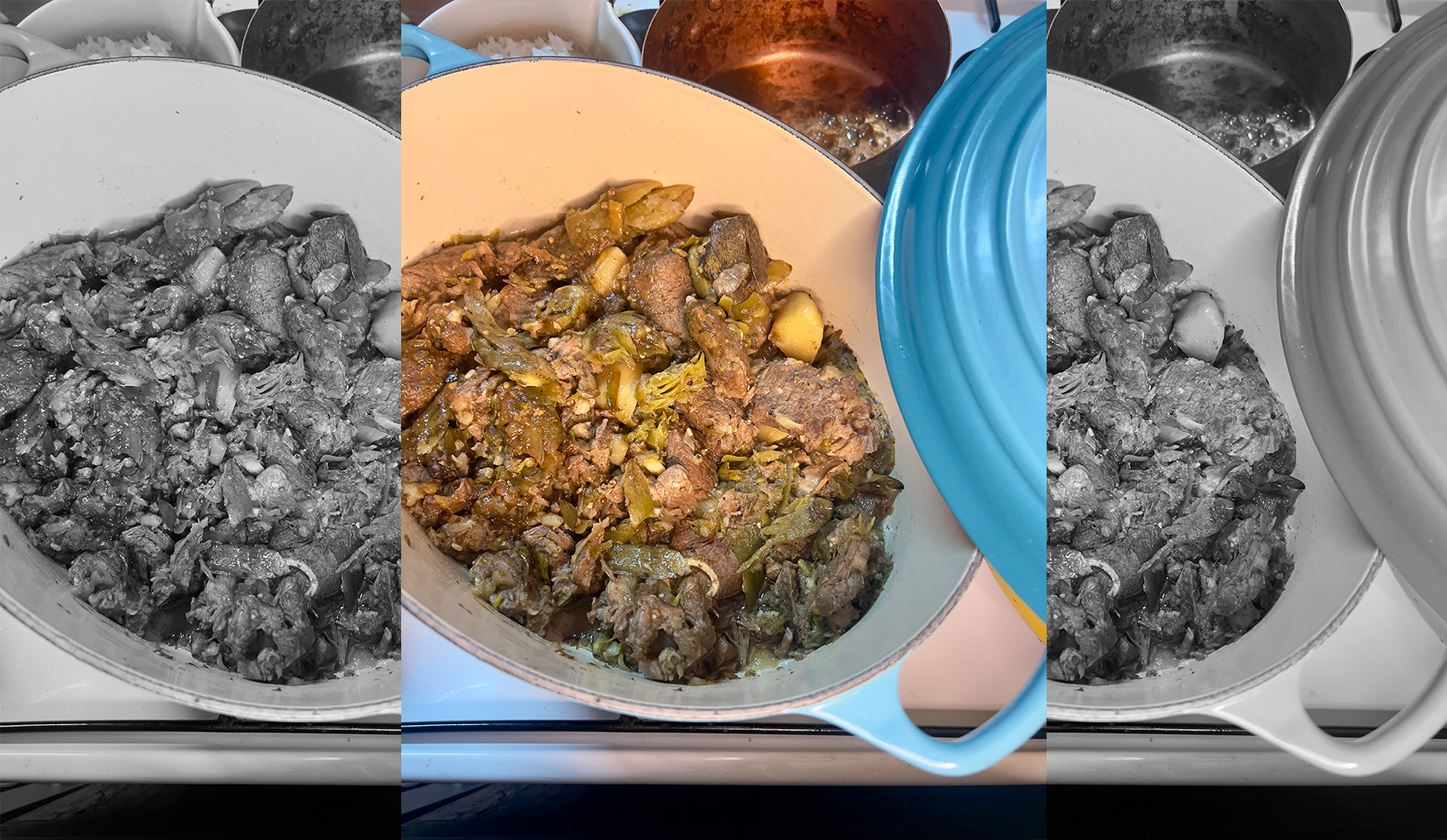
 Tony Jackman’s Waterblommetjiebredie. (Photo: Tony Jackman)
Pondweed, if you like. Waterblommetjies, I prefer. Water hawthorn, according to C Louis Leipoldt. Either way, they’re the bright green calyces of a water-loving plant called Aponogeton distachyos, and have a second Afrikaans name of wateruintjies. And they make good eating. Calyces are the outer casing of a flower bud, so, although they are bright green, they are in a sense petals.
Rifling through Leipoldt and Ina Paarman, and wishing I had bought more of Peter Veldsman’s books, my eye alighted on Michael Olivier’s Friends. Food. Flavour. Great South African Recipes. There it was, on page 110. Waterblommetjiebredie. And, yes, spelt correctly as one word. Even Wikipedia gets that part right, would you believe. And yes, it has a Wikipedia entry, brief as it is.
The Wikipedia entry for it has the air of having been written by a sceptic, or perhaps the apparent disdain is in my imagination: “Waterblommetjiebredie/ˌvɑːtərˌblɔmikiˈbrɪədi/ is a stew. The name comes from the Afrikaans language and literally means ‘little water flowers stew’. It is made of meat, typically lamb, stewed together with the waterblommetjies (Aponogeton distachyos flowers) which are found in the dams and marshes of the Western Cape of South Africa. The buds of Aponogeton distachyos are usually ready to be picked in the southern midwinter months of July and August, leading to their use in winter stews such as waterblommetjiebredie.
“The taste of the stew has been described as much like stewed green beans. Waterblommetjiebredie is a local delicacy in South Africa.”
Wikipedia adds that waterblommetjiebredie “was first prepared by the Khoikhoi people indigenous to South Africa. They taught the early settlers of South Africa how to use waterblommetjie as food and medicine.”
/file/dailymaverick/wp-content/uploads/2024/07/water-hawthorn-319382_1280.jpg "Water hawthorn, aka waterblommetjies, pondweed, or wateruintjies. (Photo: PollyDot on Pixabay)")
Leipoldt gives us the deep context. Naming it water hawthorn (aka wateruintjies), he wrote: “This is undoubtedly the most popular of all the edible wild plants, and anyone who travels by road through the country will notice its beautiful white, strongly-scented flowers studding the surface of quiet wayside pools almost hiding the small, lancet-shaped leaves.”
He noted that waterblommetjies could be bought in bundles at the Grand Parade in Cape Town, “and sometimes in the street from itinerant hawkers, four bunches making a kooksel, or sufficient for an average dish”.
He offers some old Cape variations that now seem less popular. Adding crushed coriander seeds is among them. I noted the day before that Ina Paarman uses them, and they went into mine the previous evening.
Also: “With eggs. Make a purée of stewed buds, and mix it with cream, a pinch of tangerine peel pounded fine, and a teaspoonful of China (soya) sauce; fill small ramekin dishes with the purée, and place on each a newlaid egg; place in the oven till the egg is lightly set; powder with grated nutmeg and serve.”
There’s even a soufflé: “Make a purée of stewed buds and beat it till it is very fine. For each pound of the purée take four eggs; mix the yolks of these in the purée; beat the whites to a stiff froth, and fold in the mixture; bake in a quick oven and serve at once.”
Enjoy Tony Jackman’s writing and way with food? Sign up to Tony’s weekly newsletter here. It’s free, and in your in-box every Friday afternoon. If it goes to promotions or spam at first, please drag it into your inbox.
The above purée could be adapted in various ways: baked with cooked potato, mashed with butter and cream, formed into balls and fried; made into a pie with fried bananas; stirred into a chicken soup with cream, or topped with steamed fish, garnished with peeled hanepoot grapes.
Sorrel is the herb most commonly added to a waterblommetjiebredie. Or water hawthorn if you prefer. Or pondweed, as it is sometimes called (the English edition of SJA de Villiers’s Kook en Geniet, Cook and Enjoy, calls it pondweed stew). Again, as I wrote about Japie se Gunsteling pudding in May, some names are too strong and distinctive to warrant translation. The Afrikaans name for “pondweed stew” has all the impact required. The English-speaking circles I moved in in Cape Town invariably called it waterblommetjiebredie.
Leipoldt wrote, describing its preparation: “Wash the buds and remove the stalks; put them in a stewpot with a lump of fat or butter, salt, pepper, a little chopped onion, a few thyme leaves and a bay leaf; let them simmer gently, then add a handful of chopped sorrel leaves, and allow to simmer for a little while longer; stir in a glass of sherry, and serve.” Always, a glass of something, with Leipoldt. And yes, I did too: a glass of wine went into mine.
Leipoldt notes that while some cooks prefer to parboil the buds in salted water, then drain them and discard the “wine-coloured liquid”, this is not necessary.
Plenty of garlic
Olivier, interestingly, used to go to town a bit with the spices, and I concur with him. His recipe has chillies, plenty of garlic, fresh ginger, allspice, cloves, nutmeg (lots), and of course the sorrel that all traditional recipes call for, including SJA de Villiers’s Cook and Enjoy. Olivier also used potatoes (most recipes list them as optional), and as many as six onions. But his recipe was for 3kg of lamb (most, myself included, prefer fatty mutton for this).
And there is sugar, light brown in Olivier’s case. While cooking my version this week, and tasting along the way, it clearly needed something sweet, so I added about two tablespoons of honey. Olivier explained that you could substitute, for the sorrel, either lemon juice (which Paarman also uses) or tamarind juice. Now that is a fine idea. In the end, I went with lemon juice, which complemented the honey I thought. The Cook and Enjoy version asks for sour apples to be used in place of sorrel.
Renata Coetzee, in her inimitable classic The South African Culinary Tradition, explains that the word bredie comes from the Malay for spinach, but at the old Cape it soon came to refer to a stew of fatty mutton with vegetables; hence a tomato bredie absolutely having to have lots of fatty mutton in it. This is the key to a bredie, whatever vegetables go into one.
Coetzee, who always keeps things direct and simple, calls for rib or leg of mutton, two medium onions, “a spray of sorrel”, water, white wine, and salt and pepper. No other spices at all.
I made two what I like to think of as improvements, if I may.
One was to deglaze the bottom of the pot with a glass of white wine after browning the meat and cooking the onions. With vigorous use of a flat-edged wooden spoon, I was able to dislodge all of the collected brown caramelisation so that it would remain in the pot. The French are not regarded as fine cooks for nothing.
Then, ultimately, near the end of the cook, I had a Damascene moment: I went back to French tradition and ladled off the cooking broth, reduced it in a saucepan until it was a gorgeous, syrupy sauce with utterly amazing flavour, and served the stew with that poured over. It was transformational. All of the waterblommetjie flavour was there, magnified.
So, drum roll please, for my version of this wonderful Cape speciality…
Tony Jackman’s waterblommetjiebredie
(Serves 4)
Ingredients
1.5kg fatty mutton, in chunks or slices
Butter
Oil
2 onions, sliced
250ml white wine
A bunch of sorrel, if you can get it, or substitute the juice of a lemon, or ¼ cup of tamarind water
2 medium potatoes, peeled and diced
2 Tbsp coriander seeds, crushed
1 bay leaf
2 or 3 sprigs of thyme
3 garlic cloves, chopped
2 red chillies, deseeded and chopped
500g waterblommetjies
Lamb or mutton stock to cover
2 Tbsp raw honey
Salt and pepper to taste
Rice, steamed, for serving
Method
Rinse the waterblommetjies under cold running water and, if you spot any interior parts that are black, remove them and discard. Remove the stems.
Put the buds in a bowl of well-salted water to soak for half an hour. Drain, and repeat. Drain again and leave to one side.
Chop the meat into suitable pieces and salt all sides.
Melt butter in a heavy casserole with a little oil, and when hot brown the meat in batches. Remove to a side dish. Repeat with remaining mutton, adding more fat as needed.
Add more fat and fry off the sliced onions until golden brown.
Add 250ml white wine and deglaze energetically. You want the bottom of the pot to be clean again, and every bit of the caramelisation to stay in the stock.
Add the meat back to the pot and stir to mix.
Add the sorrel (or lemon juice, or tamarind water), potatoes, coriander, bay and thyme. Pop the garlic and chilli into the mix too.
Pour in the stock and the honey, stir, taste, and adjust seasoning if needed.
Add the waterblommetjies and fold through, being careful not to damage the cubes of meat or the buds.
Bring to a bubble, reduce to a simmer, put the lid on, and cook gently on the hob until the meat is tender. Do not be tempted to stir it along the way, or you will destroy the waterblommetjies.
Taste and adjust seasoning if necessary.
Spoon off the stock and reduce it violently in a strong saucepan.
Reheat the stew if it has cooled, and serve on or alongside rice with the reduced stock poured over. DM
Tony Jackman is Galliova Food Writer 2023, jointly with TGIFood columnist Anna Trapido. Order his book, foodSTUFF, here
Follow Tony Jackman on Instagram @tony_jackman_cooks.
Daily Maverick’s journalism is funded by the contributions of our Maverick Insider members. If you appreciate our work, then join our membership community. Defending Democracy is an everyday effort. Be part of it. Become a Maverick Insider.
Comments
Scroll down to load comments...