




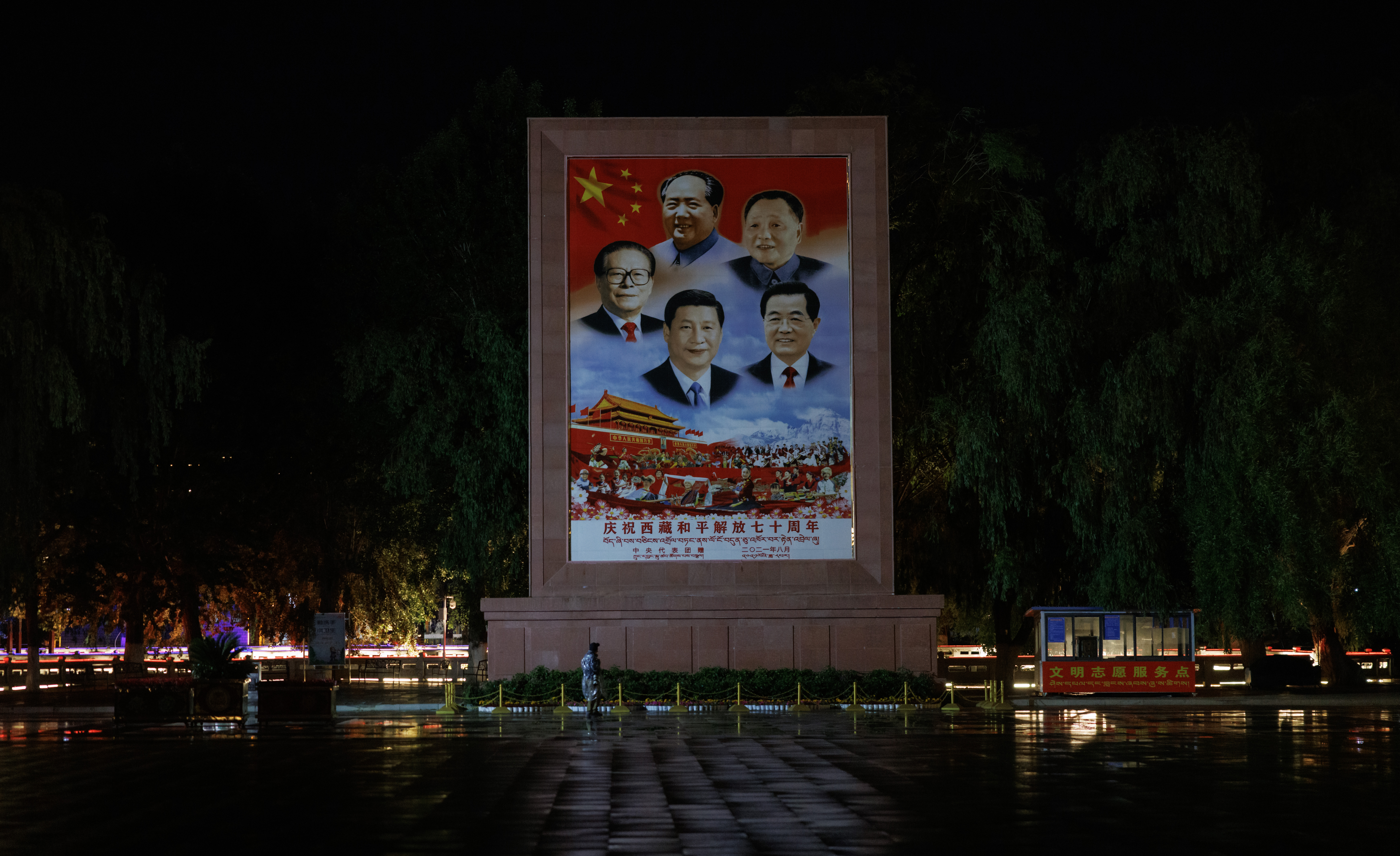
 A man walks past a poster showing Chinese President Xi Jinping and other CCP (Chinese Communist Party) leaders, on a main square in Lhasa, Tibet Autonomous Region, China, 15 June 2023 (issued 23 June 2023). Lhasa, the capital city of Tibet, is a revered pilgrimage destination nestled in the Himalayas. It attracts pilgrims worldwide who seek spiritual enlightenment and engage in personal introspection. The city is known for its numerous monasteries and temples, including the iconic Potala Palace. Originally built in the 7th century and expanded over time, the palace serves as the winter residence of the Dalai Lama and houses religious artifacts and scriptures. Pilgrims endure challenging journeys to reach Lhasa, often engaging in prostrations as a sign of devotion. The pilgrimage to Lhasa is considered a significant and life-changing journey, providing pilgrims with a profound connection and enlightenment. EPA-EFE/ALEX PLAVEVSKI ATTENTION: This Image is part of a PHOTO SET
 The two officials had been removed from their jobs last year.
The ruling Communist Party ended its long-delayed third plenum on Thursday, a meeting of the 205-member Central Committee held roughly once every five years to map out the general direction of the country's long-term social and economic policies. Removals of Central Committee members would also be approved at such meetings.
The Central Committee said in a communique released by Xinhua that it accepted Qin Gang's resignation from the body, and confirmed the expulsion of Li Shangfu, 66, as well as former PLA Rocket Force commander Li Yuchao, 61, from the Communist Party for "serious violations of discipline and law", a euphemism for corruption. Li Yuchao was also removed from his job last year.
The decision to expel Li Shangfu and Li Yuchao from the Communist Party and its Central Committee by extension suggests harsher political consequences for the pair, compared to Qin Gang's resignation. Qin remains a Communist Party member.
Chinese President Xi Jinping has spearheaded a wide-ranging anti-corruption campaign since becoming leader of the Communist Party in 2012. In the first half of this year alone, the party's top graft watchdog has investigated 36 officials at the vice-ministerial level and above.
Li Shangfu and his predecessor Wei Fenghe were both expelled from the Communist Party last month on bribery charges, as China's People's Liberation Army undergoes a sweeping anti-corruption purge which has implicated two former defence ministers and nine top generals.
Qin, 58, was abruptly removed as foreign minister in July last year after seven months in the job, and has not been seen in public since following rumours of an extramarital affair. He was removed from China's cabinet, the State Council, in October and "resigned" from the national legislative body in February.
Li Shangfu was ousted as defence minister last October without explanation, before being placed under a graft investigation. He was removed from the party's highest military command body in February.
Li Yuchao was replaced last July during a shakeup of the Rocket Force leadership which also saw its political commissar dismissed. He oversaw a highly strategic unit of the PLA responsible for the nation's conventional and nuclear missile arsenal.
Agriculture minister Tang Renjian, 61, who has been under investigation for corruption since May, remains a member of the Central Committee.
Three alternate Central Committee members were appointed as full members according to the communique: Anhui provincial Communist Party personnel boss Ding Xiangqun, Sichuan provincial Communist Party personnel boss Yu Lijun and Beijing Normal University President Yu Jihong.
According to past convention, the Central Committee would appoint some of its 171 alternate members to fill in vacancies by order of the number of votes they received.
The new appointments this time skipped PLA Rocket Force deputy political commissar Ding Xingnong, who would have been second in line to join the Central Committee.
Former Central Committee alternate member and PLA Rocket Force chief of staff Lieutenant General Sun Jinming was also expelled from the Communist Party for corruption, the communique said.
(Reporting by Laurie Chen and Beijing NewsroomEditing by Peter Graff and Susan Fenton)