




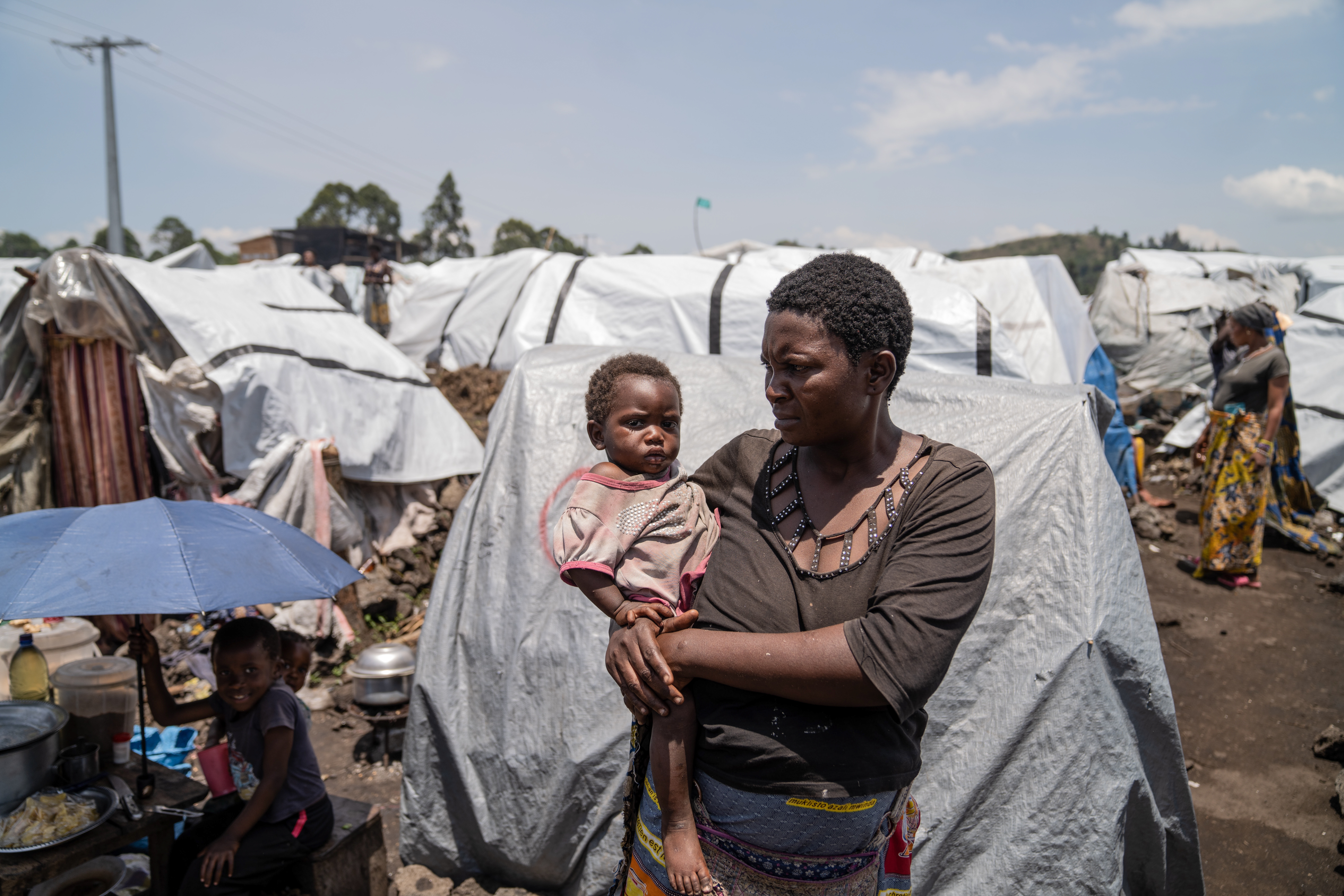
 A woman carries a child in a refugee camp in Mugunga, Goma, Democratic Republic of Congo, 13 March 2024. Ramesh Rajasingham, Representative of the United Nations Office for the Coordination of Humanitarian Affairs (OCHA) in Geneva and Director of the Division of Humanitarian Operations Coordination met with the provincial authorities, humanitarian actors and civil society organisations involved in the humanitarian response in Goma. According to the UNHCR, in 2024, as a result of continuing insecurity and an alarming resurgence of violence generated by non-state armed groups in the past two years, nearly six million people are internally displaced across the eastern provinces of Ituri, North Kivu, South Kivu and Tanganyika. EPA-EFE/MOISE KASEREKA
The impact on civilians of the more than two-year conflict between Congolese forces and the Rwanda-backed M23 militia in eastern areas of the country is worsening, causing more people to flee with 2.7 million displaced in North Kivu alone.
Severe flooding and landslides as well as long-simmering conflicts affecting other parts of the country have worsened needs and around 25 million currently require humanitarian aid, according to the WHO.
"If immediate action is not taken to address basic needs in DRC over 1 million children will suffer from acute malnutrition," WHO's Senior Emergency Officer Adelheid Marschang told a press briefing in Geneva.
"The acute malnutrition is a result of widespread, increasing and also recurrent food insecurity in the areas that have seen conflict for years and decades now but where we now very recently see an escalation," she said.
The children at risk were mostly among the millions already displaced by fighting in eastern areas but also children in the central Kasai provinces, she said. Already hundreds of thousands of children are suffering from acute malnutrition, she said, which can make them more vulnerable to infection and disease and requires sustained treatment.
The WHO has registered over 20,000 cases of cholera across the country so far this year and 60,000 cases of measles, with real numbers probably higher due to insufficient surveillance.
"The needs are just increasing exponentially, especially very recently and the projections are that this will continue," Marschang said.
Adding to the challenges, humanitarian access has been "severely constrained by military presence around (displacement)sites and health facilities, bureaucratic impediments, roadblocks disrupting aid delivery", she added.
The U$2.6 billion funding plan for Congo is currently only 26% funded, U.N. data showed.
(Reporting by Emma Farge, Editing by Angus MacSwan)
Comments
Scroll down to load comments...