



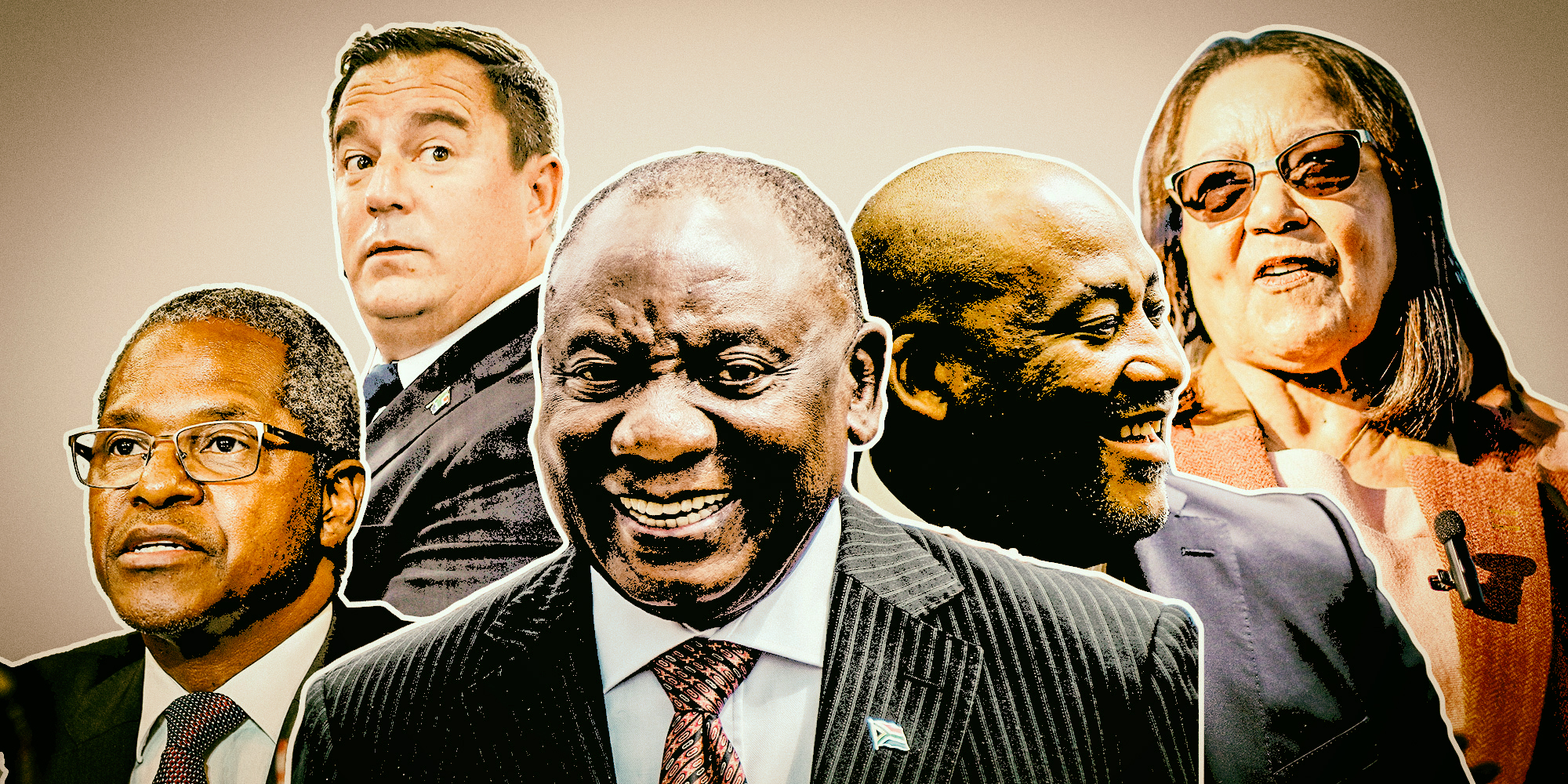
 Illustrative image, from left: The IFP’s Velenkosini Hlabisa. (Photo: Gallo Images / Darren Stewart) | The DA’s John Steenhuisen. (Photo: Felix Dlangamandla) | President Cyril Ramaphosa. (Photo: Julia Evans) | The PA’s Gayton McKenzie. (Photo: Shelley Christians) | The Good party’s Patricia de Lille. (Photo: Gallo Images / ER Lombard)
 Is there a way to make Cabinet ministers from different political parties and with opposing ideologies commit to capable and effective service delivery under a Cyril Ramaphosa presidency?
Answers to these questions and more are yet to emerge.
At best, given time, a GNU could unite ministers to the common vision of making South Africa work for everyone. At worst, it could lead to regression, constant squabbling among ministers and gridlock in policy development that could harm service delivery and our quality of life.
The temperament of ministers — from the DA, IFP, Patriotic Alliance, Freedom Front Plus, UDM and others who form part of the GNU — is already being regulated through paperwork: the statement of intent that was signed by the ministers’ respective political parties.
This statement of intent outlines their commitment to, among other things, effective service delivery, good governance, respect for the Constitution and accountability.
A close reading of the statement reveals two crucial words that have been heard before in politics and public sector governance circles – “social compact”.
To ensure that the ministers are committed to good governance and effective service delivery, the statement of intent calls for a national dialogue process which will involve political parties, civil society, labour, business and others, to “discuss… critical challenges facing the nation”.
This national dialogue will, in theory, lead to a social compact being developed.
It is hard to see how this process will work or be different from the many structures of consultation/dialogue that already exist and are built into every cog of democracy.
Currently, the law and policy-making processes allow for public comment or input from society. The steps of doing so are rigorous, well-defined and rarely sidestepped because there is a broader recognition that it is a fundamental requirement of democracy and the rule of law.
Although a social compact is a good and noble idea, President Cyril Ramaphosa has attempted to conclude one with great difficulties since he secured a mandate to lead in the 2019 general election. At a basic level, a social compact outlines the government’s programme of action (in partnership with organised business, labour and communities) for building a better and more inclusive society by growing the economy, creating jobs, and tackling crime and corruption.
SA’s elusive social compact
Social compacts are common around the world. In Asia, they are geared towards maintaining high levels of economic growth and production. In Europe, social compacts tend to focus not only on production levels but also on the general wellbeing of the populace. And since 1994, social compacts in South Africa have focused on creating prosperity for all.
Social compacts are also binding on the bona fides of politicians (that’s if you even believe they have any, and if they do exist, that they are not already compromised).
During his February 2022 State of the Nation Address, Ramaphosa promised that a new social compact would be completed within 100 days. More than 850 days have since passed and there is still no social compact.
Although Ramaphosa is known as a skilled negotiator, considering that he knows business and labour well (having worked in both spheres), getting consensus on the contents of the social compact has proven difficult. This is because capital and labour are deeply fragmented in South Africa, each bringing their vested interests and competing ideas on how to manage the economy and run the country.
At least two frameworks of the social compact have been drafted since 2022, the latest of which was in September of that year. The frameworks included many priority actions to boost investment and growth in the economy, increase employment, allow increased private sector participation in the economy and expand welfare support for the unemployed. However, some draft frameworks have been rejected by organised business and labour.
Big business has argued that the priorities in the framework are too many and too fragmented. Labour representatives believed that the draft social compact framework did not go far enough in protecting workers’ rights, removing unfair labour practices and protecting workers’ wages from the rising cost of living.
Nonetheless, the government rejected the latest draft social compact frameworks because communities and labour representatives also lobbied for the R350 per month Social Relief of Distress grant to be increased to R600 until the implementation of a universal basic income grant. The government did not want to commit to this, saying it would cost too much to implement at a time when public finances were under pressure.
A source close to Ramaphosa and ANC internal processes told me recently that coming up with a new social compact would be “dead before it even starts, with no reasonable prospects of success”.
Big tent politics, which require securing consensus among parties who often have narrow and divergent interests, is hard if not impossible to achieve. DM