




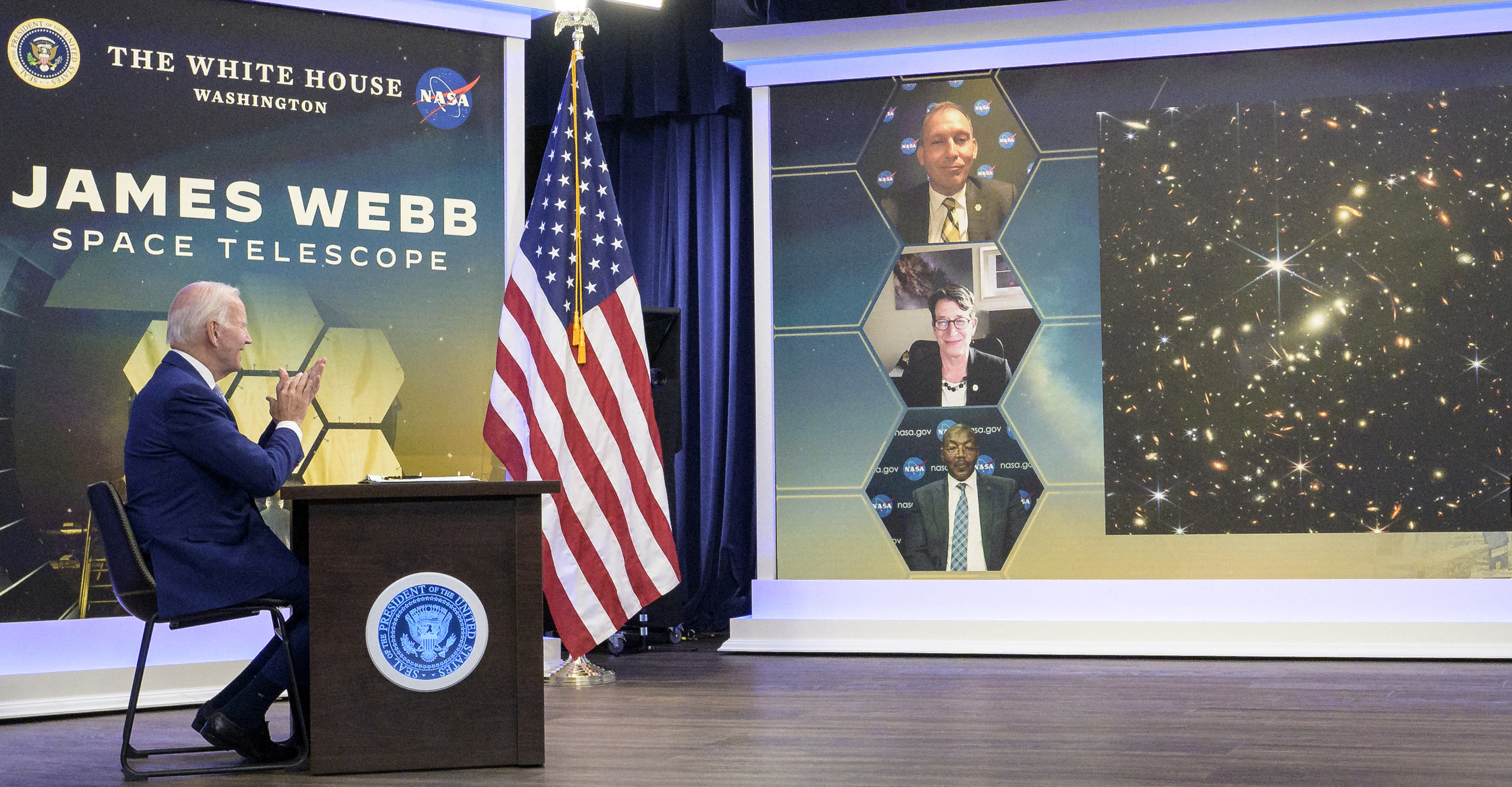
 In this NASA handout image US President Joe Biden previews the first full-color image from NASAs James Webb Space Telescope, the highest-resolution image of the infrared universe in history, on July 11, 2022, in the South Court Auditorium in the Eisenhower Executive Office Building on the White House complex in Washington. - Humanity's view of the distant cosmos will never be the same.
The James Webb Space Telescope, the most powerful to be placed in orbit, has revealed the clearest image to date of the early universe, going back 13 billion years, NASA said Monday.
The stunning shot, released in a White House briefing by President Joe Biden, is overflowing with thousands of galaxies and features some of the faintest objects observed, colorized in blue, orange and white tones. (Photo by Bill INGALLS / NASA / AFP) / RESTRICTED TO EDITORIAL USE - MANDATORY CREDIT "AFP PHOTO / NASA / Bill INGALLS" - NO MARKETING - NO ADVERTISING CAMPAIGNS - DISTRIBUTED AS A SERVICE TO CLIENTS
In this NASA handout image US President Joe Biden previews the first full-color image from NASAs James Webb Space Telescope, the highest-resolution image of the infrared universe in history, on July 11, 2022, in the South Court Auditorium in the Eisenhower Executive Office Building on the White House complex in Washington. - Humanity's view of the distant cosmos will never be the same.
The James Webb Space Telescope, the most powerful to be placed in orbit, has revealed the clearest image to date of the early universe, going back 13 billion years, NASA said Monday.
The stunning shot, released in a White House briefing by President Joe Biden, is overflowing with thousands of galaxies and features some of the faintest objects observed, colorized in blue, orange and white tones. (Photo by Bill INGALLS / NASA / AFP) / RESTRICTED TO EDITORIAL USE - MANDATORY CREDIT "AFP PHOTO / NASA / Bill INGALLS" - NO MARKETING - NO ADVERTISING CAMPAIGNS - DISTRIBUTED AS A SERVICE TO CLIENTS By Will Dunham
Add hydrogen sulfide, the chemical compound behind the stench of rotten eggs. Researchers said on Monday new data from the James Webb Space Telescope is giving a fuller picture of HD 189733b, already among the most thoroughly studied exoplanets, as planets beyond our solar system are called. A trace amount of hydrogen sulfide was detected in its atmosphere, a first for any exoplanet.
"Yes, the stinky smell would certainly add to its already infamous reputation. This is not a planet we humans want to visit, but a valuable target for furthering our understanding of planetary science," said astrophysicist Guangwei Fu of Johns Hopkins University in Baltimore, lead author of the study published in the journal Nature.
It is a type called a "hot Jupiter" - gas giants similar to the largest planet in our solar system, only much hotter owing to their close proximity to their host stars. This planet orbits 170 times closer to its host star than Jupiter does to the sun. It completes one orbit every two days as opposed to the 12 years Jupiter takes for one orbit of the sun.
In fact, its orbit is 13 times nearer to its host star than our innermost planet Mercury is to the sun, leaving the temperature on the side of the planet facing the star at about 1,700 degrees Fahrenheit (930 degrees Celsius).
"They are quite rare," Fu said of hot Jupiters. "About less than one in 100 star systems have them."
This planet is located 64 light-years from Earth, considered in our neighborhood within the Milky Way galaxy, in the constellation Vulpecula. A light-year is the distance light travels in a year, 5.9 trillion miles (9.5 trillion km).
"The close distance makes it bright and easy for detailed studies. For example, the hydrogen sulfide detection reported here would be much more challenging to make on other faraway planets," Fu said.
The star it orbits is smaller and cooler than the sun, and only about a third as luminous. That star is part of a binary system, meaning it is gravitationally bound to another star.
Webb, which became operational in 2022, observes a wider wavelength range than earlier space telescopes, allowing for more thorough examinations of exoplanet atmospheres.
"Our research finds that HD 189733b is more similar to Jupiter than previously known," Arizona State University astrophysicist and study co-author Luis Welbanks said. "This planet is very much like Jupiter, but just hotter."
Jupiter, too, has trace amounts of hydrogen sulfide in its atmosphere. This planet is about 10% larger than Jupiter in diameter and mass.
In addition to detecting hydrogen sulfide, a sulfur-containing molecule, Webb observations showed that this planet has water and carbon dioxide in its atmosphere, as earlier data also indicated.
"With these three molecules, we are able to count the amount of oxygen, carbon and sulfur the planet has, giving us an opportunity to understand how the planet may have formed and whether it is different or not to the planets in our solar system," Welbanks said.
The Webb observations also ruled out the presence of methane in the planet's atmosphere.
"Understanding the composition of this and other exoplanets allows us to understand how unique our own solar system is and helps us place our existence in context," Welbanks added.
"While we are not searching for life on HD 189733b - it is too hot, made up mostly of hydrogen and helium, it's not like Earth, et cetera - understanding its atmosphere allows us to understand how physics and chemistry behave under different environments and to begin to put together the 'recipe' for forming planets."
(Reporting by Will Dunham, Editing by Rosalba O'Brien