




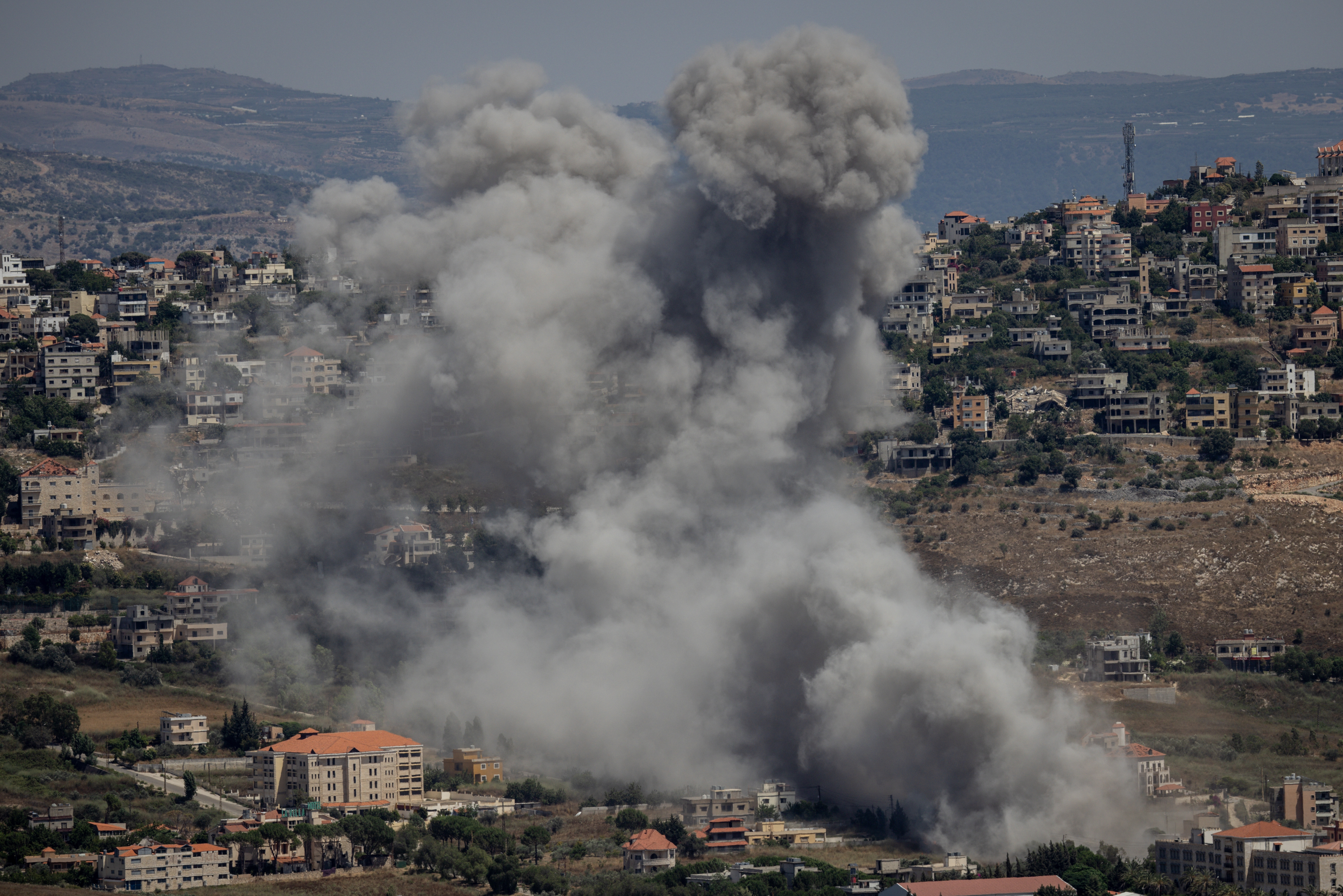
 Smoke rises after an Israeli air strike on a Hezbollah target on 25 June 2024 in Khiam, Lebanon. (Photo: Chris McGrath / Getty Images)
 Israel’s military killed a senior Hezbollah commander in an air strike after targeting his vehicle in south Lebanon, adding to already intensifying hostilities.
Some of the world’s biggest oil-hauling supertankers are instead loading up vast volumes of diesel in the latest sign of how attacks by Yemen’s Houthis are upending global shipping.
Israel gets latest Hamas response on possible hostage deal
Israel has received the latest response from Hamas on a proposed hostage and ceasefire deal, Prime Minister Benjamin Netanyahu’s office said, as mediators continued to work toward an agreement that could end almost nine months of fighting in the Gaza Strip.
A Hamas official, who asked not to be identified discussing private deliberations, confirmed that the group gave the mediators a new response. The person said the response remained in line with Hamas’s longstanding demands for a ceasefire, an Israeli troop withdrawal and the return of displaced civilians.
If those demands remain intact, the negotiations are likely to continue to falter. Israel has so far resisted withdrawing its troops from Gaza, arguing it won’t stop its fight until Hamas is eradicated. Netanyahu’s government has also only committed so far to the idea of a temporary ceasefire as a way to release hostages seized after Hamas fighters attacked the country’s south on 7 October.
That attack by Hamas, which is labelled a terrorist group by the US and the European Union, provoked an Israel military campaign that has killed some 37,000 people, according to the Hamas-run health authority in Gaza, and provoked a humanitarian crisis there. Mediators from Qatar and Egypt — with help from the US — have worked in recent weeks to forge a proposal that both sides could accept, without success so far.
President Joe Biden joined those efforts in late May when he announced a three-phase proposal that would chart a path toward an end to the war. He said from the start that Israel had agreed and the holdup was Hamas, even as Israeli officials hedged on their commitment to support his idea.
The push to forge a ceasefire has gained new urgency with fears growing that Israel is lurching toward a full-blown war with Hezbollah fighters across its northern border in Lebanon.
Israel kills senior Hezbollah commander in south Lebanon
Israel’s military killed a senior Hezbollah commander in an air strike after targeting his vehicle in south Lebanon, adding to already intensifying hostilities.
The head of the militant group’s Aziz unit, a regional division in the southern sector, was hit while travelling in the Hosh area in Tyre, Al-Jadeed television said on Wednesday. Hezbollah confirmed one of its commanders, Mohammed Naameh Nasser, was killed by Israel.
Israel has killed hundreds of members of the Iran-backed militia, including other senior figures, since the two sides began exchanging near-daily cross-border fire in October. The simmering conflict has raised fears of an all-out war that could draw in Tehran and other regional powers, and countries including the US are working to prevent an escalation.
Israel took responsibility for the strike that killed Nasser, saying he led the firing of rockets and anti-tank missiles from southwestern Lebanon toward Israeli civilians and communities. Hezbollah responded to the assassination with the launch of dozens of rockets into northern Israel.
“Nasser directed a large number of terror attacks toward Israel both during and before the war,” the Israel Defense Forces said in a post on Telegram.
Hezbollah has been firing missiles into Israel in solidarity with Hamas. Israel has responded with strikes in Lebanon.
“We are hitting Hezbollah very hard every day and we will be fully prepared to carry out any action required in Lebanon or reach an agreement — from a position of strength,” said Israeli Defense Minister Yoav Gallant. “We prefer the latter, but if reality forces us, we will know how to fight.”
A month ago, Hezbollah escalated its attacks against Israel after the killing of a senior military commander, Taleb Abdullah. The Associated Press said Nasser was the most senior official from Hezbollah to have been killed since Abdullah.
Israel wants Hezbollah fighters to retreat at least 10km from the border, a move that could allow Netanyahu’s government to bring back thousands who were evacuated from the northern front at the start of the conflict in Gaza.
On the Lebanese side of the border, thousands have fled and Israeli strikes have levelled neighborhoods in border villages. Lebanon is still reeling under an economic and financial meltdown that started nearly four years ago and a war on its soil could spell more devastation.
The group has said that — while it doesn’t want a war with Israel — it is ready for one. An Iranian official told the Financial Times this week that Tehran would support Hezbollah directly and via other allied militias in the region in the event of a full-blown conflict.
Giant oil tankers find new business after Houthi ship attacks
Some of the world’s biggest oil-hauling supertankers are instead loading up vast volumes of diesel in the latest sign of how attacks by Yemen’s Houthis are upending global shipping.
At least one so-called very large crude carrier, or VLCC, capable of hauling two million barrels of oil, was already sailing from the Middle East to Europe, while another is in the process of loading, according to Kpler and ship-tracking data compiled by Bloomberg.
At least five more were expected to switch to carrying so-called clean petroleum product, a category that includes diesel, said shipbroker Braemar. That would mean about 14 million barrels of the fuel could end up on the huge ships.
The switchover has been at least partly a knock-on effect of Houthi attacks on shipping in the Red Sea and the Gulf of Aden that have upended some longstanding trade routes.
The incidents boosted earnings for smaller vessels that haul fuels like petrol and diesel — known in industry jargon as clean tankers — as the ships sail thousands of kilometres extra around Africa. At the same time, benchmark crude tanker rates have been easing, giving shipowners an incentive to switch their vessels out of that trade.
Houthi threat triggers surge in pirate attacks off Somalia coast
Attacks by Iran-backed Houthi militants on the Red Sea have reinvigorated piracy networks in Somalia, with criminal groups growing in both number and force, a European naval commander said.
The Yemen-based Houthis began attacking vessels in the Red Sea last year to pressure Israel and its allies over the war in the Gaza Strip.
Their campaign has roiled global shipping, forcing many vessels to sail thousands of kilometres around southern Africa instead.
Pirates “think there is a window of opportunity due to the Houthis’ presence”, with increased traffic along Somalia’s coast and the pirates venturing further out into the Indian Ocean, said Vice-Admiral Ignacio Villanueva, who commands a European Union operation tasked with curbing piracy. “They are really trying to stretch the Western, international operations’ limits and capabilities.”
One of the tactics being used by the pirates is to hijack smaller boats such as skiffs or dhows and travel for about 10 days into the middle of the Indian Ocean where they attempt to attack bigger ships, said Villanueva. About 10 of the recent attacks were carried out on large vessels, while a ransom fee was paid on one occasion, he said.
The increasing number of attacks were being carried out by groups that were “well armed, organised and bigger in numbers” than ever before, he said.
“We are encountering 25 or 30 pirates on the same attack,” Villanueva said. “They are very well coordinated with satellite phones and heavy weapons.”
There had been 30 attacks on commercial vessels, fishing boats and dhows since November, he said. Recent incidents include hostages being taken in December on board the Malta-flagged MV Ruen, which led to Indian, Japanese and Spanish warships rescuing its 18 crew members. That was the first successful hijacking of a vessel off the Somali coast since 2017, according to the International Maritime Bureau. DM
Read more in Daily Maverick: Middle East Crisis news hub