




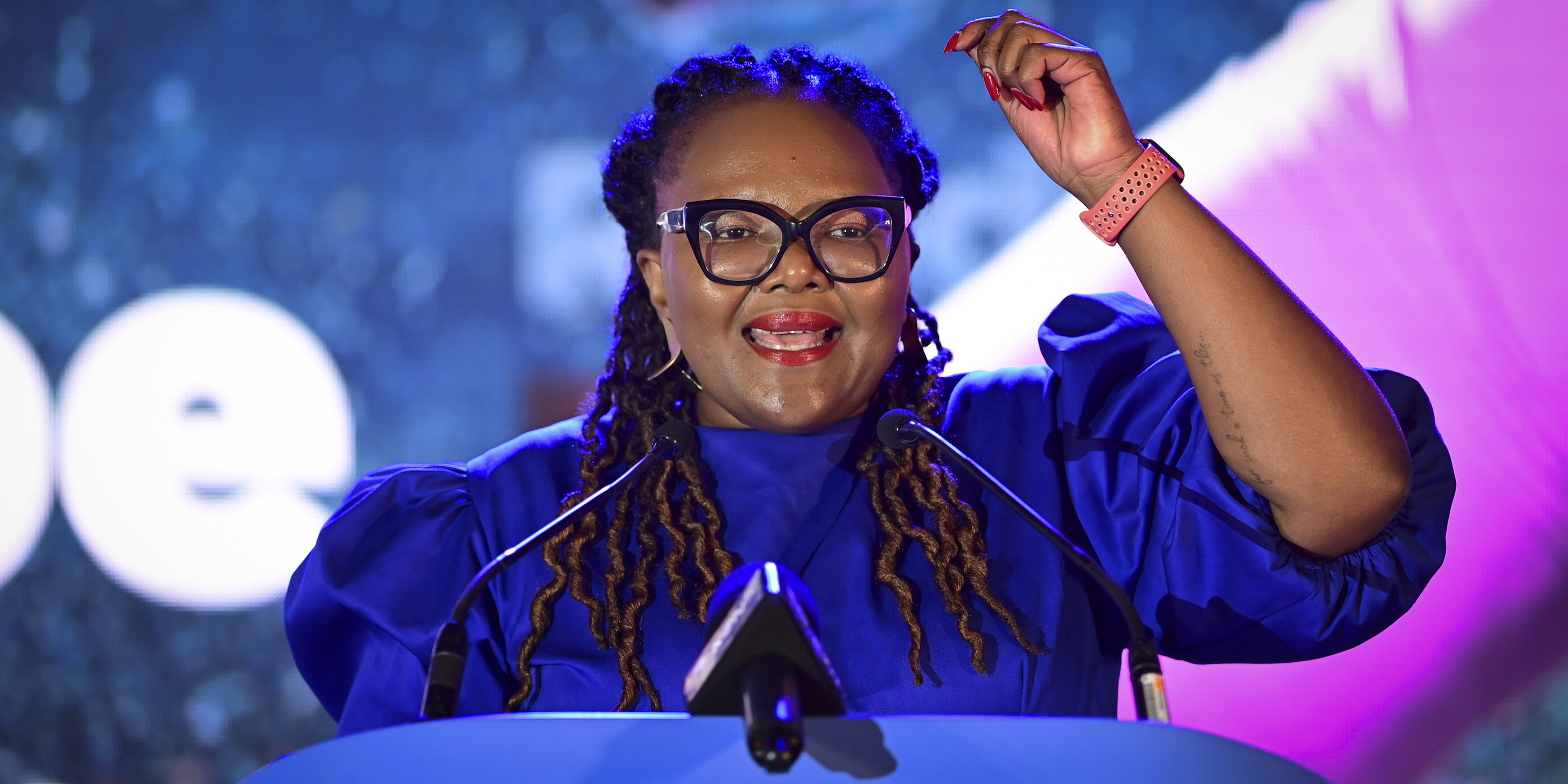
 Incoming Minister of Basic Education Siviwe Gwarube. (Photo: Gallo Images /Darren Stewart)
 You could ask the same question the other way around – how much power does a minister actually have? Or perhaps – why on earth did the ANC choose Education, the department with the largest budget and arguably the most significance, as the department it was prepared to grant to its GNU partner, the DA?
I think I know why: they are aware that the job is impossible. Or at least it was for them. After all, despite being well regarded in the sector, Angie Motshekga – who held the job for 15 years – saw the results from SA’s education system dip lower and lower in nearly any ranking you choose to examine.
Just consider, for a second, the odds stacked against Siviwe Gwarube. For a start, from an “outcomes” point of view, the ANC’s record in running the department has been gobsmackingly disastrous. That’s hardly a surprise given the level of maladministration overall, but it was unexpected because it’s the one thing you might expect the ANC to have prioritised.
We have a problem
So how bad is it? The indications are formal, informal, anecdotal and reported. But I think if you can’t manage to churn out literate matriculants, or even provide school children with toilets that don’t kill them, in 30 years of governing, Houston, we have a problem.
For the record, one of the benchmarks that really matters internationally is the Trends in International Maths and Science Study which assesses scholars aged 13 to 14 in some 40 countries around the world. The last time it was published in 2019, SA came second last in maths, and last in science. And this was even though the test was given to Grade 11 students, unlike in the rest of the world where it was given to Grade 10 students.
SA has been in the bottom three every year since the test began in 1995.
Why has SA’s performance over the years been so bad? It’s not about money or even history: in other international tests, Kenyan students perform more or less the same as SA’s students, even though Kenya is spending a fraction of what SA is spending on schooling. So if it’s not that, what is it?
Sadtu
I think the answer was inadvertently provided by the South African Democratic Teachers’ Union (Sadtu), which on Wednesday put out a statement of unremitting bile about Gwarube’s appointment. They are obviously completely freaked out.
The union said it was “affronted” by the appointment because the DA had “declared war” against Sadtu in its manifesto. It didn’t.
We have long ago given up on unions – even teachers’ unions – to accurately comment on what documents say. What the DA did say in its manifesto is that the SA education system had failed because the ANC had “allowed our education system to be captured by the vested interests of the South African Democratic Teachers’ Union”, which I think is broadly true and evidenced by the fact that Sadtu goes certifiably nuts if anyone dares suggest that unannounced visits to schools should be made by education officials.
Sadtu also spouts typical union rubbish about the DA refusing to acknowledge the role of colonial and apartheid education systems that perpetuated deeply rooted inequalities for centuries, which, of course, the DA does acknowledge, and it rails against the DA’s attempt to “entrench a colonial education system”.
This is all dross, of course – SA’s education outcomes are better in the Western Cape than in any other province. But it illustrates the defensiveness of the organisation which exists essentially to protect underperforming teachers and education administrators – and there are plenty of them, which is why it’s so vociferous.
Systemic reform
But it also illustrates the huge burden now on Gwarube’s shoulders because education experts know that the system doesn’t just need reform; it needs to be completely reimagined – and Sadtu is only part of the problem.
If I may try to consolidate an extremely complex problem into a simplistic notion, I think what happened is that the ANC tried to outsource school management to “the community”. The result was that parents’ organisations were given unduly extensive powers, unions were allowed to dictate terms, and scholars were elevated beyond their station – all in the name of progressive pedagogics.
The result was that schools which were capable of managing these complexities did well, and those that couldn’t simply fell apart.
But lo and behold, in a desperate effort to turn the ship around, both houses of the previous Parliament have just passed some of the most aggressive legislation the sector has ever seen, namely the Basic Education Laws Amendment Bill.
It’s an omnibus Bill with many aspects to it, but, hidden in all the detail, it gives the Department of Education enormous new powers, including the power to dissolve governing bodies and to insist that schools keep financial records (they haven’t been?!) It also allows the department to determine admissions policy.
How ironic, then, that the person who gets to implement these sweeping powers (which the DA opposed!) is someone from the former opposition. The Bill has yet to be signed into law by the President. Let’s watch to see if that will now happen. DM
Daily Maverick’s journalism is funded by the contributions of our Maverick Insider members. If you appreciate our work, then join our membership community. Defending Democracy is an everyday effort. Be part of it. Become a Maverick Insider.